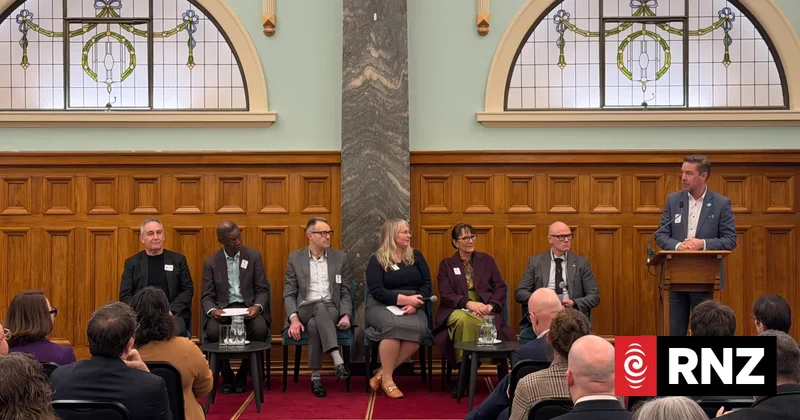
The minister for mental health, Matt Doocey, launched the plan at Parliament on Thursday morning, under the Healthy Futures (Pae Ora) Act.
It had a focus on launching AI navigation to help access and scale integrated services across mental health, housing and employment, and gave mental health services the same "long-term direction and accountability as the rest of our health system".
Shaun Robinson, chief executive of the Mental Health Foundation, said he liked the plan's focus on prevention and early intervention, as well as the recognition of the social determinants of poor mental health such as housing, employment and discrimination.
"That's a very tangible benefit. What we also need to do is make sure that all people have safe, warm, dry housing, have enough income, are not experiencing racism, discrimination, bullying. Those are the things that are driving what was acknowledged today as our massively increasing levels of mental distress."
"If we don't get upstream and really address those root causes, we're never going to have enough services to meet need."
Good data was also important. "We actually are still basing our planning of data that is over 20 years old," he said.
Last month, Doocey announced the government would begin publicly reporting youth mental health wait times in addition to its other targets.
Robinson explained as someone who lived with bipolar disorder: "I absolutely know that getting good services, good clinical support is really important".
"One of the reasons I've been able to recover and live well regardless of my bipolar is because I have enough income, I have housing, I don't face racism, I don't face discrimination. So it's the combination of all of those things that really leads to genuine mental health as opposed to just managing mental illness."
John Moore, chief executive of Yellow Brick Road - an organisation which supported families of those struggling with mental health - said he was pleased to see the importance of whānau support acknowledged.
"Whānau are the most important, the biggest provider of mental health support in New Zealand," he said. "We support them and we want to see them get more support."
But he would have liked to see more mentions of specific initiatives to support whānau in the implementation plan.
"In the 50 actions, there wasn't specific mention of whānau and how we are going to support them to develop the skills and the capacity to support their loved one because they're carrying the mental health system," he said.
Well-resourced and supported families could reduce the pressure on clinical care services, too.
"We've got overwhelmed clinical services," Moore said. "We have areas that don't have anything like enough provision of psychiatry and other important services - but for most people, their journey to wellbeing is about the people they live their life with, not about that a clinician."
Meanwhile, psychiatrists welcomed the strategy, but warned it risked repeating the patterns of previous mental health plans unless it was backed by all political parties and accompanied by long-term investment.
The Royal Australian and New Zealand College of Psychiatrists (RANZCP)'s Dr Alison Masters said: "This strategy has many of the right ingredients, but ultimately its success would be measured by outcomes rather than aspirations."
Masters said addressing workforce shortages must remain a national priority.
"We have seen ambitious mental health strategies before. What people now need is delivery. This strategy presents an opportunity to demonstrate sustained and measurable improvements in the lives of tāngata whai ora, whānau, and communities."