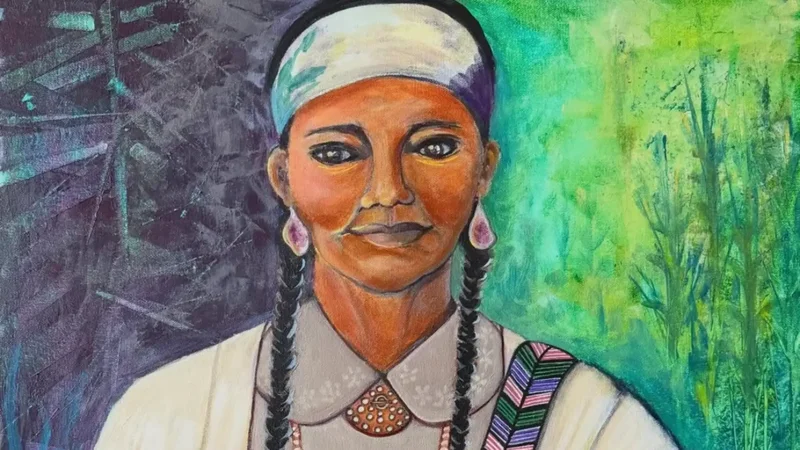
Her picture is still circulating in millions of pockets every day, and yet her story remains largely untold. Flip the U.S. Mintâs 2026 Sacagawea $1 coin, and you will see her: Polly Cooper, a woman from the Oneida tribe who helped George Washingtonâs Continental Army during the Revolutionary War. Chances are, you still have these coins without realising it is the woman on them. This is the woman who kept an army alive when it was falling apart. She asked for nothing in return, perhaps the very reason she has faded from the pages of history.
She walked 200 miles in the snow to feed an army
Pic courtesy: Instagram/ @pennyhundleyart
In April 1778, a group of 47 Oneida warriors departed Kanonwalohale (located in present-day Vernon, New York), with something more valuable than weapons: food. The Continental Army was collapsing under cold and hunger. They were dying faster from starvation and disease than from bullets. The Oneida warriors made a gruelling 200-mile trek through snow and arrived at Valley Forge, Pennsylvania, on 15 May. Among them was a woman named Polly Cooper. She wasnât there to fight, but to save them. The details of Cooper's life are scarce in written colonial records. There is no signature on a military document or an entry in a ledger. One soldier recorded the groupâs arrival in his journal, but her name wasnât mentioned.
âA few days ago, 40 Indians, of the Oneida [Indian] nation, arrived at our camp⦠to scout near the lines,â the journal entry read, according to a report in Smithsonian magazine. Much of her contribution has been preserved by Oneida families and passed down through oral tradition across generations, until historians such as Chief William Honyost Rockwell wrote it down in the early 20th century.
The Oneida were one of the Six Nations of the Haudenosaunee. Their society was organised along matrilineal lines, with women passing down cultural and agricultural knowledge through generations. So, when George Washington's request reached Chief Shenendoah, asking for warriors and supplies, the Oneida decided to send their best scouts and fighters. The corn came too. Since women controlled agricultural knowledge, it made sense that Cooper would accompany the warriors. She knew how to handle white corn, how to prepare it, and how to feed people.
When the starving soldiers first saw the corn, they tried to eat it raw. Thatâs the kind of detail that gets lost when history focuses on battlefields and treaties. Cooper recognised the problem immediately. Uncooked corn, with its tough hull, would have swollen painfully in empty stomachs. So, she cooked it. She made soup, bread, and mash from those corn kernels. Sometimes she added strawberries or nuts to improve both taste and nutrition.
While the Oneida warriors moved north to engage British forces at Barren Hill, Cooper stayed behind. She used the time to teach soldiers how to prepare the corn themselves. At first glance, that isnât exactly glamorous work. Thereâs no battle name associated with her contribution. But soldiers who still had breath lived because she showed them how to cook.
Polly Cooper didnât do any of this for recognition. She even refused payment when the army offered it. So they honoured her with a black shawl and bonnet as a token of gratitude. The stories diverge on exactly how this exchange happened: one version places her shopping with soldiers' wives in Philadelphia; another credits Martha Washington with purchasing the gifts.
The bonnet disappeared somewhere over the centuries, but the shawl remained with Cooper's descendants. It exists as physical proof of her presence at a moment that nearly destroyed the Oneida Nation.
In January 2026, the U.S. Mint released the Sacagawea $1 coin honouring Polly Cooper. The coin was released to coincide with celebrations of the 250th anniversary of the signing of the Declaration of Independence. It recognises Cooperâs role in a 1778 relief expedition from Oneida territory in what is now central New York to the rebel troopsâ winter encampment in Valley Forge, Pennsylvania, where they were facing a food and supply crisis.
âPolly Cooper symbolises courage that is not just found on the battlefield but in compassion and willingness to help others, which is a core part of Oneida culture and hospitality,â Ray Halbritter, a representative of the Oneida Indian Nation of New York, said.
The coin features Cooper offering a basket of corn to Washington, a design that Halbritter said his community worked on closely with the U.S. Mint.