It's been two months since the launch of the Google Fitbit Air. While the $99 fitness tracker grabbed plenty of attention for its affordable price and screenless design, its health tracking and the companion Google Health app left many early reviewers wanting more.
But now that the dust has settled, and Google has pushed a number of software updates for both the Google Health app and the Fitbit Air, has the tracking improved compared to other (and more premium) fitness trackers?
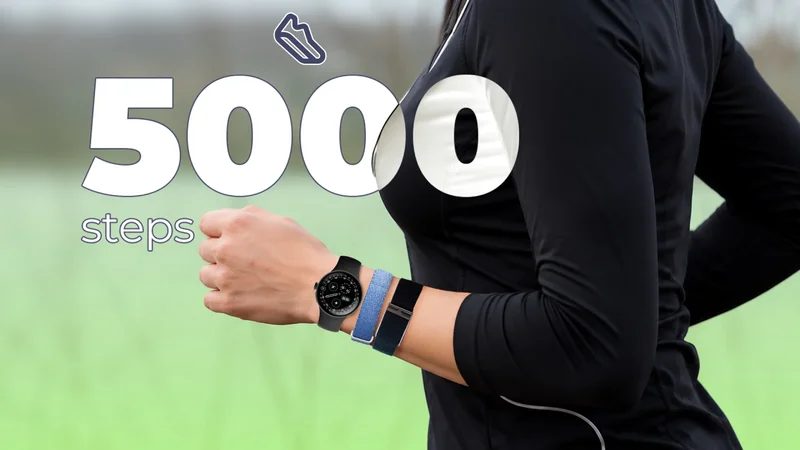
I walked 5,000 steps wearing the Fitbit Air, Google Pixel Watch 2, and Whoop MG at the same time to test which fitness tracker is the most accurate. The winner wasn't the one I expected.
Related
Whoop does what my watch couldn't
Fitbit Air vs. Whoop MG vs. Pixel Watch: Setup
I wore all three trackers and manually counted every step for a fair comparison
Before we take a look at the results, it's worth quickly running through how I set up this test, since the details matter here.
For this test, I used the Whoop MG paired to my iPhone, the Fitbit Air also paired to my iPhone, and the Pixel Watch 2 paired to my Pixel 10 Pro. All three devices were running the latest available software to keep things as fair as possible.
I wore the Fitbit Air and the Pixel Watch 2 on my left hand, while the Whoop MG went on my right. Step counting shouldn't really depend on which wrist you wear a tracker on, but it can certainly influence the reading, so it's worth keeping that in mind.
Importantly, I didn't start a workout on any of the devices. Instead, I kept things casual and simply walked outdoors, letting each tracker record my steps passively in the background, like a regular user would.
To keep the test structured, I divided the 5,000 steps into three checkpoints. I tracked and compared the readings at 1,000 steps, 2,500 steps, and 5,000 steps, manually counting each step myself along the way to serve as the baseline for the accuracy test.
Fitbit Air vs. Whoop MG vs. Pixel Watch: The numbers tell an interesting story
First 1,000 steps
Starting off, both the Fitbit Air and the Pixel Watch 2 came impressively close to my manual count. The Fitbit Air recorded 960 steps against my counted 1,000, undercounting by 40, while the Pixel Watch 2 slightly overshot the mark, logging 1,016 steps for an error of just 16.
Both are well within the margin of error you'd expect from a fitness tracker, so at this early stage, there wasn't much separating them in any meaningful way.
The Whoop MG is where I need to add some context, though, because it doesn't appear at this checkpoint at all. Unlike the Pixel Watch 2 and the Fitbit Air, the Whoop MG isn't designed as a dedicated step tracker.
Step counting on Whoop is still in beta, and rather than updating live as you walk, it fills in your step count passively throughout the day.
That's why there's no Whoop reading at the 1,000-step mark, and it's worth keeping that in mind for the rest of the test, since the Whoop figures you'll see aren't real-time measurements like the other two.
| Tracker | Starting steps | 1,000 steps | 2,500 steps | 5,000 steps | Total error |
| --- | --- | --- | --- | --- | --- |
| Pixel Watch 2 | 40 | 1,016 | 2,450 | 4,913 | −87 |
| Fitbit Air | 62 | 960 | 2,368 | 4,641 | −359 |
| Whoop MG | | — | 1,693 | 4,341 | −659 |
At 2,500 steps
By the halfway point, the two dedicated step trackers started to pull apart. The Pixel Watch 2 stayed remarkably close, recording 2,450 against my manual count of 2,500, an undercount of 50 steps.
The Fitbit Air, meanwhile, began to drift a little more noticeably, landing at 2,368 for a gap of 132 steps.
On its own, that's still a perfectly usable result, but it was clear the Pixel Watch 2 was starting to hold its accuracy better as the distance increased.
The Whoop MG also updated for the first time when I checked the count at 2,500 steps. It showed 1,693 steps, well behind the other two, but that number comes with the asterisk I mentioned earlier.
Because it catches up passively rather than counting steps in real time, it simply hadn't reached my actual step count by the moment I reached that checkpoint.
It's less a sign of poor accuracy and more a reflection of how differently Whoop approaches step tracking in the first place.
The Pixel Watch 2 remained remarkably consistent from start to finish.
At 5,000 steps
By the end of my 5,000-step test, a clear pattern had emerged. The Pixel Watch 2 finished as the clear winner, logging 4,913 steps against my manually counted 5,000, an undercount of 87 steps across the entire walk.
The Fitbit Air continued its gradual drift, finishing at 4,641 for a total error of 359 steps.
That tells me its accuracy tapers off slightly the longer you walk rather than remaining perfectly consistent, although that still works out to an error of roughly 7%.
The Whoop MG, interestingly, clawed back much of its earlier deficit by the finish, ending at 4,341 steps.
Given that it's a passive, beta-stage step counter that was never really designed to compete directly with dedicated step trackers, finishing within a few hundred steps of the others is more respectable than it first appears, even if it technically ended up furthest from the mark.
Fitbit Air vs. Whoop MG vs. Pixel Watch: The winner
Each tracker has its strengths, but only one excelled at counting steps
Overall, the results make it clear that the Whoop MG simply isn't a dedicated step tracker, and I don't think it should be judged as one.
Instead, it's a passive activity tracker that's built for athletes who care more about daily strain, recovery, and overall activity than hitting a specific step count.
As for Google's two fitness trackers, the Pixel Watch 2 impressed with its accuracy. Even though it's a couple of years old at this point, it still delivers excellent step-counting accuracy and justifies its price tag if you are looking for a smartwatch just for counting the steps.
The Fitbit Air may be considerably cheaper, but a roughly 7% error over a 5,000-step walk is still a little too much for me. If accurate step counting is one of your priorities, I'd lean towards a proper smartwatch.
That said, this is only a 5,000-step test. I'm planning to repeat the same experiment over a longer 10,000-step walk to see if these results hold up.
For now, though, the Google Pixel Watch remains the clear winner, while the Fitbit Air still has a bit of catching up to do, even if its lower price makes those compromises a little easier to accept.
Case size
: 41mm / 45mm
Case Material
: Aluminum
Display
: AMOLED
The Pixel Watch 4 comes in 41mm and 45mm sizes with a domed Actua 360 display that hits 3,000 nits of brightness. It runs on a dual-chipset setup with Wear OS 6 out of the box. Compared to screen-free trackers, it lasts only 30-40 hours on a single charge, though it offers a 15-min quick-charge feature.