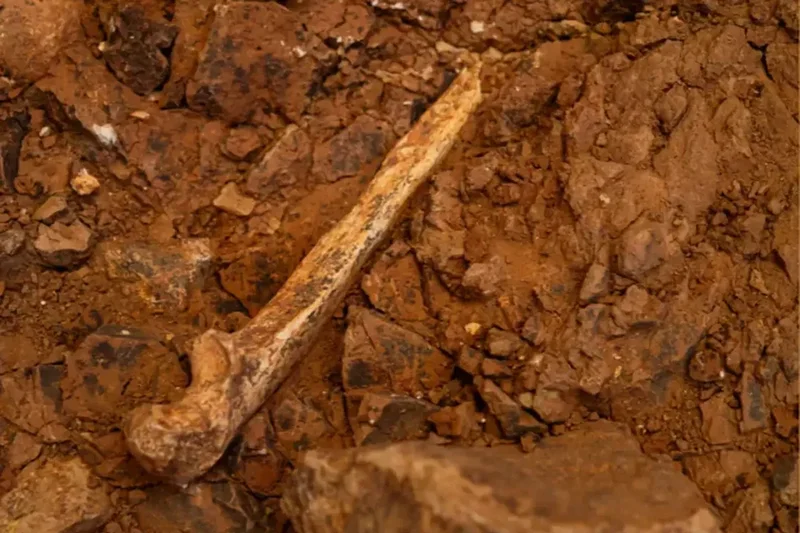
Over two dozen new human ancestor fossils unearthed at a Spanish cave site suggest these first Europeans may have engaged in cannibalism 850,000 years ago.
More than 30 years after the discovery of the first fossils attributed to the prehistoric human species Homo antecessor, new finds at the cave site of Gran Dolina continue to reshape our understanding of the species.
Ongoing excavations have found that the adult remains of Homo antecessor buried here preserve cut marks produced during the processing of the bodies, indicating they were victims of cannibalism.
The findings shed more light on the biology, development, social relationships, and behaviour of Homo antecessor around 850,000 years ago.
At the cave site, researchers unearthed several fossil bones of the human ancestor species, including a fragment of the temporal bone, several vertebrae, hand and foot phalanges, three teeth and long bones such as the first inner forearm bone ever recovered from the site, as well as fragments of leg bones, tibia, femur and humerus.
“Each excavation season helps us complete a puzzle that still has many missing pieces. The increase in the number of individuals, and especially the addition of more adults, allows us to begin understanding this population from a much more complete perspective than ever before,” excavation co-director Andreu Ollé said.
“For the first time, we can approach its demographic structure with a level of representativeness that we simply did not have until now,” Dr Ollé said.
Compared to previous fossil recoveries, there has been a substantial increase in the number of adult individuals documented at the site, researchers say.
This has helped better reconstruct the species population in a way that is far more balanced and demographically representative, they say.
Many of the unearthed remains, including those of juvenile and adult individuals, had cut marks produced during the processing of the bodies, hinting at cannibalistic practices among the population.
“The discovery of more adult individuals, some of whom also bear cut marks, demonstrates that cannibalism was not restricted to younger individuals,” said Palmira Saladié, a researcher at the Catalan Institute for Human Palaeoecology and Social Evolution (IPHES).
“More importantly, however, it provides us with a much more representative population for understanding the biology, demography and behaviour of Homo antecessor,” Dr Saladié said.
At the cave site, researchers also unearthed stone tools made from flint, quartzite, sandstone and quartz, as well as remains belonging to hyenas, beavers, deer, bovids, horses and rhinoceroses.
Taken together, the stone tools, animal remains, and human fossils make the cave site one of the finest archaeological records in Europe for understanding the continent’s earliest human populations.
“The significance of Gran Dolina extends far beyond its human fossils. The relationship between the stone tools, faunal remains and the bones of Homo antecessor allows us to reconstruct a human occupation site from 850,000 years ago with extraordinary detail,” Dr Ollé said.
“We have only just begun excavating this new area, and the first results already demonstrate its enormous scientific potential,” said IPHES director Marina Mosquera.