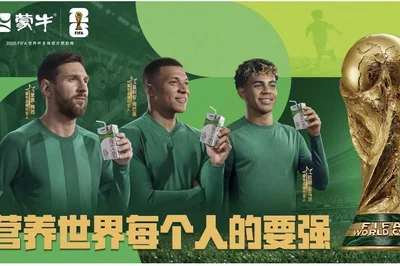
From left, Lionel Messi, Kylian Mbappé and Lamine Lamine Yamalpose with milk cartons in a promotional image. Courtesy of Mengniu
Spain emerged victorious in the 2026 World Cup final, defeating Argentina 1-0 to stand at the apex of the football world. The club’s 19-year-old superstar Lamine Yamal faced former Barcelona legend and global football icon Lionel Messi, now with Inter Miami. The Golden Boot, meanwhile, went to Kylian Mbappé, the star of Barcelona’s longtime rival Real Madrid.
But fans were not the only ones smiling as the tournament’s biggest names made it all the way to the end. In one promotional image, Messi, Lamine Yamal and Mbappé are seen together, each holding a carton of milk. The world "Mengniu," the name of one of China's largest dairy companies, is prominently displayed above them.
As an official FIFA World Cup sponsor, fans who followed this year’s expanded 48-team tournament will surely have seen Chinese characters flashing across stadium screens. The dairy company was not the only Chinese company to use the World Cup as an opportunity for marketing, with Lenovo and Hisense also making their presence felt. Lenovo belonged to the highest sponsorship tier as a FIFA Partner, while Mengniu and Hisense were FIFA Sponsors.
Lee Ki-hyuk reacts after Korea’s defeat by South Africa in their final Group A match of the 2026 World Cup at Monterrey Stadium in Mexico on June 25. Korea Times photo by Choi Ju-yeon
China fields more World Cup sponsors than Korea or Saudi Arabia
Chinese companies poured a combined $500 million into sponsorships for this year’s World Cup, the second-largest sum spent by any country after the United States, according to China’s Sina Sports.
Unlike China’s national team, which failed to qualify, the country’s brands delivered a strong performance, dominating advertising boards both inside and outside the stadiums.
For Mengniu, which enlisted Messi, Lamine Yamal and Mbappé to pose with its milk cartons, the World Cup in North America marked its third consecutive tournament as a sponsor. It first became an official FIFA World Cup sponsor in 2018, when the company formed one half of a duopoly in China’s dairy market with Yili Group and was looking to expand its global reach, particularly in Southeast Asia.
Using the planet’s most famous sporting tournament as a springboard for an overseas marketing push seemed like a sound strategy for Mengniu. When the continuation of its FIFA sponsorship was announced in 2022, FIFA President Gianni Infantino lavished praise on the company, saying its pursuit of healthier lives for people around the world aligned perfectly with the positive spirit of sport.
After sponsoring three consecutive World Cups, people around the world have become familiar with the name Mengniu, even if many still have no idea what the company actually does.
Chinese referee Ma Ning gives a yellow card during the Group E match between Ecuador and Curaçao at Kansas City Stadium in Missouri on June 20. AP-Yonhap
Lenovo puts China’s AI rise on display
Lenovo made its presence felt just as strongly, if not more so. The AI-powered analytics services it developed in partnership with FIFA gave the company an opportunity to showcase China’s growing artificial intelligence prowess to the world. The referee camera footage introduced at this year’s tournament also served as a showcase for Lenovo’s video stabilization technology, which made the first-person footage considerably smoother.
The South China Morning Post noted that this demonstrated how deeply Chinese businesses remain embedded in global commerce, including at one of the highest-profile international events ever staged in North America, even as US policymakers intensify their scrutiny of Chinese technology companies and seek to mitigate security risks in strategically sensitive sectors.
Hisense, a regular sponsor since the 2018 World Cup in Russia, supplied its proprietary RGB Mini LED televisions to the tournament’s video assistant referee centers, showcasing its technological capabilities to a global audience.
Chinese companies may have several reasons for pouring astronomical sums into World Cup marketing. For one, it helps them consolidate their share of China’s football-crazy domestic market. Repeated exposure also allows them to expand their foothold overseas.
Another intriguing possibility is that such lavish spending is intended to build influence behind the scenes at FIFA. Infantino’s decision to expand the World Cup from 32 to 48 teams has even been widely interpreted in international football circles as a gift intended, at least partly, to improve China’s chances of qualifying.
The tournament’s commercial partners / Captured from FIFA website
One tangible sign of China’s growing presence is found among the World Cup referees, whom FIFA has the authority to select and assign: China had officials at the tournament; Korea did not.
A record 170 match officials were dispatched to the 2026 World Cup in North America — 52 referees, 88 assistant referees and 30 video match officials. China effectively sent an entire officiating team with referee Ma Ning, assistant referee Zhou Fei and video match official Fu Ming.
Ma first rose to prominence at the 2014 Asian Games in Incheon. He subsequently received strong backing from the Chinese Football Association and is regarded as one of Asia’s more capable referees. Ma was appointed as an official at the 2022 World Cup in Qatar before taking charge of matches as a referee at this year’s tournament.
A broadcast image from the 1994 World Cup in the United States shows advertisements for Japanese companies. Captured from FIFA’s website
Japanese companies retreat amid restructuring and a weak yen
Korean referees were not the only ones conspicuously absent from this year’s World Cup. Japan’s corporate sponsors were also nowhere to be seen, despite having eagerly backed football’s biggest tournament through the early 2000s. Until little more than a decade ago, the country most committed to World Cup marketing in Asia was neither Korea nor China but Japan.
Longtime fans may remember the considerable influence Japan once wielded in international football. Prominent companies such as Sony, Toshiba, Fujifilm, JVC and Canon all served as official FIFA sponsors, while automotive giant Toyota sponsored the FIFA Club World Cup. However, those major sponsorships have largely disappeared. Japanese corporate involvement was confined mostly to behind-the-scenes technical services, such as the video assistant referee system supplied by Sony subsidiary Hawk-Eye.
Several factors help to explain the retreat, including changes in Japanese companies’ business structures and the weakening yen. From the 1980s through the early 2000s, Japanese companies used the World Cup extensively to promote their consumer electronics around the globe. But as leadership of the global home appliance market shifted toward Korea and China, Japanese conglomerates had less reason to spend vast sums on World Cup marketing.
Regza, a television brand that was formerly owned by Toshiba, was sold to China’s Hisense in 2018. People often buy new televisions ahead of a World Cup, after all. Japan now has fewer television brands of its own to promote globally, while China has a greater need to put its brands before international consumers.
The weakening yen has also played a substantial role. Official World Cup sponsorship contracts are in US dollars, and the yen’s steep decline in recent years has sharply increased the amount Japanese companies must pay in their own currency. Marketing that was already expensive has simply become too costly to justify against the returns.
Currency issues have also affected the Korean won and prominent local brands like Hyundai Motor and Kia. Exchange rates certainly affect the automakers, but both have substantially expanded their global market share and receive much of their export revenue in dollars, giving them a degree of protection against the currency burden.
FIFA President Gianni Infantino applauds while watching the World Cup semifinal between Spain and France in Arlington, Texas. AP-Yonhap
A 64-team World Cup — will China finally make it in 2030?
China’s influence within FIFA is likely to grow further. Chinese corporate sponsorship remains robust, while other countries like Japan and Saudi Arabia — once busy showering the sporting world with oil money — have begun seeking more efficient uses for their investments.
Coincidence or not, Infantino recently floated the idea of expanding the 2030 World Cup — to be hosted by Spain, Portugal and Morocco — to 64 teams, likely yet another way to nurture China’s hopes of returning to the tournament for the first time since the 2002 World Cup in Korea and Japan.
For now, however, FIFA appears likely to retain the existing 48-team format for at least one more tournament. As massive Chinese investment converges with FIFA’s continuing efforts to widen the path to qualification, one cannot help but wonder whether the world will finally see China return to the World Cup stage in 2030.
This article from the Hankook Ilbo, the sister publication of The Korea Times, is translated by a generative AI system and edited by The Korea Times.