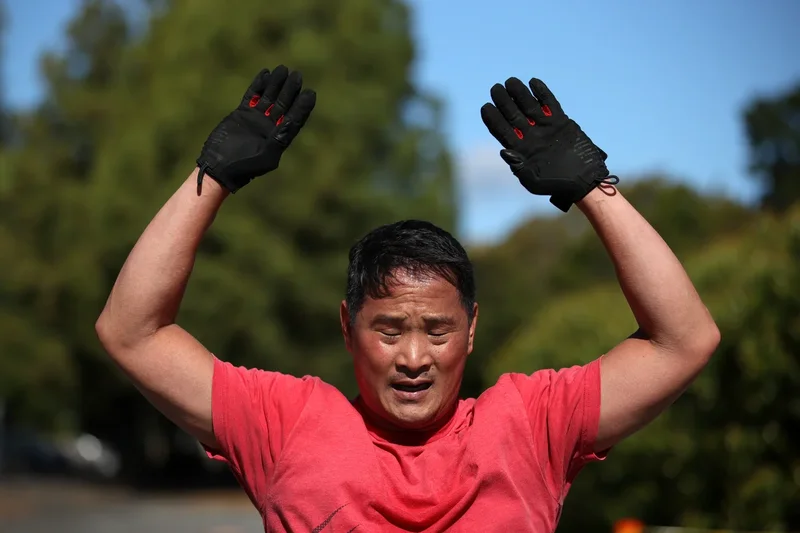
Are burpees the most hated exercise of all time? While I’ve not been able to find any actual evidence, I think it’s quite possible – as a fitness instructor, I’ve heard far more people curse than praise the invention of the burpee. Invented by Royal H Burpee Sr, it was adopted by the US Army as part of their physical fitness test in 1942.
How many burpees can you do in 20 seconds? According to the Army, 10 burpees is “fair”, while 13 or more is “excellent”. In order to be considered strong enough for “the rigor of war”, you’d be expected to do 40 or 50 burpees without pausing, in an easy rhythm.
These suitably gruelling origins will be no surprise for anyone who’s ever been asked to stop, drop, and plank in the middle of a HIIT or callisthenics class.
But whether you’re preparing to run into battle or just want to be able to make it up the stairs without panting, burpees can help you get there. Here’s why I believe burpees are misunderstood, why you’re probably doing them wrong, and how to do them properly.
Why everyone hates burpees
Burpees are a compound movement involving many muscle groups. They’re also a calisthenic exercise, using body weight and gravity for resistance rather than weights or machines.
Burpees increase our heart rate very quickly, making us hotter and sweatier than other exercises. The legs, arms, and core are all activated, and because so many of them are being used at the same time, muscles fatigue quicker. Breathing becomes difficult, as our body demands more oxygen.
For a killer full-body workout, check out this video from Strong Like Mum:
Basically, they’re hard work because they make a lot of things happen all at once.
The bad news is: all the things which make burpees so difficult are also what make them so beneficial. They get a lot done in a really short period of time, which can be intense, but comes with loads of perks, too.
How you’ve been doing them wrong
The most common mistake people make is to rush through the exercise (... probably to get it all over and done with). But with any movement, quality is far more important than quantity or speed.
This is especially true when it comes to compound exercises, as we engage so many parts of our bodies at once. Doing something incorrectly can increase pressure in all the wrong places and lead to injury. Often, when I hear that burpees are causing someone pain, it ends up being due to them rushing the exercise. So, the first tip is to slow down.
Another error I see all the time is poor plank posture. Either the hips sink downwards, compressing the lower back. Or the bum gets pushed into the air too high, which fails to engage the core.
Take your time while planking and ensure you hold a sturdy, straight posture, with the legs, glutes and core properly engaged. Square your shoulders with your chest, rather than letting your neck collapse towards the floor.
The other tricky part is the jump. Without proper discipline while jumping, the knees can collapse inwards, increasing stress on the joints.
Make sure you land solidly on your feet and let your knees follow your toes slightly outwards. Slow, steady, purposeful movements here make all the difference.
Why bother with burpees?
For all its haters, there are many, many benefits from doing burpees.
They challenge all the areas that count: strength, power, co-ordination, balance, and cardiovascular fitness, leading to better heart health, muscle growth, and joint stability.
They also improve aerobic fitness (how well your heart, lungs, and muscles work together to use oxygen during exercise) and your VO2 max.
Basically – the more you do them, the less difficult they get. Though I can’t promise they ever feel great. Sorry.
How to do a burpee properly
-
Stand up straight with your feet slightly wider than hip-width apart
-
Raise your hands above your head and jump
-
On the return from the jump, bend at the waist and with your knees into a squat position, and lay your palms flat on the floor
-
Using your hands to stabilise you, jump your feet backwards into a plank position – making sure that your body forms a strong, stable line from head to feet, engaging your core and your glutes
-
Bend your arms to lower yourself to the ground
-
Push back up to the plank position
-
Jump your feet back up, landing either side of your hands
-
Bring your torso back up, returning to the squat position
-
Stand and jump, starting the sequence again
Burpee variations
There are loads of ways of modifying burpees to make them a bit easier, which is very helpful if you’re recovering from injury or just getting back into exercise.
You can skip the jump and just reach your hands above your head. This does mean losing out on the benefits of jumping, which is one of the most important types of movement we do. The sudden pull on the ligament and the bones when jumping stimulates bone-building cells called osteoblasts to continue building more bone cells.
Or, you can skip the push-up. Stay in a plank and, alternating legs, tap your toes out to the side to challenge your core strength.
For more workouts, breathing exercises, evidence-based postnatal recovery advice, pelvic floor education and realistic fitness guidance for women navigating motherhood and midlife, subscribe to Strong Like Mum on YouTube.