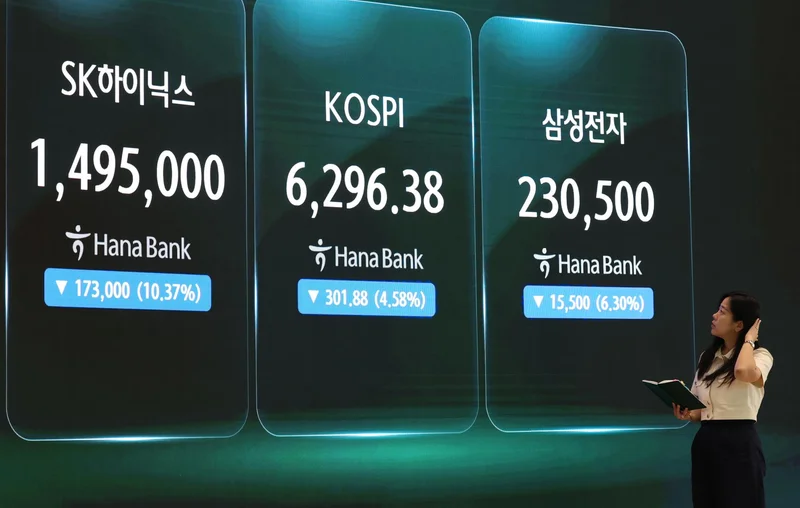
The KOSPI plunged more than 4 percent Thursday, giving up gains from the previous two sessions as weakness in major semiconductor stocks weighed on the market.
The tech-heavy Kosdaq swung between gains and losses before closing up 0.26 percent, extending its winning streak to five sessions.
The KOSPI opened at 6,478.75, down by 119.51 points, or 1.81 percent, and extended its losses to close at 6,296.38, down 301.88 points, or 4.58 percent.
Heavy selling pressure during the session prompted the Korea Exchange to suspend program selling orders for five minutes at around 10:18 a.m. under its sidecar mechanism.
The benchmark index had climbed 3.76 percent the previous day for its second straight advance before reversing course Thursday.
U.S. stocks provided mixed signals overnight. Nvidia, the leading AI chipmaker, gained 3.44 percent after SpaceX said it would use Nvidia chips exclusively for its data center infrastructure.
AMD, on the other hand, dropped 7.04 percent after its outlook was viewed as weaker than expected. Alphabet also declined 4.06 percent after reports that Jeff Dean, a senior scientist widely regarded as a key figure at Google, would leave the company.
Against this backdrop, the Philadelphia Semiconductor Index fell 1.40 percent, ending a four-session winning streak.
The weakness in U.S. semiconductor stocks weighed on Korean shares, with Samsung Electronics and SK hynix, two of the market’s largest companies, falling 6.30 percent and 10.37 percent, respectively.
Kim Jae-seung, an analyst at Hyundai Motor Securities, said the KOSPI is unlikely to regain the strong upward momentum seen in May and June anytime soon. He said the sharp selloff in semiconductor stocks has raised concerns about the sustainability of chip earnings and intensifying competition from China’s semiconductor industry.
“It could take time for investor sentiment to recover. Even if the KOSPI rebounds, retail investors are likely to take profits and reduce their positions as the index rises, limiting its upside,” he said. “As a result, the market is likely to remain range-bound, with high volatility and lower highs.”
Still, Goldman Sachs maintained its bullish stance on Korean stocks despite the recent steep decline.
The Wall Street bank characterized the drop as a sharp correction within a broader structural bull market, rather than the start of a long-term downturn, and kept its 12-month target for the benchmark KOSPI index unchanged at 12,000.
The Kosdaq, meanwhile, opened 2.15 points, or 0.27 percent, lower at 797.44 before fluctuating between gains and losses and closing up 2.08 points, or 0.26 percent, at 801.67.
The gain extended the Kosdaq’s winning streak to five sessions.
The Korean won strengthened, ending onshore trading at 1,423.8 won against the U.S. dollar, up 0.7 won from the previous session.