It’s common to see sportspeople wearing or using health and activity products we can buy, from the Whoop band on the wrists of tennis players to smart glasses on the faces of triathletes.
What we don’t often see is the technology some use to track and optimize their sleep.
During the recent Aston Martin Technology Forum, it was revealed that sleep tech company Eight Sleep helps drivers rest as well as they train.
I caught up with Rafa Oliveira, vice president of international marketing and partnerships at Eight Sleep, after the event to understand more about the technology and whether we should all take inspiration from the Aston Martin F1 drivers.
Introducing The Pod 5
Not your usual sleep tracker
When we think about tracking sleep, we associate it with some type of wearable, or a mat that slips under the mattress.
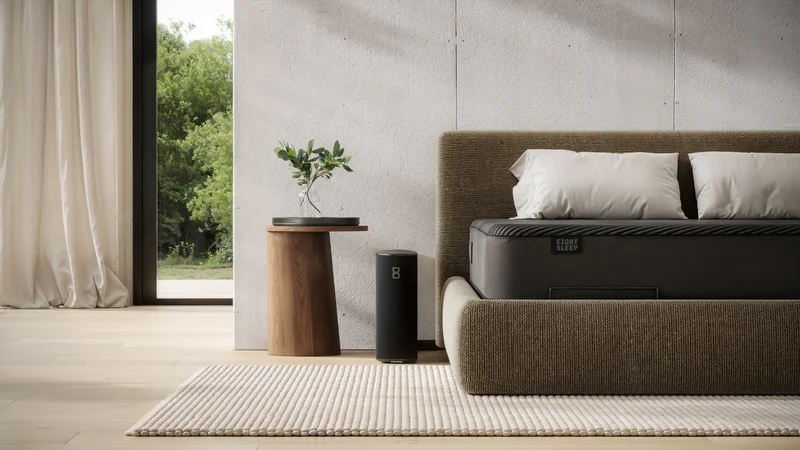
Eight Sleep is different. The Pod 5 is its main product. It consists of the Cover, which goes over your mattress, and the Hub, which is a PC-like central base station.
Oliveira explained:
We see ourselves as building the world’s first intelligent sleep system. The Pod uses embedded sensors to passively capture biometric signals every single night. Things like your heart rate, your breathing rate, your movement, your temperature, and all the sleep stages you get throughout the night.
AI transforms that raw data into actionable health intelligence and response. We don’t only give you insights on your sleep, on how great or how bad you slept; we can actually improve it with no effort required. It just works while you go to bed every single night.
During the Aston Martin Technology Forum, Oliveira revealed 70% of the grid uses its product and that it already had investors from F1, including Ferrari driver and Eight Sleep ambassador Charles Leclerc, before joining Aston Martin as an official partner.
Oliveira talked about why F1 is a good partner for Eight Sleep.
One interesting parallel is if you look at Formula 1 cars, they have hundreds of sensors making thousands of decisions every single lap. Every single component of the car is measurable and optimized.
Historically, perhaps there has been one exception, which is the people. Not only the drivers, but also the pit crew, the engineers, the CEOs, and so on. I think that’s the gap we bridge.
When they go to bed, the Pod is actually making thousands of adjustments, specifically for them, throughout the night to improve their sleep and recovery.
Heating, cooling, and more
Right where you sleep
The Pod 5’s cover has built-in sensors to track the expected metrics associated with sleep, plus it has an unusual heating and cooling system.
Water, which Oliveira says is more effective at conducting temperature than air, is piped through thin tubes inside the Cover, allowing dual-zone control over the bed’s temperature between 12 degrees centigrade and 43 degrees centigrade. It’s independently controllable on both sides.
The Eight Sleep Hub is where sleep data is processed, plus it has a speaker to play soundscapes and ambient noise to promote sleep.
Why would you choose an all-in-one sleep-tracking and temperature system that goes on your bed, over a smart ring like the Oura Ring 5 and an effective air conditioner?
Oliveira said:
With an air-conditioner, you set one temperature that is not only flat throughout the night, but it’s also the same temperature for the two people. The dual-zone system of the Pod is one of the most loved features, because as human beings, we inevitably have different temperature preferences.
The Pod does something very simple. It helps you fall asleep faster; it helps you wake up less often during the night, because most of the time we wake up during the night it’s because it’s either too hot or too cold, even if we don’t realize it.
Because you wake up less often during the night, you get to stay for longer periods of time in both deep and REM sleep, which is what you want to do to wake up feeling refreshed and energized every morning.
There are a few limitations with wearables. First, they are bound by the battery. We don’t have that issue because our unit is plugged into the wall.
Second is our users lay flat on a big surface for eight hours, and we’re not restricted to very small sensors collecting data. We’ve developed our own algorithm and our own AI because we believe the data is where our advantage is.
Does sleeping on The Pod 5 make a difference?
Data suggests it does
Wearables are great for tracking sleep and viewing your data, but very few actively help you sleep better, unless you take the initiative to make adjustments to your sleep health and routine.
Oliveira says data backs up why Eight Sleep is different.
Over the last few years, we’ve collected over 1.5 billion hours of great-quality sleep data. We give actionable insights every single morning to our users; we feed exercise tracked with a smartwatch into the Pod, so we can give even better recommendations and responses.
Let’s say you went for a long run, but late in the evening. By the time you go to bed, generally, your body will be overheated. We can come in with the response and suggest that, for that night specifically, you lower your temperature two degrees lower than usual, so you can fall asleep faster. Data is meaningless if you cannot do anything about it.
When we look at our member base, we see their deep sleep improving up to 34%. We see their snoring reduced by up to 45%, fewer wake-ups during the night, and, in general, waking up a lot more energized and refreshed.
This is also where Eight Sleep’s advantages lead back to F1 drivers and other athletes.
What’s becoming obvious is a tired brain makes measurably worse decisions. When you improve that, the competitive advantage can actually be real. I think athletes are a great example because they all have very tiring schedules.
Eight Sleep has also made sure its technology doesn’t get in the way of a good night’s sleep. Oliveira repeatedly emphasized the system’s automated nature, indicating it doesn’t need constant attention.
The Hub is apparently no louder than a laptop at idle, plus Eight Sleep has 10 years of experience using water for heating and cooling, and Oliveira says the comfort level using the Cover is the same as your regular mattress.
There are optional additions to the Pod 5 ecosystem, including a pillow that uses the same cooling technology, plus The Base, which is a motorized platform that goes under the mattress, and not only raises and lowers your legs and upper torso in bed, but it does it actively while you’re asleep to alleviate snoring.
The price you pay for Eight Sleep
Is it worth it if you’re not an athlete?
Eight Sleep’s approach to helping you sleep better involves both hardware and software, and the package is quite expensive compared to a $400 Oura Ring or Samsung Galaxy Watch 9.
The Pod 5 with the Hub and Cover is $3,000, while the adjustable Base is an additional $2,000, and a cooling pillow cover is $1,000.
The Pod 5 requires a subscription. The standard option is $17 per month, or $25 per month if you add in a five-year warranty. The top $33 subscription adds in cardiovascular and respiratory pattern tracking.
It’s a significant investment for those not on an F1 driver’s salary. Oliveira closed by summarizing how Eight Sleep does things differently from the average sleep tracking wearable.
Wearables do a great job creating awareness, and they will tell you how great or how bad you sleep, but they don’t do anything about it. It’s where we’re different. We have the awareness, but we also have the response.
We will improve your sleep without you having to do anything about it. It’s an invisible layer that sits on your bed; you don’t need to interact with it after you set it up, and it will improve your sleep every single night.
Using an Oura Ring 5 or another wearable to track sleep is one thing, but none seem to take the proactive approach of Eight Sleep to improve it. Eight Sleep has a 30-night free trial to see if it lives up to its promise.