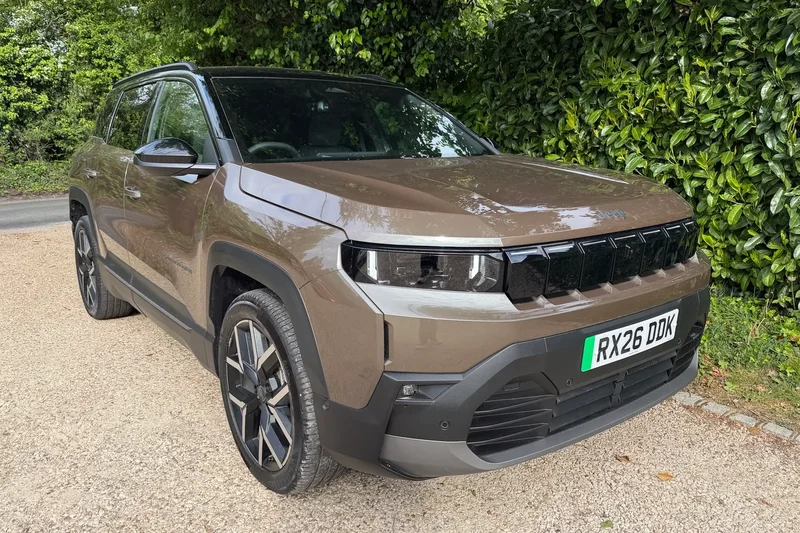
I’ve always liked a Jeep. I’ve owned a classic Jeep Cherokee in the past, too, so I understand the appeal of that upright, rugged, go-anywhere look. There is something pleasing about a car that appears ready to climb a mountain, even if in this case the two-wheel-drive versions clearly won’t be doing anything too heroic.
That is a big part of the new Jeep Compass Electric’s charm. In a sea of samey SUVs, it looks refreshingly different. It is square-edged, upright and chunky, with a more traditional off-roader shape than many of the rounded, road-biased electric SUVs and crossovers now filling supermarket car parks. It has the trademark Jeep seven-slot grille, trapezoidal wheel arches, tough-looking cladding and enough visual attitude to suggest it might be happiest with a little mud around the edges.
This is the third-generation Compass and the first Compass to be offered as a fully electric model. It is also Jeep’s second all-electric car after the smaller Avenger, but this is a larger, more family-focused SUV. At 4,550mm long it drops straight into the busy mid-sized electric SUV sector, where cars such as the Skoda Enyaq, Tesla Model Y, Volkswagen ID.4, Hyundai Ioniq 5 and Kia EV5 are already fighting hard for family buyers.
Underneath, the Compass uses Stellantis’ STLA Medium architecture, the same electric platform family as the Peugeot E-3008, Citroën ë-C5 Aircross and Vauxhall Grandland Electric. That means it must lean heavily on Jeep design, character and cabin personality to separate itself from the wider Stellantis pack. Happily, it does a pretty convincing job.
There is plenty of familiar Stellantis switchgear inside, but Jeep has made the Compass feel more rugged and more Jeep-like than you might expect. There is a broad horizontal dashboard, chunky controls, a little Willys Jeep graphic on the steering wheel and rotary switches with a tough, grippy finish. Some of the trim feels chosen for durability rather than outright luxury, but that is fine in a Jeep. In fact, it feels right.
The model I tested is the Jeep Compass Electric First Edition, the front-wheel-drive launch version with a 74kWh battery, 210bhp and a price of £39,800. The entry-level Altitude model costs £36,999. Jeep is planning three electric versions in total, including front-wheel-drive and four-wheel-drive models, plus there’s a petrol mild hybrid version and a plug-in hybrid will follow.
The Compass Electric is not trying to be the most polished, most efficient or most obviously sensible electric SUV in the class. Instead, it is trying to be the one with a bit more outdoor attitude and a stronger sense of identity. That alone will matter to buyers who want an EV that does not look or feel quite like everything else.
How we tested
I drove the Jeep Compass Electric First Edition in the UK on the sort of roads (and a few dirt tracks) that potential Compass owners would use. I assessed everything, from the range, refinement and comfort, to its technology, practicality, and the buying and ownership costs. Ultimately, I set out to discover how well it separates itself from closely related Stellantis electric SUVs, and the wider market.
Independent rating: 8/10
- Pros:Distinctive Jeep character, useful family space, practical boot, easy-clean cabin materials, decent claimed range, proper rough-road usefulness
- Cons:Steep price and low range, ride comfort on 20-inch wheels, noticeable body lean, wind noise at motorway speeds, touchscreen climate controls, modest towing capacity
Jeep Compass Electric specs
- Price from:£36,999
- Battery size:74kWh
- Maximum claimed range:310miles
- Miles per kWh:3.3
- Charging :160kW DC; 20 – 80 per cent charge in 35 minutes
Battery, range, charging, performance and drive
The Jeep Compass Electric uses the familiar 74kWh battery from the Stellantis electric SUV family. It drives the front wheels through a single electric motor producing 210bhp and 345Nm of torque. That gives it a 0-62mph time of 8.3 seconds and a top speed of 112mph.
Performance feels perfectly brisk for the sort of road-based family use most buyers will give it. There is a fairly strong shove from the motor when you ask for it, and the higher driving position gives the Compass a more substantial SUV feel than many electric rivals; it doesn’t feel like a car trying to be sporty for the sake of it, which is probably just as well. This is more about everyday punch, confidence and ease, rather than making passengers wonder why their shopping trip has turned into a qualifying lap.
The official range for the First Edition is 285 miles, but Jeep claims a maximum of 310 miles for the Altitude model. As with other Stellantis EVs using similar technology, my test car did not manage anywhere near the official maximum during real-world use. That doesn’t make the Compass unusual – speed, weather, roads, wheel size and driving style all make a difference – but anyone planning regular long motorway journeys should treat the official figure as a comparison point rather than a promise, a bit like MPG.
That said, there is more range to come. A 97kWh battery should join the line-up, with a claimed range of between 370 and 404 miles depending on drive layout – and a four-wheel drive option should join the Compass family then too. With the larger battery, the Compass moves into broadly the same territory as a Tesla Model Y for official range, which should make it much more appealing to drivers who cover a lot of miles.
All versions get selectable terrain settings to help with loose, wet or slippery surfaces. Maximum ground clearance is 200mm, which is useful for rough tracks and poor roads, although it is no greater than the smaller Avenger. The Compass can also drive through water up to 470mm deep. That gives it a bit more credibility than the average road-biased crossover, but it is clearly aimed at people using farm tracks, muddy lanes and bad rural roads rather than those planning serious Jeep-style off-roading.
Charging is competitive rather than class-leading. The maximum DC rapid charging rate is 160kW, and Jeep quotes 35 minutes for filling from 20 to 80 per cent charge. The First Edition has an 11kW onboard charger, while optional 22kW AC charging could be worth having for drivers who regularly use public AC posts or on-street charging. Jeep quotes a full recharge on a 7kW home wallbox at around 12 to 16 hours, depending on the battery chosen.
On the road, the Compass Electric has a character of its own. It feels taller, chunkier and a little more outdoorsy than many electric SUVs. There is a soft edge to the way it moves, which suits the Jeep image, but it also means there is noticeable lean when the road gets twisty. It appears to trade some polish and precision for a more rugged, substantial feel.
The test car had 20-inch wheels, which seemed to expose broken road surfaces rather more than ideal. It is not uncomfortable all the time, but sharper edges and scruffy town roads are more obvious than they need to be. The steering is capable and reassuring rather than a highlight, while the Compass does not feel as calm or as well rounded on the road as a Skoda Enyaq.
Motorway refinement is marked down by noticeable wind noise at higher speeds. That is a shame, because the upright body and higher seating position otherwise make it feel like the sort of car that should be happy covering long family miles.
Brake regeneration is well handled, with three selectable strengths plus an adaptive setting, adjusted using paddles behind the steering wheel. A proper one-pedal mode is available, too. The brake pedal itself is not especially full of feel, but the ability to fine-tune the regen gives the driver useful control in town, on faster roads, or when trying to eke out a little more range.
Interior, practicality and boot space
The Compass Electric makes a strong case as a family SUV. The tall, upright body helps with forward visibility, gives the cabin a useful feeling of space and makes it feel more like a traditional SUV than many lower, sleeker electric crossovers. It’s not trying to hide its size or disguise itself as something sportier. It sits you up high, gives you a clear view out and feels ready for the daily chaos of family life.
There is plenty of Jeep personality in the cabin, too. The dashboard is broad and horizontal, the controls feel chunky and some of the touchpoints have a tough, grippy finish. There is that small Willys Jeep graphic on the steering wheel, too, which is a tiny detail but one that helps the car feel more characterful than some of its closely related Stellantis cousins.
There is also plenty of familiar Stellantis switchgear, so anyone coming from a Peugeot, Citroën or Vauxhall will spot a few common ingredients. Jeep has done enough with the design and materials to make the Compass feel more rugged, though. Some of the trim feels chosen for durability rather than luxury, but that works here. It feels like it can cope with a wet dog, muddy shoes, children’s snacks and the odd bit of outdoor kit thrown in without anyone having a meltdown.
That is where the practical cabin materials make sense. Waterproof seat material and rubber floor covers are exactly the sort of things that sound ordinary until you actually live with a family SUV. They should make it easier to deal with school bags, sports kit, muddy walking boots and dogs climbing in after a wet walk. It may not feel as plush as some rivals in places, but it feels authentic to the Jeep brand.
Space in the back is good. There is plenty of room for teenagers or a large rear-facing child seat, and there are two Isofix mounting points in the rear. Rear passengers get charging sockets and a centre armrest with cupholders, which are simple but important family-car details. The rear seating position feels slightly unusual, so it is something worth checking properly in person, but the amount of space on offer is generous.
Without the panoramic roof, the rear compartment can feel a little gloomy. That is partly the price of the Compass’s chunky shape and higher window line, and while it won’t bother everyone, families carrying children in the back should pay attention on a test drive. Up front, the seats are broad and comfortable, while the upright shape helps make the car easy to place on the road.
The boot holds up to 550 litres, which is a useful size for a family SUV, even though a Skoda Enyaq provides more room. The shape is practical, too, and there is a large storage well beneath the boot floor that looks handy for charging cables, muddy walking boots or wet kit. That is more useful in everyday life than a perfectly flat brochure figure.
The rear bench folds in a 40/20/40 arrangement, giving more flexibility than a simple 60/40 split when carrying long items. That means you can load something narrow through the middle while still leaving two proper rear seats in place; it’s exactly the sort of arrangement that makes a car easier to live with.
There is no frunk, which is a pity in an electric family car, but cabin storage is decent. Jeep quotes 34 litres in total, compared with 14 litres in the previous Compass. That is a useful improvement and gives families more places to stash the day-to-day clutter that ends up in a car.
This is strictly a five-seater, so buyers needing an EV with room for seven at this sort of money should consider the Peugeot E-5008 or Mercedes EQB. For those who only need five seats, however, the Compass delivers a sensible blend of rear room, boot space, storage and tough-feeling materials. Its strongest practical qualities are not flashy, but they are exactly the kind of things that make a family SUV easier to live with.
Technology, stereo and infotainment
The Compass Electric gets a much more modern dashboard than previous Jeep models, and the technology makes a strong first impression. There is a 10-inch driver display and a large, 16-inch central touchscreen dominating the dashboard. It gives the cabin a clean, up-to-date look and helps the Compass feel properly competitive in a class where buyers now expect a big screen and connected features as standard.
The latest infotainment system includes wireless Apple CarPlay and Android Auto, over-the-air software updates and navigation that can help find chargers and plan charging stops. Early signs are that it is a noticeable improvement on Jeep’s previous multimedia systems – it’s a quicker, clearer and more useful interface than those buyers may remember from older Jeeps.
It should do the essentials well enough, but Kia, Hyundai and Renault systems still seem easier and more intuitive. The Compass system is not bad, but it doesn’t feel quite as naturally laid out as the very best.
There is a touch-sensitive shortcut strip underneath the screen, which is useful because it gives some direct access rather than burying features in sub-menus. But it is not necessarily the most natural set of controls to use. Proper buttons would still be preferred for key functions, especially in a car that sells itself on rugged, practical sense.
The climate settings are dealt with through the touchscreen, which is always a frustration compared with proper switches. The temperature icons remain permanently displayed, so at least they are not buried away, but they appear rather small for easy use on the move. In a family SUV that may be used on cold school runs, wet weekends and long holiday trips, simple physical temperature controls would have suited the car’s personality far better.
There are some pleasing character touches. A fun little guitar noise when changing certain settings adds personality and feels more Jeep-like than a generic electronic chime. The indicator sound, though, appears rather more intrusive than charming, and may become one of those small things owners either tune out or quickly wish they could change.
The driver assistance systems seem relatively straightforward to switch off or back on, which is welcome. The First Edition also brings a strong safety and driver-assistance list, including Level 2 autonomous drive, lane positioning assist, autonomous emergency braking, front and rear parking sensors, a rear camera, adaptive high-beam assist, matrix LED headlamps, automatic headlamp levelling, rain-sensing wipers, emergency call and a perimetric alarm.
Equipment is generous elsewhere too. The First Edition specification includes keyless entry and start, two-zone automatic air-conditioning, an electrochromic rear-view mirror, heated windscreen, roof rails, LED fog lamps with cornering lights, USB-A and USB-C sockets in the front and two USB-C sockets in the rear. The rear charging provision is particularly useful in a family car, where phones, tablets and games consoles often seem to require more careful management than the journey itself.
The overall technology package feels like a considerable step forward for Jeep. It is not class-leading for usability, mainly because the touchscreen takes on too much responsibility, but it is modern, well equipped and has enough personality around the edges to stop it feeling completely generic.
Prices and running costs
The Jeep Compass Electric starts at £36,999 for the Altitude, goes up to £39,800 for my First Edition test car, and on to the Summit (of course) at £40,800. Obviously bigger battery and four-wheel drive versions will cost more, pushing the Jeep into expensive mid-forties territory.
The First Edition is well equipped, with 20-inch alloy wheels, matrix LED headlamps, the 16-inch touchscreen navigation system, Level 2 assisted driving, a heat pump, 11kW onboard charger, keyless entry and start, two-zone air-conditioning, front and rear parking sensors and a rear camera. The specification attached to the car tested also lists Convenience Pack First Edition, First Edition Pack and Amazonia paint with black roof, taking the total price to £42,600.
That puts the Compass right in the middle of a very competitive family electric SUV market. It is not cheap, but it is not wildly out of step either, especially given its equipment level and distinctive Jeep character. The question is whether buyers value that identity enough to choose it over rivals that may be more comfortable, more efficient or better value.
Official efficiency is 3.34 miles/kWh, with a claimed maximum range of 310 miles. Those figures are decent rather than exceptional. The Compass has been designed carefully to help efficiency, despite its upright SUV look. Jeep describes it as the most aerodynamic Jeep yet sold in Europe, with a drag coefficient below 0.29, helped by a fully flat underbody, active grille shutters, aero-optimised wheels, sharp rear edges, rear air curtains and a high-efficiency roof spoiler.
The standard warranty is just three years or 60,000 miles, whichever comes first, and looks unremarkable against rivals from MG, Hyundai, Kia and Toyota that give owners longer protection. Towing capacity is also a weak point, with the First Edition rated to tow a braked trailer of up to 1,000kg. That may be fine for some buyers, but it is modest for a car with rugged Jeep imagery.
The verdict: Jeep Compass Electric
The Compass Electric has real Jeep flavour, useful family space and a tougher attitude than most rivals, although ride comfort, efficiency and value stop it from beating the very best.
Jeep Compass Electric rivals
FAQs
How long does it take to charge?
How long does it take to charge? The Jeep Compass Electric can rapid charge at up to 160kW DC, with Jeep quoting 35 minutes for a 20 to 80 per cent charge. The First Edition has an 11kW onboard charger, while Jeep quotes a full recharge on a 7kW home wallbox at around 12 to 16 hours.
How much does the Jeep Compass cost - is it worth it?
The Jeep Compass Electric starts at £36,999 in Altitude trim, rises to £39,800 for the First Edition tested here, and reaches £40,800 for the Summit. Larger-battery and four-wheel-drive versions will obviously cost more, likely pushing the Jeep into the mid-£40,000s. It’s worth considering if you want a family electric SUV with more Jeep character, a useful boot, practical cabin materials and some rough-road ability, although the Skoda Enyaq will be stronger on comfort, efficiency and value.
Does Jeep replace batteries for free?
Although the standard vehicle warranty is only three years or 60,000 miles, the battery gets eight years’ warranty included.
Why trust us
Our team of motoring experts have decades of experience driving, reviewing and reporting on the latest EV cars, and our verdicts are reached with every kind of driver in mind. We thoroughly test drive every car we recommend, so you can be sure our verdicts are honest, unbiased and authentic.