In early August 2016, a phrase began circulating in Germany that would shape political and societal discussions for many years to come: "the divided society."
There were still many Germans who remained committed to welcoming thousands of refugees who had begun arriving the previous year, mainly from Syria. However, an increasing number were more skeptical of immigrants and foreigners, especially following the mass sexual assaults involving young men with immigrant backgrounds that took place in Cologne on New Year's Eve 2015–2016.
Under the leadership of Chancellor Angela Merkel, the coalition government of the conservative Christian Democratic Union (CDU)/Christian Social Union (CSU) and the center left Social Democratic Party (SPD) sought to calm the polarized mood in Germany by introducing an integration act , a law designed to appeal to all sides through the guiding principle of "support and challenge" (fördern und fordern).
Some thought it offered too many giveaways; others felt it imposed too many demands.
'Support and challenge' means squaring the circle
"For someone in favor of strong regulatory policy, the integration law offered too much assistance while demanding far too little. One example is the fact that a rejected asylum application did not necessarily lead to deportation," says Holger Kolb, of the Expert Council on Integration and Migration (SVR).
"For someone very concerned with integration policy, on the other hand, the requirements were far too high, especially regarding temporary residence permits for vocational training. They believe this creates far too many obstacles to successful integration," Kolb explains.
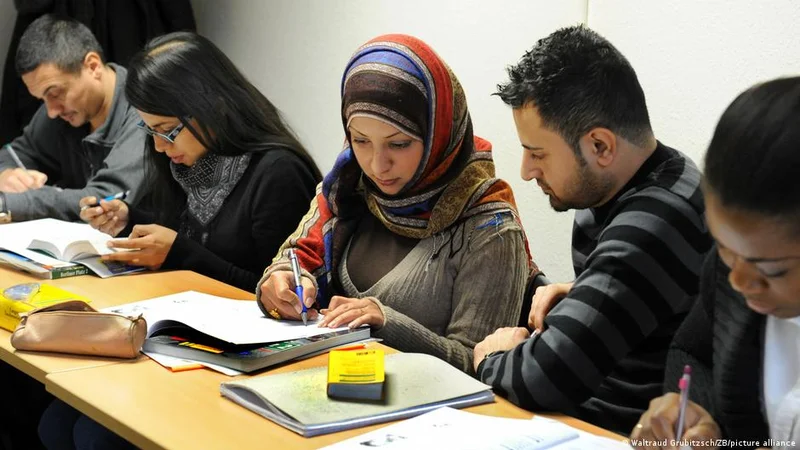
Providing support for new arrivals meant massively expanding integration and language courses, allowing new arrivals to enter the labor market more quickly. A vocational training permit for refugees whose individual asylum applications had been rejected, but whose home countries were still categorized as unsafe, to complete a three-year vocational training program followed by two years of employment in the field they trained in.
On the other hand, it was made obligatory to participate in language and integration courses. Sanctions were imposed in the form of welfare benefit cuts for those who refused to participate. Also, the refugees were distributed evenly across Germany to prevent over-concentration in major cities.
Criticisms of the residence requirement
This "residency requirement" had a very negative impact on integration, says Herbert Brücker, head of the Research Department for Migration, Integration and International Labour Studies at the Institute for Employment Research (IAB).
"People were distributed disproportionately to economically weak regions with high unemployment. If we restrict people to regions where the economy isn't doing so well, that naturally has negative effects on labor market integration," Brücker explained.
Brücker, however, has a positive assessment of the vocational training policy allowing rejected refugees to finish their vocational training. He argues that it always makes sense to offer those who integrate well the prospect of staying: they put more effort into learning the language and finding employment and ultimately contribute to the social security systems.
Integration in Germany is better than many think
And it turns out, integration in Germany isn't going nearly as badly as has often been claimed, says Brücker, even if refugees are entering the labor market much more slowly than other immigrants.
"Ten years later, we're now seeing employment rates of 65% to 67% — just 3% below the national average. This puts Germany at the top of the European rankings, alongside Norway. This is also due to the fact that we've offered integration courses, language programs and vocational training to actively promote integration."
The Federal Ministry of the Interior and the Federal Office for Migration and Refugees (BAMF) has partially scrapped plans to severely restrict free access to integration courses to only those with "good prospects of remaining in the country." Since June 2026, Ukrainians and EU citizens have once again been able to participate in the courses — including those without a secure prospect of remaining in the country.
Brücker points out that integration courses are a relatively inexpensive tool for integration. "They increase employment rates by five to ten percentage points once people complete the course. Cutting funding for integration courses delays integration into the labor market and prolongs reliance on benefits. This doesn't save money — it actually costs us a lot of money."
Integration Act — room for improvement
Were Brücker able to refine the Integration Act, he says he would relax the residency requirement after asylum proceedings are concluded, begin integration courses just one month after arrival and expedite asylum proceedings in order to integrate people with protection status more quickly while also being able to deport those without protection status more quickly.
Holger Kolb of the Expert Council on Integration and Migration, however, wants to see more coordination between the federal government and the states and a simpler regulatory framework.
The Integration Act of August 2016, Kolb says, does not really deserve that name. "People expect the Integration Act to provide comprehensive regulations governing the integration of people who are already here. In reality, however, the Integration Act is specifically designed for people who have come here as refugees. It would have made more sense to manage expectations better, and establish regulations that are significantly simpler," Kolb adds.
This article has been translated from German.