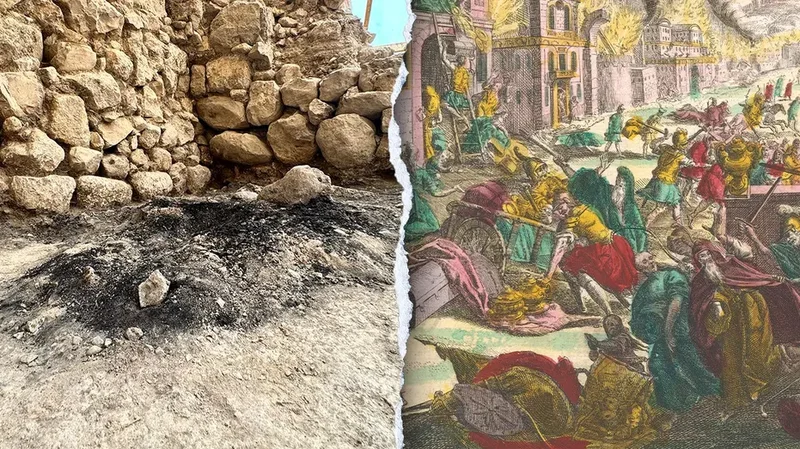
Archaeologists recently uncovered charred wooden beams in Jerusalem dating back roughly 2,600 years — likely remnants of the destruction of Solomon's Temple.
The discovery, which was found beneath a parking lot in the City of David, was announced by the Israel Antiquities Authority (IAA) in July.
IAA officials said the wood was found "within a building that collapsed by the intense fire at the time of the First Temple's destruction."
Their statement added, "What likely preserved the beams for approximately 2,600 years was plaster that melted from the building's walls, sealing the burnt wood beneath it."
Solomon's Temple, also called the First Temple, was destroyed by Babylonian King Nebuchadnezzar II in 586 B.C., after his army captured Jerusalem following a lengthy siege.
It was originally built by King Solomon in the 10th century B.C. as the permanent house for the Ark of the Covenant, according to Scripture.
The destruction of Solomon's Temple ushered in the Second Temple period, the era of Judaism in which Jesus lived and practiced.
Efrat Bocher, an excavation director, said that the beams "appear to have served as the roof of an inner courtyard."
"During the destruction, they collapsed onto the floor," Bocher said in a statement.
"We believe that the plaster cladding of the building's walls, melted by the fire, covered the charred wooden beams, and ultimately enabled their exceptional preservation."
The beams contain an unusually high number of growth rings, giving researchers the potential to narrow their dating to within about a decade.
"It is very rare in Israel to find wood with such a large number of growth rings," said Johanna Regev, a radiocarbon dating expert at IAA.
"Here, in the City of David, we found thick beams with many rings, offering significant research potential — with more growth rings enabling higher dating resolution," she noted, according to the IAA.
"This discovery makes you feel that you are witnessing the very moment of destruction, the moment when it all happened."
Regev added, "Until now, we could date finds within a range of hundreds of years. Now we can attain much greater precision, narrowing the dating range down to as little as 10 years."
Interestingly, experts believe Jerusalem's residents likely chose to preserve the memory of the destruction by leaving the ruins in place.
"Preserving memory is a human need, seeking to preserve what once existed," excavation director Yiftah Shalev said in a statement.
"Here we see it in its clearest form: a deliberate choice to leave ruins in place as a testament to the destruction and build the new layer over them."
In a statement, Bocher called the discovery "deeply moving."
It "makes you feel that you are witnessing the very moment of destruction, the moment when it all happened," she said.
Jerusalem, known as the Eternal City, is the setting of countless notable archaeological discoveries per year.
Last year, archaeologists in Jerusalem uncovered the longest and best-preserved section of the city's Hasmonean-era wall.
Earlier this year, excavators uncovered a "mysterious and impressive" ancient tunnel near Jerusalem's biblical-era Kingdom of Judah.