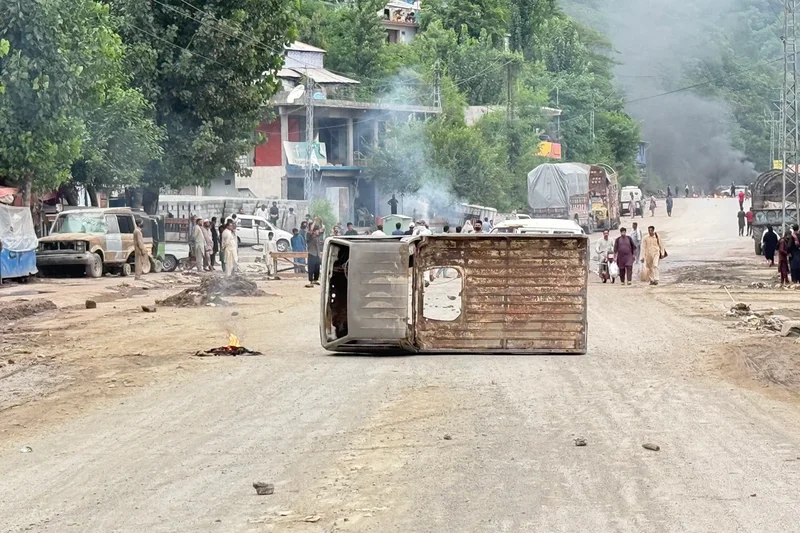
The protest group at the centre of the deadly unrest in Pakistan-administered Kashmir denied receiving any backing from India, challenging Islamabad to show evidence for such allegations and insisting its campaign was driven by demands for democratic rights rather than foreign interests.
In an interview with The Independent, SA Khan, a member of the advisory council of the Jammu Kashmir Joint Awami Action Committee, said his coalition of civil society and political organisations was “not answerable to India” and rejected accusations that it was financed or directed by Delhi.
Pakistan-administered Kashmir is in the grip of its worst political unrest in years, with deadly violence, an internet blackout, and allegations of police brutality overshadowing regional elections.
What began as demonstrations over soaring costs of electricity and essential commodities has evolved into a movement demanding political reforms, representative government, and greater accountability.
Since the protests started earlier this year, Islamabad has repeatedly alleged that the Awami Action Committee is backed by the rival country and has portrayed it as an armed group seeking to disrupt elections.
It even banned the organisation under anti-terrorism laws in June.
This month, federal information minister Attaullah Tarar claimed an investigation had uncovered an India-linked digital disinformation network that financed and amplified online campaigns associated with the banned group.
He said security agencies had arrested a digital-marketing service provider allegedly linked to India, while investigators found payments for promoting social media content in Pakistan had been routed through payment gateways originating in India.
Mr Khan dismissed the allegations. "JKJAAC categorically rejects the allegation that it is sponsored, financed or controlled by India," he told The Independent. "It is an indigenous civil-rights movement rooted in local concerns about electricity prices, essential commodities, governance, public resources, implementation of signed agreements and political representation."
His remarks came after India's foreign ministry dismissed the recent elections as a "complete farce".
Mr Khan argued that Delhi's statement did not establish a relationship between India and the movement as he called on the government to disclose “credible evidence of foreign financing”.
"A statement by the Indian government about the elections does not establish an organisational, financial or operational relationship with JKJAAC,” he said.
“Foreign governments may comment on events for their own political purposes. JKJAAC doesn’t control those statements and should not be judged by them."
A prolonged internet blackout and restrictions on journalists have hampered independent reporting from Pakistan-administered Kashmir amid allegations of brutalities committed by the security forces.
Pakistani authorities have insisted that security forces acted lawfully against violent protesters who attacked police and paramilitary personnel, releasing videos they said showed armed demonstrators and maintaining that several security officers were killed in the unrest.
Mr Khan, however, insisted that the movement remained committed to peaceful protest. "JKJAAC rejects the description of the movement as an armed organisation,” he added. “Its declared policy is peaceful and non-violent.”
Mr Khan also called for an independent examination of the government's evidence.
At the heart of the unrest is the demand to do away with the 12 seats reserved in the regional legislature for refugees from India-administered Kashmir.
The Awami Action Committee argues that legislators who do not live in the territory should not be in any position to determine who forms the government in the semi-autonomous region. “Our movement is centred on Haq-e-Hukmrani, the people's right to participate meaningfully in governing themselves, and Haq-e-Malkiat, the right to equitable ownership, management, and benefit from public resources," Mr Khan said.
Mr Khan insisted the movement was not seeking to strip refugees of political rights. "The issue is not whether refugees and displaced State Subjects deserve recognition and representation. They do," he said.
“The concern is that 12 members of the legislative assembly are elected from constituencies outside Azad Jammu Kashmir by voters living elsewhere in Pakistan, yet those members can determine who forms the government inside AJK."
Mr Khan said the movement was open to reforms that would preserve refugee representation while addressing disparities in voting power and territorial accountability.
"These aren’t abstract constitutional questions," he said. "They affect whether families can afford electricity and food, whether young people can find work, whether public money is spent on communities, whether residents have a meaningful voice in the institutions governing them."
According to documentation supplied to the Awami Action Committee by the Jammu Kashmir Human Rights Observatory, at least 88 civilians had been killed in the unrest until 3 August.
Amnesty International, however, said in a report published in late July that at least 40 people, including 34 civilians and six security personnel, had been killed.
"We cannot responsibly say that every deceased person was a formally registered JKJAAC supporter. Many were protesters, local residents, or participants in the wider civil-rights mobilisation," Mr Khan said.
He said there was still "no reliable" final injury count because of limited access to hospitals, families and official records.
Mr Khan said his group regretted every death, including of police and paramilitary personnel.
"JKJAAC regrets the deaths of civilians, police officers, and paramilitary personnel and extends sympathy to all affected families. No family should lose a relative because a political dispute was allowed to become violent."
At the same time, Mr Khan rejected attempts to hold the entire movement responsible for the deaths of security personnel, insisting on individual accountability rather than collective blame. "If evidence establishes that an individual committed a killing, that person should face lawful proceedings. JKJAAC will not defend criminal violence."
Mr Khan accused Pakistani authorities of treating the dispute primarily as a security issue rather than addressing its political and civil-rights dimensions.
"We regard this as a political and civil-rights dispute that has been securitised rather than resolved," he said.
Looking ahead, Mr Khan said the group saw two possible paths: further escalation or a return to negotiations.
"One is continued securitisation, further deaths, deeper public anger and long-term damage to trust," he said.
"The other is reciprocal de-escalation and serious negotiation."