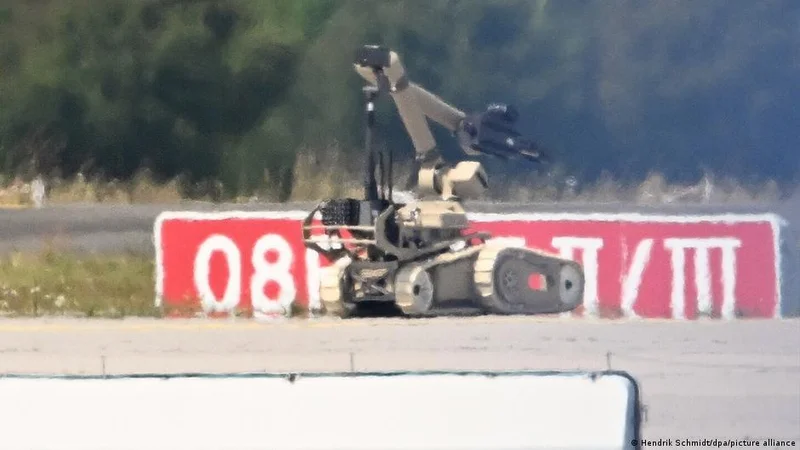
German airports have seen hundreds of drone alerts, but this incident eclipses them all: in the middle of the night on Wednesday, airport staff at the Leipzig/Halle Airport in the eastern state of Saxony found a drone rigged with explosives on the runway.
Federal police specialists were able to defuse it using a bomb disposal robot. The incident prompted the closure of part of one of Europe's largest cargo hubs.
German media reports say that experts from Saxony state police found the package to contain the highly explosive substances PETN and Semtex, which are also used in military applications. The detonator attached to the package had apparently broken off, which prevented an explosion.
A hybrid threat scenario
This unconfirmed information is particularly significant because the drone was found next to a plane of the Ukrainian state-owned carrier Antonov Airlines. The aircraft was reportedly loaded with military munitions that — according to reports — had just been transported from France to Leipzig and were slated for onward shipment to Ukraine.
Federal Interior Minister Alexander Dobrindt cut his vacation short to assess the situation firsthand at the scene. His initial assessment: "This represents a new threat scenario." At a press conference on Wednesday evening, he spoke only in general and vague terms regarding potential perpetrators and motives. However, Dobrindt did not rule out the possibility that "foreign powers" might be behind the incident — with the aim of unsettling Germany.
"All the speculation that is currently going on about the explosives, the construction, the question of the drone, the origin and, of course, who is behind it, is now part of the investigation," Dobrindt said.
In June, Dobrindt created a so-called Joint Center for Countering Hybrid Threats, as Germany has been on high alert for espionage, sabotage and disinformation, particularly from Russia.
Suspecting links to Russia
Leipzig/Halle Airport is high on the priority list regarding security and, like other airports, is being equipped with technology to detect and intercept drones. At the same time, however, Dobrindt acknowledged that this is an ongoing race: "When drones are designed to bypass technology, the technology itself must be continuously upgraded," he said.
After Frankfurt am Main, Leipzig/Halle Airport is Germany's largest cargo hub. Security experts say this makes it a potential target for state-sponsored attacks. Consequently, counter-terrorism expert Hans-Jakob Schindler considers it possible that Russia could be the mastermind behind the explosive-laden drone.
For the moment, the facts remain unknown. "But given the location — where we have already seen similar disruptions that could be traced back to Russia — that would be my initial assumption," Schindler told DW.
Hybrid attacks generally refer to covert operations that do not aim for direct confrontation, but are designed to create uncertainty. These can involve a combination of various tactics such as sabotage, economic pressure, or disinformation.
Earlier on Thursday, Saxony's Interior Minister Armin Schuster said that authorities are searching for parts of a possible second drone that collided with an aircraft at Leipzig/Halle airport.
Germany's anti-drone defense in the spotlight
Drone sightings have frequently disrupted German airports, canceling flights and causing headaches for travelers. Drones are also sometimes sighted over German military installations.
In December last year, Holger Münch, the head of Germany's Federal Criminal Police Office (BKA), said that over 1,000 suspicious drones had been registered in 2025, which he said represented a "significant situation of danger."
Leipzig had already been the site of an attempted attack in July 2024: a container belonging to the logistics company DHL caught fire in the airport's cargo area. The cause was a package sent from the Baltic states containing an incendiary device designed — according to investigators — to detonate mid-air. At the time, the Federal Public Prosecutor's Office suspected a targeted act of Russian sabotage.
This article was translated from German.