Labor groups oppose plea to stop wage hike B
MANILA, Philippines — Labor groups have asked a Navotas court to dismiss a petition filed by fishing companies seeking to stop the implementation of the P85 daily minimum wage increase in the National Capital Region (NCR).
The groups argued that wage-setting matters should remain under the jurisdiction of wage boards and labor agencies and not the courts.
They raised concern over the impact of an order issued by the Regional Trial Court (RTC) Branch 152 in Pasig, which halted the implementation of the first tranche of the P85 daily wage increase.
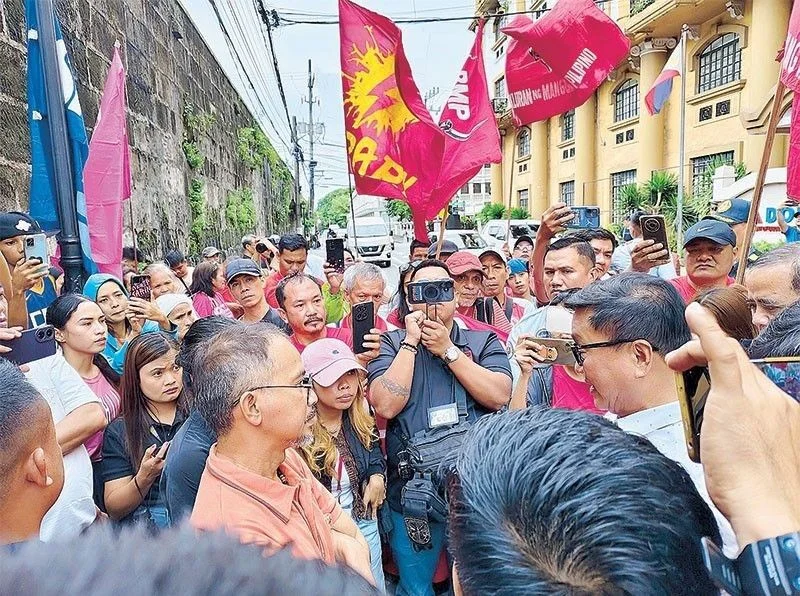
The Federation of Free Workers (FFW) and leaders of the NAGKAISA Labor Coalition yesterday filed an Urgent Motion for Leave to Intervene with an attached Opposition-in-Intervention before the RTC Branch 287 in Navotas in connection with the case challenging NCR Wage Order No. 27.
FFW president Sonny Matula personally went to the Navotas Hall of Justice to submit printed copies of the electronically filed pleading. However, court personnel were unavailable due to the suspension of government work brought by Typhoon Maymay.
But the labor leaders proceeded with the filing, saying the case would directly affect millions of workers who are expected to benefit from the wage increase.
“This case is not merely about legal procedure. It is about protecting the wages and livelihood of millions of workers whose voices deserve to be heard before any court decides their fate,” Matula said.
The intervention was filed on behalf of 13 labor organizations, with Matula and other lawyers from NAGKAISA preparing the pleading to challenge the petition seeking to overturn the wage order.
The labor groups argued that they are real parties in interest because several of their organizations participated in the proceedings before the Regional Tripartite Wages and Productivity Board (NWPC) -NCR, which resulted in the issuance of NCR Wage Order No. 27.
They said they were not included as parties in the petition despite having interests that could be affected by the court’s decision.
The groups maintained that issues involving alleged wage distortion should not be resolved by a regional trial court, citing Article 124 of the Labor Code, which provides mechanisms through grievance machinery, voluntary arbitration, negotiations, conciliation before the National Conciliation and Mediation Board, and, when necessary, compulsory arbitration before the National Labor Relations Commission.
NAGKAISA also argued that the petition against the wage order attempts to bypass the wage-fixing system established under the Labor Code and pointed to Article 126, which prohibits courts from issuing temporary restraining orders or injunctions against proceedings before the NWPC and regional wage boards.
“A court without jurisdiction has only one lawful authority – to dismiss the petition,” Matula said.
Matula said workers had expected to receive the increase after it was announced by President Marcos and then labor secretary Bienvenido Laguesma, but the TRO delayed the release of the initial P60 wage adjustment.
“When the President and the labor secretary announced the P85 wage hike, workers hoped that they would soon receive the increase. However, due to the TRO, the initial P60 tranche has remained unimplemented,” Matula said.
He added that the suspension affected not only the workers’ income but also the implementation of the wage policy issued by the executive branch.
The labor coalition acknowledged the role of the judiciary in upholding the rule of law but stressed that wage determination is a specialized function assigned by Congress to tripartite wage boards, with review authority lodged with the NWPC.
The groups urged the courts to respect the jurisdiction provided under the Labor Code and uphold constitutional protections for labor and social justice.
- Latest
- Trending