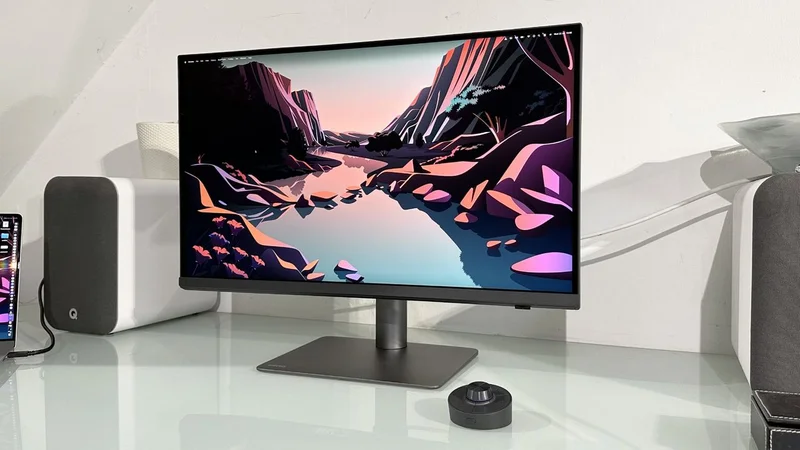
TechRadar Verdict
The BenQ Creative Pro PD2732U has a super-strong feature set for creative pros at a great price, including good colour coverage, support for multiple digital workflows and excellent connectivity. For general computing tasks, however, there are better value and more suitable 4K options.
Pros
- +Fantastic creator-centric feature set
- +Excellent connectivity
- +Nice build quality
Cons
- -Not a true HDR display
- -Limited SDR brightness
- -There are cheaper 4K options
Why you can trust TechRadar
If the clue is in the name, it's not hard to clock who the BenQ Creative Pro PD2732U is aimed at. This is a very well specified 27-inch 4K IPS monitor that's been carefully optimised for creative workflows while hitting an accessible price point.
For sure, there are still much cheaper 27-inch 4K monitors. But not with the suite of connectivity and colour management features offered here.
On the connectivity side, that includes Thunderbolt 4, an integrated KVM switch and display daisy chaining support. If anything, however, the features for creative workflows are even more comprehensive.
That starts with excellent colour coverage given the price point and extends to factory calibration and hardware calibration support, Pantone Validation, Calman certification, specific support for MacOS devices and more. There are also some neat extras, including a wireless control puck that makes it as quick and easy as possible to switch between colour modes and inputs.
The one obvious feature omission is true HDR capability. There is HDR10 support. But without local dimming hardware, the actual HDR performance is very limited. But then this monitor is not intended to replace an HDR reference monitor, which is a very different market with monitors costing upwards of 10 times the price.
On paper, then, the BenQ Creative Pro PD2732U looks set to take its place as the affordable display of choice for creative pros among the best photo editing monitors we've tested. But does it actually deliver?
BenQ Creative Pro PD2732U: Design and features
- Slick design
- Excellent connectivity
- Creator-centric feature set
Panel size: 27-inch
Panel type: IPS
Resolution: 3,840 x 2,160
Brightness: 400 nits
Contrast: 1,000:1 (static)
Pixel response: 5ms
Refresh rate: 60Hz
Color coverage: 99% DCI-P3, 99% Adobe RGB
HDR: HDR10
VESA: 100mm x 100mm
Connectivity: HDMI 2.0 x1, DisplayPort 1.4 x1, Thunderbolt 4 x2 with 90W PD and daisy chaining, USB hub with USB-C x1 and USB-A x3
The BenQ Creative Pro PD2732U looks familiar and that's no bad thing. It sports BenQ's premium design ethic of the last few years and it remains a cut above much of the competition in terms of both visual appeal and overall build quality.
The part metal construction and gun metal colorway is certainly more appealing than the often creaky feeling and anonymous black plastic of much of the monitor market, that's for sure. OK, Apple's displays including the latest Studio Display XDR, feel quite a bit better built still. But then they're much more expensive, too.
If styling is ultimately a subjective call, what can't be objectively denied is the BenQ Creative Pro PD2732U's excellent all-round feature set that's been fully optimised for creative professionals.
First up, there's good color coverage, including 99% of both DCI-P3 and Adobe RGB. Those figures are better than you'll find on cheaper 4K IPS monitors, which tend to be around the 95% to 97% range. The PD2732U also comes factory calibrated with sub-2 DeltaE across the board and further supports hardware calibration.
What's more, it's Pantone Validated, Pantone SkinTone Validated, and has Calman Verified certification. When you factor in the wide Adobe RGB coverage, this monitor is particularly well suited to digital-to-print workflows and photography, including SDR color grading.
It's also well specified for SDR video workflows, though with a peak brightness of 400 nits and no local dimming, it's far less optimised for HDR content, albeit with HDR10 and HLG support, it can at least accept an HDR signal.
Connectivity is another major part of the PD2732U's appeal, starting with a main Thunderbolt 4 interface and 90 W of power delivery. That's supported by a Thunderbolt out port, allowing for display daisy chaining and dual-monitor setups via a single cable. Incidentally, all of the primary connectors hook up perpendicularly on the rear as opposed to up from the bottom, which is generally a plus in terms of ease of use and access.
There's also Smart KVM, allowing you to use a single keyboard and mouse with two computing devices, handy if you regularly switch between, say, a Mac and PC. Speaking of Apple Macs, BenQ has included its M-Book color space mode, which BenQ says, "minimises the visual differences between the monitor and the connected MacBook series product."
Exactly how it differs from the P3 mode which BenQ also includes and aligns with the default P3 operation of MacOS isn't clear. But the results are good, all the same. With M-Book mode enabled, this display is an excellent visual match for MacBook displays.
Rounding out the main features both physically and figuratively is the BenQ Hotkey Puck. It's basically a wireless controller that simplifies settings access via shortcut functionality. It offers three customisable keys for quick access to Color Mode, Input, KVM, or app launch. It also has a rotary dial for precise control over brightness, contrast, and volume.
BenQ Creative Pro PD2732U: Performance
- Good color coverage
- Nicely calibrated
- Limited SDR brightness
If you want a really succinct summary of the BenQ Creative Pro PD2732U's performance, what you're looking at is a 27-inch 4K IPS monitor with some added color coverage and capability.
Out of the box, it's very nicely calibrated, both in sRGB mode on PC or in M-Book mode with a Mac. In both cases, color rendering is accurate and pleasing. The one potential snag is brightness in SDR mode.
For most serious professional SDR content creation workflows, this is not going to be a problem. You'll likely be targeting a brightness level well below 200 nits, which this display will easily achieve. But it won't do the full 400 nits in any of its SDR modes.
If anything, what the capped SDR brightness does is underline that this monitor isn't an ideal choice for generic computing remits, where you might want a bit more day-to-day pop. You can pay less and get more in that regard from what you might call a standard 27-inch 4K monitor.
That said, you can see the full capability, in brightness terms, of the PD2732U in HDR mode. Indeed, if you then crank up the brightness of SDR content in either the MacOS or Windows display settings, the result is actually nicely calibrated SDR colors and plenty of visual punch. But that's ultimately something of an aside given that this monitor lacks local dimming and has very limited actual HDR capability.
It's also worth noting that the refresh rate is limited to 60Hz. Again, for the content creation remit, this is not a technical limitation. It's just that if you are used to 120Hz-plus displays, 60Hz doesn't feel terribly slick or responsive. It's a day-to-day feel issue rather than being relevant to the vast majority of content workflows.
Of course, as a 27-inch 4K monitor, you also get decent pixel density and thus good image detail and crisp text rendering. The pixel density of around 160DPI isn't up to full Apple Retina display standards, which would require something above 200DPI and a native resolution of 5K on this display size. But it's still pretty sharp.
BenQ Creative Pro PD2732U: Final verdict
The BenQ Creative Pro PD2732U is either very sharply priced or not great value depending on what you're looking for. As a general computing display it's both pretty expensive and slightly flawed.
You can get far cheaper 27-inch 4K IPS monitors than this. Indeed, you can have one with 144Hz refresh for under half the price. What you won't get for less money, or arguably even the same price as the PD2732U's $699 / £649 asking, is anything like the same feature set for content creation.
The combination of excellent color coverage, various validation standards, and good factory calibration makes this an excellent choice for a sensible-money monitor for SDR content creation of pretty much any kind.
Sure, it's arguably still more of a prosumer display than, say, a true professional class grading monitor. But even in a really demanding professional context, it wouldn't be at all shabby, which is impressive for the price.
Then factor in some neat touches, like the wireless control puck, and excellent connectivity and you have a recipe for one of the most compelling content creation monitors currently available at an affordable price point. That's very much the remit BenQ was aiming for and fair to say the company has nailed it.
For more displays, we've tested the best business monitors and the best monitors for video editing*. *
Technology and cars. Increasingly the twain shall meet. Which is handy, because Jeremy (Twitter) is addicted to both. Long-time tech journalist, former editor of iCar magazine and incumbent car guru for T3 magazine, Jeremy reckons in-car technology is about to go thermonuclear. No, not exploding cars. That would be silly. And dangerous. But rather an explosive period of unprecedented innovation. Enjoy the ride.