Writer and illustrator Osamu Tezuka helped establish many of the tropes of shōjo manga with his 1953 series Princess Knight, where a cross-dressing princess protects the medieval kingdom of Silverland. Netflix’s very loose anime adaptation, The Ribbon Hero, won’t be nearly so influential. The feature film debut from Yûki Igarashi, who previously directed the Star Wars: Visions episode “Lop & Ocho,” is dull and incoherent, so focused on paying homage to Tezuka that it ignores what actually made his work remarkable.
Tezuka based his androgynous, swashbuckling princess Sapphire on the all-female Takarazuka Revue musical theater group. Igarashi nods to that inspiration by giving his film a theatrical framing, with the image of curtains parting on a stage breaking the story into many acts. There’s even a montage of the adventures Sapphire (Saaya Kadokura) has in her adopted home of Goldland that transitions into an in-world puppet show. The gender-bending part of her story has been cut entirely, aside from some confusing imagery of two hearts racing around – a reference to the source material where Sapphire’s power comes from having both a male and a female heart.
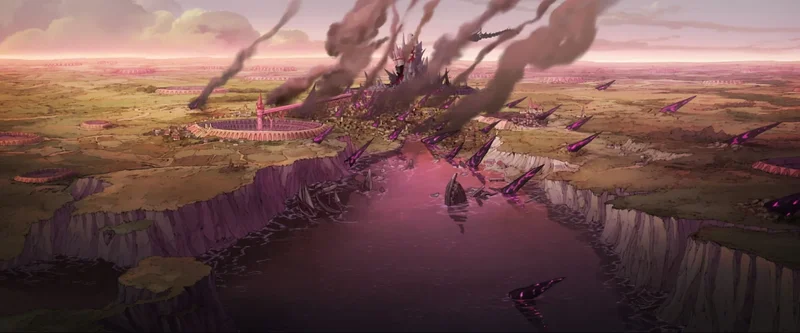
Some vague flashbacks show that Sapphire’s mother made her train hard to protect herself in a harsh world where monsters called Nergul seemingly attack at random, laying waste to entire kingdoms. That preparation proved useless. A Nergul destroys Silverland and kills everyone except Sapphire and Zirco (Mayumi Shintani), an old woman and engineering whiz who becomes Sapphire’s guardian. They wander around for seven years begging for food despite the fact that Zirco can make bionic arms and swords that shoot lasers.
The kind but somehow entirely friendless baker Pine (Seiran Kobayashi) takes pity on the two women and gets them a job mining crystals. When the mine is attacked by another Nergul, Sapphire falls in a pool of water and crystals. That should be deadly, but like a Marvel superhero, she instead comes out of the experience with a bunch of inexplicable powers tied to her giant hair ribbon, allowing her to undergo a magical girl transformation with a new outfit and laser sword. Sometimes she also turns into a swan.
Goldland’s theocracy prohibits fighting back against the Nergul, fearing it will anger their mysterious boss, the King of Ash. Velvet (Koki Uchiyama), the chief enforcer for Goldland’s pope, wants to change things and decides to team up with Sapphire. An enormous amount of dull exposition about the Nergul and how they can be stopped or appeased is delivered in monologues with entirely static backdrops showing characters looking out at the landscape or just sitting in Goldland’s palace. While Sapphire is entirely femme, Velvet is female presenting but addressed as and voiced by a man. This is never commented on. Apparently, the immigrant-hating theocracy that raises orphans to sacrifice to monsters has very progressive gender politics.
Outline and Twin Engine play with a lot of different animation styles, but their ambitions just make the film feel incoherent. Most of the art has a hand-drawn quality to complement the Disney fairy tale-style setting. The many repetitive flashbacks to Sapphire’s traumatic childhood are done in black and white or sepia tones to give them the feel of old video. The Nergul are rendered with jagged CG that makes them look alien, but also very ugly. There are exaggerated anime freakouts, a 1920s-style sequence involving angels, and a live action segment tying Sapphire’s power to Tezuka’s manga. It feels like there’s meant to be a meta message here about theater, religion, and inspiring art, but it’s lost in the trite dialogue and dull action sequences.
The most terrifying thing about the Nergul is their aura of fungal spores, which kill and rot everything around them. But after the first two fights, that element – and how special it is that Sapphire is somehow immune to it – is seemingly forgotten so that the film can have all of Sapphire’s bland allies pitch in. The tone shifts as abruptly as the visuals. One moment a demonic monster is devouring hearts and souls as part of a religious ritual; the next Sapphire’s buddies are engaged in a slapstick battle to get her magical ribbon back.
Princess Knight was both controversial and groundbreaking. It was always going to be hard to live up to the source material, but The Ribbon Hero fails on almost every level. It’s pretentious and uninspired, a collection of tropes and confusing cosmology with no compelling characters or memorable fights. If you’re curious about Tezuka’s work, you’d be far better off skipping this adaptation and just watching some of the many anime he inspired like Sailor Moon, Revolutionary Girl Utena, or Magic Knight Rayearth.
The Ribbon Hero releases on Netflix on Aug. 8.
Name That
Summer 2026 Movie
Twenty movies. Four choices each. How well do you know summer at the cinema?