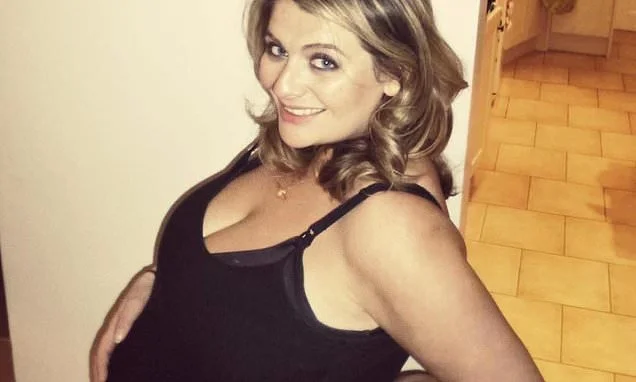
For years, I’ve had to sidestep one of the most annoying questions known to womankind: when will you be giving your child a sibling?
I find it disturbing on so many levels. Firstly, there’s the frankly bizarre assumption that my daughter deserves a brother or a sister, in a similar way to, say, a bicycle, and that her life will be incomplete without one.
Secondly, what makes you think my ovaries are capable of such a feat? Thirdly, and perhaps most importantly, has it ever occurred to you that I might not want to go through the horror of pregnancy again?
I mention it because this week, the chief executive of the Maternal Mental Health Alliance, Nikki Wilson, shared that her organisation had seen a recent rise in perinatal anxiety, from one in five women to one in four.
And last month, a study revealed that the trauma of labour is thought to be one of the main reasons for the declining birth rate in the UK. Research by the Birth Trauma Association found 44 per cent of women with birth trauma choose not to have any more children, with a further 33 per cent saying it caused them to delay having another baby.
One woman explained: ‘I was so scared of getting pregnant that sex was almost non-existent and me and my long-term partner of 15 years split up after a few years.’
Reading this doesn’t give me any pleasure, but it does bring me a small amount of comfort – since the main reason I stopped at one child was because I couldn’t bear the idea of having to go through pregnancy and birth ever again.
My labour lasted three days and ended up with me being wheeled into theatre for an emergency C-section. It was pretty unpleasant, but it was a walk in the park compared to pregnancy, which – far from being a blissful whirl of bizarre cravings and trips to John Lewis’s baby department – was one of the most distressing periods of my life (not to mention my husband’s).
The main reason I stopped at one child was because I couldn’t bear the idea of having to go through pregnancy and birth ever again, writes Bryony Gordon
As a woman with a history of mental illness, I of course knew about postnatal depression. So when I saw the two lines on my pregnancy test, I made a note to be vigilant for it. But that was almost nine months away, and for the time being I just wanted to put my feet up and enjoy the peace and quiet as I settled into my new sober life as a mum-to-be.
It was a shock, then, when within days of discovering our joyous news I had turned into a raging bull, furious at everything and prone to the kind of temper tantrums you might expect from a toddler, but not a 32-year-old.
One night my husband cooked a spaghetti bolognese that I deemed too watery, and I stormed out of the flat for three hours, only coming back when I’d eaten a share box of chicken nuggets from McDonald’s.
Soon, the Obsessive Compulsive Disorder I’d experienced on and off since childhood had reared its monstrous head. I was terrified for the safety of my unborn child, and refused to go to my mum’s because she had a cat (they can carry a virus called toxoplasmosis, which can cause miscarriage and birth defects, although this was vanishingly rare).
I had to say a series of phrases perfectly each morning to make sure the baby was safe for the rest of the day, or else I couldn’t leave the flat. Endless intrusive thoughts began flashing through my brain repeatedly: I tormented myself with the idea that I might have drunkenly blacked out and had sex with a stranger, and the baby wasn’t my husband’s.
I slept rarely, and sobbed uncontrollably. It was my mother who made me call the GP, and this was how I ended up being put under the care of maternal mental health services, in particular a department that dealt with women who had ‘severe and complex mental illness’.
It was here that a kind psychiatric nurse told me I had perinatal depression, which was likely caused by the shift in hormones from pregnancy.
I was put on antidepressants and a watchlist, to ensure I wasn’t a danger to myself or my baby. I had to see a therapist every two weeks, and when my daughter was born they would need to assess me in hospital to check it was safe for me to take her home.
Last month, a study revealed that the trauma of labour is thought to be one of the main reasons for the declining birth rate in the UK
It was a dreadful time. I could barely care for myself, let alone contemplate the prospect of looking after a newborn baby.
The most astonishing thing was that the moment I had my daughter, the depression seemed to vanish into thin air. Some maternal instinct kicked in, or maybe it was more to do with the progesterone produced during pregnancy leaving my body. Later, I learnt I am one of the 10 to 20 per cent of women who are intolerant to the hormone, and my brain goes to funny places when it builds up in my body.
I wish it hadn’t taken until perimenopause for a doctor to diagnose it, because perhaps my life might have been different and my experiences with OCD might’ve been more manageable. Maybe I’d even have gone on to have a couple of those siblings people are always asking me about.
So often, women are blamed for the falling birthrate, but it’s the system that refuses to acknowledge the complexities of pregnancy, birth and childcare that we should focus on.
It’s about time we listened to mothers, instead of endlessly questioning them.
Women were always the REAL stars of Ted Lasso
Hooray, Ted Lasso is back! And thankfully it’s for a better reason than giving Justin Bieber a pep talk during that utterly woeful World Cup final half-time show.
Yep, Jason Sudeikis has returned for a fourth season of the Apple TV series, this time to help AFC Richmond’s new women’s team. He’s assisted by coach Alice, played by the peerless Tanya Reynolds (definitely one to watch), and of course there’ll be plenty of the brilliant Hannah Waddingham and Juno Temple.
For a show that’s – until now – focused on the travails of the very blokey men’s team, it’s always been the women who were the stars.
Hannah Waddingham, right, and Juno Temple will be reprising their roles in Ted Lasso for the fourth season
Bryony enjoyed The Odyssey but had one problem with it... how smooth Matt Damon's head was as lead character Odysseus
Matt's far too smooth to play Odysseus
I took myself to the cinema to see The Odyssey this week, if only so I could join in polite society again; if you don’t have a hot take on the Christopher Nolan movie, is it even worth starting a conversation with someone right now?
Anyway, I enjoyed the film but had one problem – the remarkably smooth forehead of Matt Damon (Odysseus).
I don’t know about you, but if I’d been on a boat for ten years, fighting monsters and harsh weather, I’d definitely be sporting a few more wrinkles.
Reform UK’s Lee Anderson has complained after Andy Burnham went on holiday two weeks after becoming Prime Minister: ‘He’s bunked off for a jolly abroad. This isn’t a PM that’s serious about leading.’
Actually, I’d say the opposite is true, as all real leaders know you can’t pour from an empty cup. Let Burnham have a break before the return of Parliament – or he’ll burn out so fast he won’t be able to run a bath, let alone the country.
Bryony was astonished when her husband put bananas in the fridge
No bananas in MY fridge
I asked my husband to unpack our Ocado shop and was floored when he put the bananas in the fridge. Did I know him at all?
Now a survey has found three-quarters of us get confused about what needs to be refrigerated, with almost half of adults admitting they’ve been told off by their mothers over it. It’s said crisps and nuts can benefit from the fridge, but tomatoes and watermelons should be left out.
I’ve always said if you want to learn about a person, it’s not their bedroom you should go nosing around in, but their fridge.
£7 for a 99? Not cool!
Ice cream vendors are coming under fire after some were found charging almost £7 for a classic 99. They’re blaming the ‘drip-drip’ of higher costs and pricey ingredients, but I imagine the demand during record-breaking heat also has something to do with it.
Come on guys, this behaviour isn’t cool!