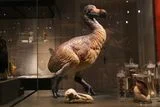
The extinct dodo gets a bad rap as a scatterbrained bird, but it’s not nearly as simple a creature as everyone might think. While we don’t know everything that was going on inside the bird’s brain, their skulls can show us what its life may have been like before it went extinct in the late 17th century.
A new study published in the Zoological Journal of the Linnean Society has gained insight into how the dodo interacted with its environment by examining the imprints left on dodo skulls by their brains. These lasting clues, which researchers compared with the brains of other birds, suggest that dodos may have been active during dusk and dawn and enjoyed an enhanced sense of smell, reframing the narrative around this often slandered bird.
"Studying extinct animals is a bit like detective work. Although the dodo's brain disappeared centuries ago, it left an imprint on the inside of the skull. By digitally reconstructing those spaces and comparing them with the brains of living birds, we can begin to piece together how the dodo sensed, behaved, and interacted with the world around it," said study co-author Christy Anna Hipsley, a professor at the Natural History Museum Denmark, in a statement.
A Lack of Dodo Knowledge
Dodos have long been portrayed as dopey, but why? To understand this cliché, we need to go back to the 17th century when humans encountered the dodo on its home island of Mauritius.
The first recorded mention of the dodo comes from Dutch sailors in 1598 (although Portuguese sailors likely saw them nearly a century earlier). These sailors were more interested in hunting the bird than studying it, however. The dodo would soon disappear in 1662, according to the Natural History Museum in London, not just from hunting, but also because of animals that the sailors brought with them. Those animals included dogs, cats, pigs, and rats, which killed the dodos and likely ate their eggs. As such, the information about dodos’ behavior at the time of their disappearance was scarce.
What stood out most about the bird was that it wasn’t so scared of humans, since it had no natural mammalian predators. This is why they’ve been characterized as absent-minded in the years since their extinction. Meanwhile, the closest relative of the dodo, the Rodrigues solitaire, didn’t get stuck with the same label. That’s because the bird, which went extinct around 1761 from the neighboring island of Rodrigues, was observed in much greater detail.
Clues Left on the Skull
In the new study, researchers took a closer look at dodos' skulls to show how they’re more complex than we’ve been led to believe. One of the skulls, housed in the National History Museum Denmark in Copenhagen, is just one of only two complete dodo skulls known to exist anywhere in the world.
Researchers examined this complete skull and two other dodo specimens with CT scans, producing a digital reconstruction of the cavity that was once occupied by the brain. They then compared the brain’s imprint on the skull with the brains of pigeons and doves, the dodo's closest living relatives.
Redefining Dodos' Intelligence
By reconstructing several components of the dodo's brain, the researchers tracked down anatomical features that pointed to several notable traits; one is that the dodo likely extended its activity into lower-light periods, such as dusk and dawn. It also may have had a keen sense of smell that helped it survive during harsh conditions and reduced food availability on Mauritius. Lastly, the dodo’s beak could easily process information about the things it touched, as indicated by nerves that would’ve carried sensory information from the face and bill to the brain.
The researchers note that while these anatomical features alone can’t confirm how the dodo lived, they support the idea that the bird didn’t have diminished cognitive abilities compared with living pigeons and doves.
"The dodo's skull is unlike that of any living bird, which makes it both fascinating and difficult to interpret. By comparing digital reconstructions of the world's only two complete dodo skulls, we now have a much stronger foundation for identifying which features are truly characteristic of the species and what they can tell us about how the dodo lived," said Hipsley.
Article Sources
Our writers at Discovermagazine.com use peer-reviewed studies and high-quality sources for our articles, and our editors review for scientific accuracy and editorial standards. Review the sources used below for this article:
- This article references information from a study published in Zoological Journal of the Linnean Society:The sensory world of the Dodo and Solitaire revealed by endocast and skull anatomy
- This article references information from the Natural History Museum: The dodo bird: The real facts about this icon of extinction