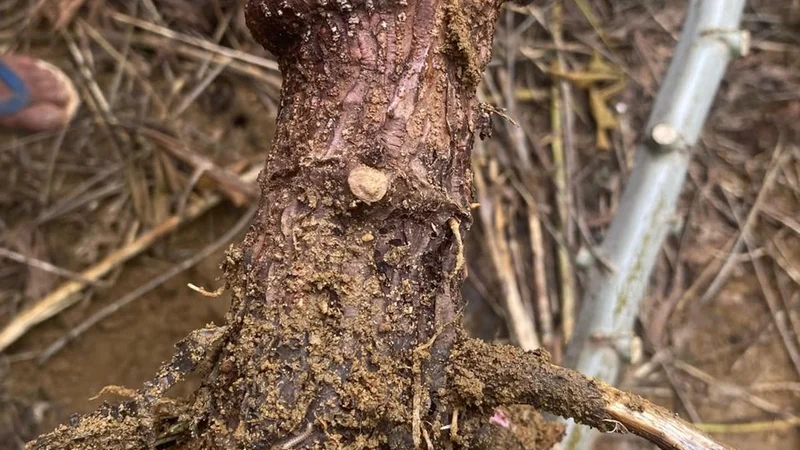
For cassava (tapioca) farmers in Kerala, the cassava stem and root rot (CSRR) disease had emerged as a major concern in 2020 after the destructive floods of 2018. Now, researchers at the ICAR-Central Tuber Crops Research Institute (CTCRI), Thiruvananthapuram, and the ICAR-Indian Agricultural Research Institute (IARI), New Delhi, may have found a solution.
The IARI and CTCRI researchers say they have identified a “promising” mycobiome-based strategy for managing CSRR. The disease has resulted in significant crop loss, especially in the wetland regions.
CSRR is caused by the pathogen Fusarium falciforme and emerges when beneficial fungi are lost and soil health declines. The researchers suggest conservation and restoration of the core mycobiome through improved soil health management and application of beneficial microbes as an integrated disease management strategy in flood-prone areas. Such an approach, they say, can also reduce dependence on chemical fungicides while improving the sustainability and climate resilience of cassava production.
Tubers decay
‘Mycobiome’ refers to the fungal part of the microbiome, the community of microorganisms such as bacteria, fungi and viruses. The disease affects the tuberous roots. The infection which begins at the base of the stem just below the soil progresses upwards and downwards. Once it spreads, the tubers decay.
Earlier, CTCRI had established that a Fusarium solani species complex causes the disease.
A research paper on the latest findings - ‘Integrated metabarcoding and culturomics reveal the rot-suppressive rhizoplane mycobiome of cassava across contrasting agroecological habitats’ - was published in Frontiers in Plant Science this month. The paper has been authored by Divya S., Bag T.K., Jeeva M.L., Makeshkumar T., Ambika Manirajan B., Chouhan V., Veena S.S. and Kumar A.
The paper notes that CSRR has 'intensified' in Kerala’s wetland ecosystems. “The disease has been observed across Kerala, especially in wetlands under poorly drained conditions,” Ms. Divya, a PhD scholar at the Graduate School, IARI, told The Hindu.
In two location
The study was carried out in two locations in Thiruvananthapuram district—Venganoor and Neyyattinkara—as part of Ms. Divya’s doctoral research at IARI. Ms. Divya, a faculty member at Kerala Agricultural University, has undertaken this research at ICAR-CTCRI and ICAR-IARI
Further field evaluation and optimisation of application strategies are needed before the disease management methodology can be recommended for use by farmers, the researchers say.
A major tropical tuber crop, cassava (Manihot esculenta) ranks fifth among global food crops after maize, rice, wheat and potato. In India, it is primarily grown in Kerala and Tamil Nadu. Together, the two States account for about 1.56 lakh hectares and 59.33 lakh tonnes of production, with Kerala contributing nearly 33.1% of the national output.
Published - August 07, 2026 05:27 pm IST