The Turkish Parliament's Justice Committee was set to begin discussions on the draft of the Law on Strengthening National Solidarity and Social Integration, landmark legislation aimed at accelerating the disarmament of the PKK terrorist group.
The discussions on Friday were expected to conclude within hours, with Parliament's General Assembly set to debate and likely approve the bill on Sunday. The law will pave the way for the return of PKK members from abroad to surrender to the authorities, while the execution of their sentences is expected to be deferred if they are not found to have been involved in acts of terrorism.
PKK members seeking deferred sentences will be allowed to apply after Turkish authorities officially announce that the terrorist group has fully laid down its arms. Those who do not apply will remain subject to judicial proceedings and the execution of their sentences.
PKK members in Iraq will apply through Turkish diplomatic missions in that country, according to a report by the Sabah newspaper. Most PKK members are currently based in the Qandil Mountains in northern Iraq. In Syria, another stronghold of the terrorist group, PKK members will also be able to surrender through Turkish diplomatic missions. Those residing in Europe will similarly be processed through Turkish embassies and consulates across the continent.
The Ministries of Foreign Affairs and National Defense, together with the National Intelligence Organization (MIT), will coordinate the process. Returnees will first be required to appear before a court and, if the court so rules, they will be released with the execution of their sentences deferred.
A monitoring board will establish a special monitoring system for PKK members released under deferred sentences or returning from abroad. The Interior Ministry and MIT will monitor these individuals. If any links to criminal organizations or signs of renewed terrorist activity are detected, authorities will intervene immediately.
The law will not apply to approximately 250 founding members of the terrorist organization, including Fehman Hüseyin, Murat Karayılan, Cemil Bayık, Duran Kalkan and Bese Hozat. It is reported that, together with those convicted of murder, the total number of individuals excluded from the law is close to 1,000.
MIT has compiled a complete inventory of all weapons and equipment in the terrorist organization's possession. Authorities will require the surrender not only of pistols and rifles, but also of drones, satellite communication systems and paramotors used by the PKK.
Commenting on the legislation and the anticipated returns, Justice Minister Akın Gürlek assured the public on Friday that the law would not be implemented until all conditions required for the PKK's dissolution had been met. Speaking to journalists in the eastern province of Iğdır, Gürlek underlined that the law would take effect only after the National Security Council (MGK), chaired by the president, officially declared that the PKK had been completely dismantled.
"Individuals who participated in armed killings, whether they are abroad or currently in prison, will under no circumstances be eligible to benefit from the regulation," Gürlek stressed.
"People want terrorism to end once and for all. According to recent surveys, 91% of our citizens say they support the initiative," he added.
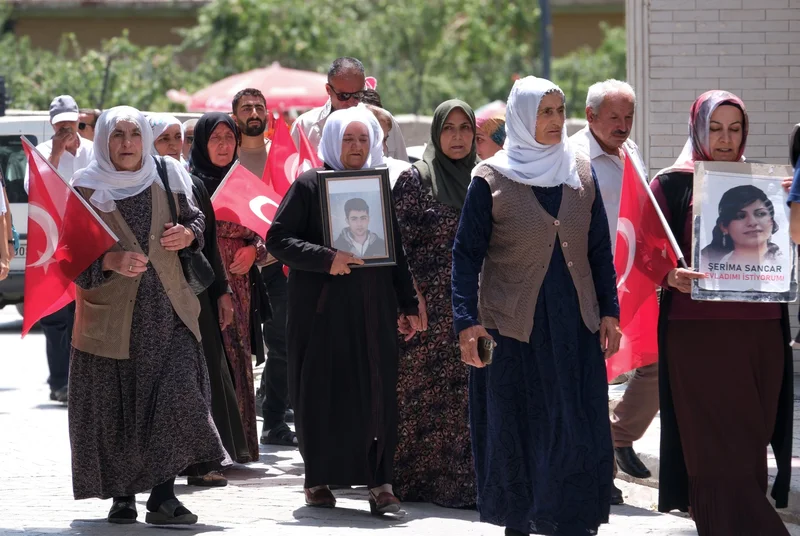
The anticipated returns are likely to be welcomed most by the Diyarbakır Mothers. The group, composed primarily of women, has staged a sit-in in the southeastern province of Diyarbakır for years, urging the PKK to release their sons and daughters. They say their children were minors or teenagers when they were lured into joining the terrorist group.
Necibe Çiftçi, one of about 80 parents participating in the sit-in, told the Sabah newspaper on Thursday that the families had endured years of hardship and that some had already been reunited with their children. Çiftçi is awaiting the return of her son, Roşat, who was 16 when he was lured into joining the PKK in 2015. Two years later, Roşat's brother Sami was killed by the terrorist group after refusing to join it.
Çiftçi, from the southeastern town of Şemdinli, said the state had "proved its greatness" by helping families reunite with their children. "May Allah bless it. I am now waiting for the phone call from my son telling me that he is coming home," she told Sabah.
Mevlüde Üçdağ, who is also waiting to be reunited with her son Ramazan, echoed the sentiment. She said the law would bring an end to the families' long ordeal and that everyone was "waiting for the doorbell to ring" to welcome their children home.