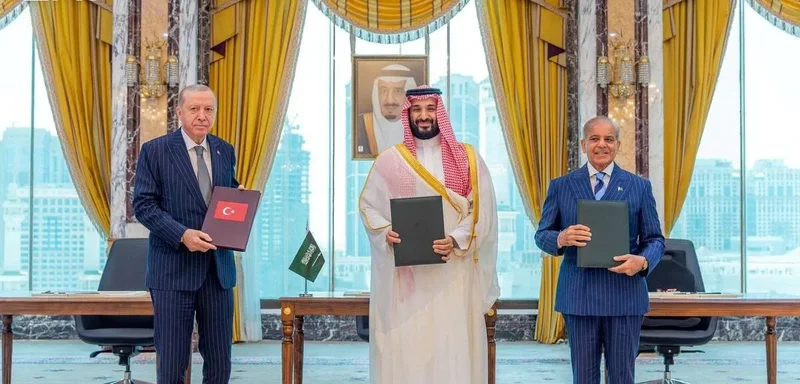
Saudi Arabia, Pakistan and Turkiye on Friday signed a joint defence agreement to deepen security cooperation amid heightened military tensions and conflicts in the Middle East.
The agreement, identified as the Mecca Joint Defence Agreement, was initiated to strengthen deterrence against attacks on any of the signatories.
It stipulates that an armed attack against any of the three would be regarded as an attack on all, they said in a joint statement.
According to a joint statement by Pakistan’s Ministry of Foreign Affairs and Saudi state media on Friday, the agreement was signed by the three Sunni Muslim-majority states in Mecca, the holiest site in Islam.
| | |
|---|
It was signed by Saudi Crown Prince Mohammed bin Salman, Turkish President Recep Tayyip Erdogan and Pakistan’s Prime Minister Shehbaz Sharif.
“The agreement is intended to strengthen collective deterrence against any act of aggression, and stipulates that any armed attack against any one of the three states shall be regarded as an attack against them all.
“It further provides for the enhancement of all aspects of defence cooperation among the three States,” the statement read.
The Middle East war between the US and Iran significantly impacted Gulf states, which have been the primary targets of Iranian retaliatory strikes since the war began in February. PREMIUM TIMES reported attacks on Saudi Arabia’s critical infrastructure and oil facilities earlier in the year.
A new front of the war opened in July between Riyadh and Yemen’s rebel group, the Houthis. This paper reported that Saudi Arabia’s national oil company shut down its Jazan oil refinery after a Houthi missile attack damaged key facilities last week. In response to the months-long war that continues to threaten its economy, Saudi Arabia has been seeking to diversify its defence partnerships.
Although Turkiye and Pakistan have not been subjected to direct attacks, both are eager to calm regional conflicts that threaten their security and economies.
Meanwhile, Saudi Arabia’s deputy minister for public diplomacy, Rayed Krimly, explained that the pact is not a threat to any country in the region.
It also stated that it was “not linked to nuclear ambitions or an arms race, but rather to building sustainable, self-reliant capabilities.”
According to Pakistan’s Sharif, the joint pact serves “the interests of our homelands and enhances the security and stability of our region.”
However, Iranian lawmaker Ebrahim Rezaei warned that it would take more than the pact to achieve regional security.
“Saudis must know that a paper agreement with Turkey and Pakistan will not bring them security, just as years of one-sided nursing to the Americans did not bring them security,” he wrote on X.