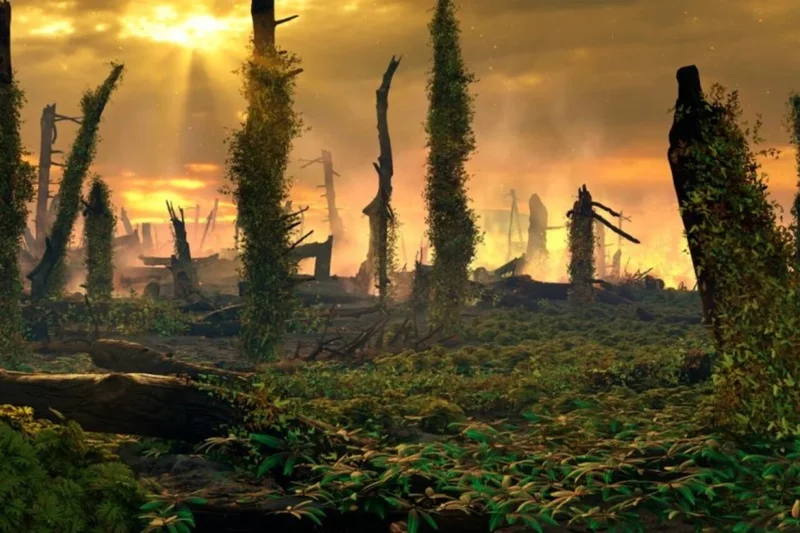
Some 200 million years ago, dramatic changes in climate and geology drove the extinction of approximately 80% of species on Earth. This hectic time in Earthâs history, the end-Triassic mass extinction event, is generally thought to come from extreme volcanic activity. But scientists think there might have been a smaller, seemingly less threatening contributor: the simple fern.
To be clear, volcanic activity likely kickstarted the mass extinction event, driving up global temperatures and carbon dioxide levels. These changes killed off tree-dominated vegetation, and in their place came large swaths of ferns that formed savannahs in modern Northwest Europe. And these ferns, according to a paper published today in Nature Geoscience, further fanned the flames, making a bad situation even worse.
âWhen the ferns dry out, the thick mats act as the ideal fuel to trigger massive wildfires,â Bas van de Schootbrugge, the studyâs senior author and an Earth scientist at Utrecht University in the Netherlands, said in a statement. âFerns responded to and delivered the fuel that fanned the flames, triggering repeated massive wildfires. A truly hellish world.â
End of an era
Roughly 201 million years ago, whatâs now the Atlantic Ocean quite literally flipped over, blowing up in volcanic eruptions that released tons of carbon dioxide and sulfur dioxide, according to a blog post by the U.K.âs Natural History Museum. This led to increases in sea levels and ocean acidity that likely killed off much of marine life from this era.
On land, things werenât much better. Severe greenhouse warming effects would have led to an âenhanced fire regimeâ for several centuries, the team explained in its paper. Importantly, this hypothesis is supported by the high concentrations of charcoal and hydrocarbons found in paleontological records from this time.
A âdarkâ record
For the latest study, the researchers generated paleo-fire records from sedimentary drill cores, retrieved from different areas in Europe. During their analysis, they found that specific sections of the cores were âprogressively, extremely dark brown,â van de Schootbrugge explained. Across the four different cores, that dark section corresponded to exactly the same timeâa so-called âfern spike intervalâ that saw a steep proliferation of ferns among the flora of the late Triassic era.
Core section from the Prees-2 core drilled in the United Kingdom in 2021. Credit: Teuntje Hollaar/Utrecht University
âThe darkening overlaps exactly with the fern spike, the main extinction interval, and the elevated abundance of charcoal and PAHs [organic compounds associated with burning biomass],â van de Schootbrugge said.
Generally speaking, itâs not uncommon for the color of organic microfossils to develop dark hues as they get buried from pressure and temperature changes, according to the statement. However, the consistency across four cores, which âexperienced very different geological histories,â suggested to the team that there was something else going on, said van de Schootbrugge.
Fueling the flames
The team sought to isolate factors that could be contributing to the fossilsâ unusually dark hues. For instance, the researchers generated 15,000 measurements from pollen and spores captured in the core record, for before, during, and after the extinction events. This analysis indicated that the darkened sections didnât vary significantly according to the type of plant involvedâa âstrong indication that it was the result of an outside force,â van de Schootbrugge explained.
Examples of fossil fern spores from before and after the end-Triassic mass extinction interval (left) and fossil fern spores from the âfern spike intervalâ that are darkened due to charring during wildfires. Credit: Bas van de Schootbrugge/Utrecht University
The fern spike may have not been a coincidence, as the fairly common plant is known to âadapt to some of the most extreme environments,â he added. Even if their leaves are wiped out by the flames, their underground root systems nonchalantly bounce back. Dry ferns happen to be the perfect fuel for massive wildfires, according to van de Schootbrugge. And the scary thing? This fern spike is estimated to have lasted anywhere between 40,000 years and 300,000 years.
Again, itâs unlikely that ferns were the sole cause of the long, fiery conditions fueling the end-Triassic mass extinction event. But itâs a reminder that Earthâs systems are closely interconnected; no part is separate from the other, and some unexpected collaborations can really make things go sidewaysâa lesson thatâs rather relevant for us today.