âThere is nothing more political than food,â wrote Anthony Bourdain, legendary American celebrity chef and bestselling author.
âFood is a reflection, maybe the most direct and obvious reflection of who we are, where we come from, what we love, who eats what in the country. The things that we eat are the direct reflection of our histories.â
Bourdainâs words really resonated on a recent foodie walkabout in Fordsburg, northwest of Johannesburgâs inner city. Fordsburg is Joziâs premier destination for halaal cuisine and spice trading, and tour guide and chef Ishvara Dhyanâs Food \& Spice Tour takes visitors on a series of tasting stops that connects the flavours with the areaâs rich history.
Each stop is a window into the history of the different immigrant groups who have settled here more recently â Indian, Pakistani, Bangladeshi, Syrian, Turkish, Somalian, Palestinian â and this walkabout is a delicious collision of bold colour, spicy streets and enticing flavours and scents.
Tour guide and chef Ishvara Dhyan. (Photo: Bridget Hilton-Barber)
âIn every migrantâs suitcase, there are recipes,â wrote acclaimed American food writer Ruth Reichl. âFood is the one thing you can carry with you that connects you to your past, no matter how far away you go.â The tastes along the way in Fordsburg include Indian/Pakistani sweetmeats like burfee and jalebis, Syrian layered baklava, Indian chakli, sev and gathiya, and Palestinian knafeh.
Itâs a three-hour wander â and shopping opportunity â through fresh fruit and vegetable markets, small spice shops, pavement stalls and wholesalers, as well as an Ayurvedic medicine shop and a Hindu prayer shop. It brings a lovely sensory overload too: the smell of spices and scent of perfumes, the sounds of haggling and a call to prayer, and colours that range from marigold orange to eggplant purple.
Dhyan is an entertaining personality and brings his own rich insights to the tour. He once taught world cuisine at the Prue Leith Academy and has years of experience travelling across India and the Middle East. Heâs been taking food and spice tours to Fordsburg for nearly two decades, so he knows the streets and the spiritual and social fabric of the area.
Fordsburg was established in 1888 after the gold rush. Named after Lewis Peter Ford of the Jeppe and Ford Estate Company, it was built to house miners, but evolved into an epicentre of working-class rebellion, anti-apartheid resistance and vibrant multicultural trade.
Chevra, a classic South African Indian snack. (Photo: Bridget Hilton-Barber)
Fresh fruit and vegetables. (Photo: Bridget Hilton-Barber)
Because property leases were less restrictive than in other areas, early Fordsburg attracted a diversity of people, from Afrikaners, Chinese and Indian merchants to Jewish immigrants. The area has a spirited history: it is where Mohandas Gandhi led a crowd of about 3,000 people to the Hamidia Mosque in 1908 to burn their mandatory âpassâ documents in a cauldron, marking the birth of the global Satyagraha movement of passive resistance.
A blue plaque in Fordsburg Square commemorates the 1922 Rand Revolt (or Red Revolt), when white miners went on a massive armed strike against mining companies that wanted to cut costs by replacing them with black miners, who were paid far less under South Africaâs racially discriminatory labour system. The state responded with military force, deploying infantry, tanks and bomber aircraft to crush the rebellion, leaving more than 200 people dead.
In the 1950s, the apartheid government declared Fordsburg a whites-only area, triggering massive resistance from the Chinese, Indian and coloured families who lived there. Many were forcibly removed to places like Lenasia, and in the mid-1970s Indian merchants were violently evicted from nearby Pageview.
The government then built the Oriental Plaza in Fordsburg to centralise and control the traders.
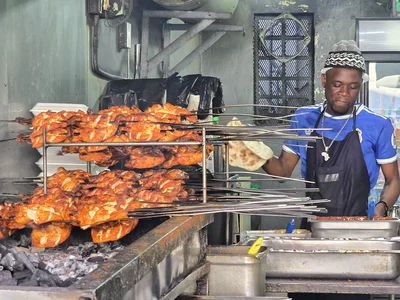
Take time after the tour to digest it all over a long, slow meal at one of the local restaurants â think samoosas and dosas, Indian curries, Middle Eastern shawarmas.
Thereâs no alcohol in Fordsburg, so go for a fresh coconut water, a mango lassi, hot Kashmiri chai or dark Turkish coffee. DM
The next tour is on 26 July and costs R350 per person. Email ishvara@africansecrets.co.za
Bridget Hilton-Barber is a freelance writer who writes for Jozi My Jozi.