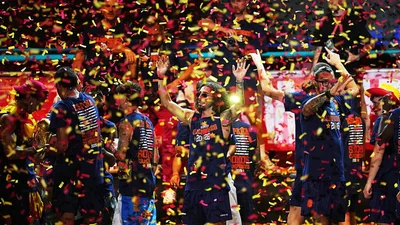
Spain’s World Cup-winning football team returned home on Monday and an estimated crowd of almost two million was on hand to greet the squad through the streets of Madrid.
The 26 players and their coaching staff met with the country’s royals, and then with Prime Minister Pedro Sanchez, after arriving in the Spanish capital a day after beating Argentina 1-0 in the final in New Jersey.
“Thank you to the coaches and players for the style of play, the effort and the victory,” Mr Sanchez said.
Players from Spain’s national football team celebrate atop a bus as it travels through crowded streets in Madrid (Cesar Vallejo/Europa Press/AP)
“We have truly enjoyed watching you play.”
The squad then boarded an open-top bus for a raucous parade through central Madrid.
“Stars shine together” was written on the bus, which also carried photos of the footballers.
Players — carrying the World Cup trophy and wearing shirts with the words Somos Campeones (We Are Champions) — danced and interacted with the fans along the route.
“It’s been an emotional and proud experience to represent a wonderful country with such passionate and devoted fans,” Spain coach Luis de la Fuente said before the parade started.
Spain’s Lamine Yamal reacts during celebrations with his national team teammates at Cibeles Square in Madrid (Manu Fernandez/AP)
“We are filled with joy.”
The squad travelled down Madrid’s historic avenues from near Moncloa Palace, the prime minister’s official residence, to Cibeles Square, where authorities told local media that some 120,000 people were on hand for a ceremony.
Groups of fans had begun securing their spots near Cibeles late on Monday morning ahead of the team’s arrival, bringing umbrellas to protect against the sun and temperatures of up to 35C.
The square is where previous Spain teams and their supporters have typically gathered to celebrate.
It is also the traditional celebration spot for Real Madrid when it wins titles.
Fans hold flares during celebrations at Cibeles Square in Madrid (Bernat Armangue/AP)
Singers Aitana, Ana Mena and Lola Indigo were set to entertain the crowd at the ceremony at Cibeles.
Officials estimated a total of around 1.8 million people welcomed the team in Madrid.
Spain walked off with the trophy Sunday after Ferran Torres scored the winner in extra time to secure its second World Cup title — and first since 2010 in South Africa.
The team was congratulated by the leaders of the three countries that co-hosted the tournament — US President Donald Trump, Mexican President Claudia Sheinbaum and Canadian Prime Minister Mark Carney.
After the final whistle, Madrid erupted into celebrations, with thousands of supporters pouring into the streets from bars and restaurants, many draped in Spanish flags or wearing the team’s colours.
A fan holds up an image of Spain’s head football coach Luis de la Fuente during celebrations in Madrid (Manu Fernandez/AP)
Crowds packed the capital’s Puerta de Sol and other major squares — singing, dancing and setting off flares while car horns blared.
Many celebrated Sunday’s victory long into the wee hours of Monday morning.
“I’m very happy. I’ve slept three or four hours, but for the team, I’ll do whatever it takes,” 19-year-old Victor Alvarez said.
The men’s victory, combined with the Women’s World Cup won by Spain in 2023, makes the European nation the first to hold both titles simultaneously.
“Honestly, it was very exciting. We preferred not to go to any bar or anything, to experience it at home, focused and very happy, very joyful,” 59-year-old civil servant Gema Rodero said.
Players from Spain’s national football team perform for fans at Cibeles Square in Madrid (Bernat Armangue/AP)
Celebrations were dampened, however, after local authorities reported that a 13-year-old in Salamanca, north-west of Madrid, had died after a fountain he had climbed onto with friends to mark the victory had collapsed.
For many young supporters, the triumph is their first time witnessing the men’s team lift the trophy — and the national delirium that has followed.
Spain now is markedly different from 2010, when the Iberian nation was beset by a debt crisis, 20% unemployment and nationalist regions fighting to win more autonomy.
The economy is expanding, the unemployment rate has halved and the country is forecast to again be among the Eurozone’s fastest-growing major economies.
Nationalist and separatist tensions have considerably cooled.