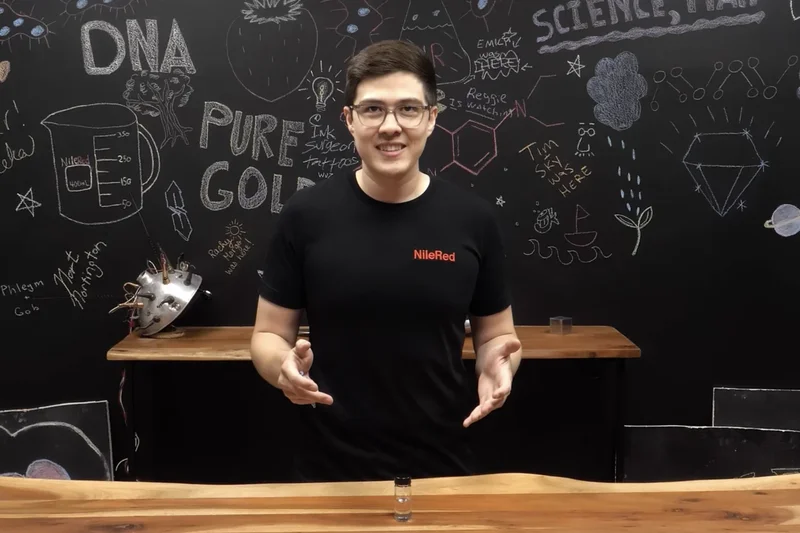
Nigel âNileRedâ Braun is one of the OG chemistry YouTubers, and heâs become famous on the platform for his Charlie Brown-esque air of melancholy, along with his unstinting devotion to performing experiments both ambitious and, well, strange. One of his ongoing projects involves turning anything and everything into alcohol. (The fact that he does this despite not in fact appearing to like alcohol feels significant here.)
Anyway, in a new video, Braun puts all his previous alcohol videos to shame by setting out to produce ethanol from thin air. Really.
The theory is actually pretty simple: air contains, among other things, hydrogen, carbon and oxygen. Ethanol contains hydrogen, carbon and oxygen! So basically, the idea is:
- Get water and CO2from the air
- Break apart the water and CO2into hydrogen, carbon and oxygen
- ???
- Profit!
And in fairness, that is the ideaâitâs just that, as ever, thereâs an awful lot of detail lurking in those question marks.
Watching a NileRed video is often like a journey into the depths of human emotion, just with added chemistry and expensive, esoteric machinery from China. This one is no exceptionâour hero declares at various points that, âI was completely delusional,â âEverything I was doing was totally wrong,â âThis was a total failureâ and âI completely screwed up.â
The main source of difficulty here is that CO2 and hydrogen donât just magically combine into ethanol; they require a catalyst to, well, catalyse the correct reaction, and as Braun laments about 15 minutes into the video, while there are plenty of options to choose from, âNone of them [are] very efficient, and a lot have major downsides, like being extremely expensive, very difficult to make, or a combination of the two.â
Eventually, he settles on a two-part catalyst based on iron, and itâs at this point that the doom spiral really begins. This choice may or may not be easier to make than other options, but it still proves something of a nightmare, and there are âI bent my Wookieâ levels of pathos in Braunâs voice when he realizes that his first synthesis attempt, which has taken five days, has yielded only 1.8 grams of the 25 grams heâs going to need.
If nothing else, though, Braun is persistent, and after weeks of painstaking, tedious work, he has his catalyst. Well, half of it. Making the second part of the catalyst only takes another week of similarly tiresome labor, and when itâs done, itâs time to load the result into the reactor system.
Ah, yes, the reactor system. If youâve been following along, youâll have noted that the headline on this article says âtwo yearsâ and the catalyst synthesis only adds up to a couple of monthsâ work. You might also have noticed that Iâve been referring to hydrogen gas, rather than water vapor.
This is because it turns out that the oxygen in water is superfluous here: ethanol is C2H6O, and since carbon dioxide contains two oxygen atoms for every carbon, thereâs already excess oxygen before you add the water. The last thing you want is more excess oxygen, given that elementâs reactivity, so the first step in this process is to pour the water into something called a hydrogen generator, which splits apart the water molecules and outputs the hydrogen alone.
This is another potential problem, though, because hydrogen plays havoc with various metals. As Braun explains, itâs such a tiny atom that it can diffuse into metal crystal lattices, rendering them brittle and weakâwhich is not what you want when youâre dealing with high-pressure gases. This means the construction of a complicated, specialized system to deliver the two gases at the correct pressure. And as Braun laments at one point, you canât just buy a system like this off the shelfâthey have to be fully customized, so you have to design and build them yourself.
This, obviously, is no small task, but the result of Braunâs months of hard work is undeniably impressiveâand honestly, itâs just nice hearing him sound genuinely happy when he says âitâs one of the coolest and most impressive things Iâve ever built.â But does it work? Well, yes, eventually. Predictably enough, there are plenty more ups and downs, but after 80 minutes of video and two years of IRL work, Braun stands proudly with, um, a tiny flask of ethanol.
Well, OK, itâs mostly water. Itâs about 7% ethanol. And thereâs some methanol in there, so ⦠yeah. Bathos and pathos! In one video!  But still, itâs hard not to smile along as Braun proudly lifts his little pipette, containing a small enough amount of liquid that itâd be harmless even if it somehow proved to be entirely methanol, and gives it a taste. âItâs ⦠itâs actually pretty good,â he beams. And, letâs remind ourselves, itâs alcohol made from air. At vast expenseâboth temporal and financialâand at a hilariously inefficient yield, but still: itâs alcohol! Made from air!
Lesser mortals might just down the whole vial, but Braun is already scheming: âI need to figure out a way to make this scalable and make a full bottle of this,â he muses. âWithout the methanol. Thatâd be really interesting.â We look forward to Air Alcohol 2.0. In 2029. God bless.