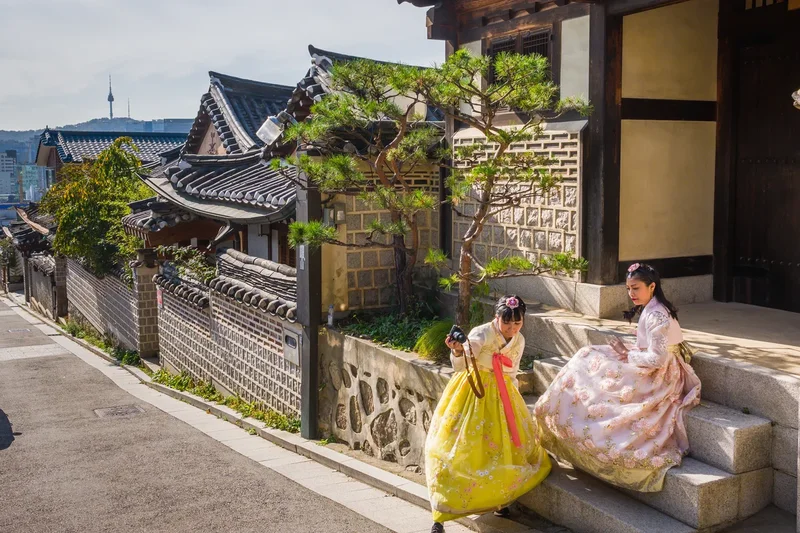
“Shh!” A tour guide raises her index finger to her lips, signalling for my group and I to keep it down. We are in the Bukchon Hanok Village in central Seoul, next to the famous first palace of the Joseon Dynasty, Gyeongbokgung. Hordes of tourists, charmed by the area’s low-rise, wing-tipped houses and hilly streets are wielding selfie sticks. Many are clad in hanbok (traditional dress) from nearby rental shops.
Wearing the hoop-skirted dresses or flowing wraparound jackets is a popular sightseeing activity, but this isn’t technically a tourist attraction – the neighbourhood is residential; a labyrinth of around 900 tightly-packed hanoks (traditional houses).
My guide was not simply a spoilsport either; the nearly 6.4 million tourists who descend on the area annually has led local authorities to deploy uniformed rangers to manage the overtourism. There are signs imploring people to “talk quietly please”, and curfews too.
The area is just as novel to most locals as it is to visitors. Only around 4,500 hanoks remain in the city, mostly scattered across pockets in the central Jongno-gu area. The majority of the nearly 9.6 million locals reside in high-rise apartment blocks, or apateu, which shot up apace after the 1960s – to the sacrifice of historical and traditional building,; many of which were already destroyed during the Korean War and the Japanese occupation.
Museums like the Namsangol Hanok Village offer the chance to see painstakingly restored single-storey hanoks, made from all natural materials: wood, clay, stone and paper; and laid out as they would have been used during the Joseon Dynasty.
However, there is a way to get a much more intimate glimpse into life in a hanok – by staying in one.
On my final night in the city I had chosen to book one of the remodelled and restored hanoks located in Anguk near the Palace. Following a stay in a towering hotel with bustling corridors and sweeping views of the skyline, a private hanok offered the chance to sample a slower pace of life in the city.
My taxi driver had dropped me off beside an alley, signalling I’d arrived with a shrug. I couldn’t see another soul in the vicinity. I wandered down an alley, toward the pin drop on my maps app, until I reached an imposing wooden entrance gate, and heaved my 19kg of luggage over the threshold to find two smaller locked doors.
Once I’d successfully discerned which was mine (named “Stay Sunshine”), I tapped in my entry code, and ducked through the gate into a neat Taoist-inspired garden (designed as miniature, idealised versions of nature), before lowering my head again to go through the front door.
I discovered a cavernous, minimalist space. The kitchen-diner was equipped with all the useful items I could – and would never – have thought of. In a basket there was a steamer and indoor shoes. A tea set was waiting on the dining table. The bedroom even had an adjoining walk-in closet.
Read more: Where to go on holiday in July, according to the experts
My hanok’s layout and style had been specifically designed for 21st-century living, though a few days earlier at the Namsangol Hanok Village, my guide Meggie Yu had explained how the the homes used to look, laid out to reflect Confucian social order, based on gender, age and status (no prizes for guessing whose quarters were largest). In all the kitchens, huge gamasots (cast-iron cooking pots) were the centre-piece.
I was taken by the ornate folding screens hand-painted with vibrant motifs, which would have reflected the occupant's wishes or ideals – mandarin ducks for marital harmony, and mountains for protection, for example.
The homes were positioned according to baesanimsu – a principle to ensure harmony with nature, meaning "mountain in the back, water in the front". And South Korea’s history of ingenuity is demonstrated perfectly in how they were adapted for the seasons, with ondol (underfloor heating) for harsh winters and wooden-floored maru halls for summer cooling.
My home for the night had plenty of mod-cons, from central heating to a Toto heated toilet, and a projector. Though it nodded to the past with a mattress close to the floor (previously a way to maximise that ondol heat), the low front door (to minimise how much cold air could seep in) and a traditional square soaking tub for jok-yok (ritualised baths or foot soaks).
Slowly, the numbers of people living in hanoks is rising. Meggie explained how more locals are now yearning for the way of living they offer versus the prevalent high-rise homes. “Korean people are enthusiastically returning to traditional styles and aesthetics, with an enhanced passion for wellbeing, as well as the younger generation's turn towards ‘slow living’. They are reinventing traditional buildings to suit the modern era.”
As well as the efforts to protect the community and homes of Bukchon, the government has been introducing more measures to help preserve hanoks across the city in recent years. Owners have been eligible for grants and low interest lows to restore them since 2002, and recently, the strict definitions (including the need to abide by baesanimsu) have been loosened in more hanok hotspots to allow more people to carry out renovations, and to build them anew.
It’s also common for Seoul residents to take "healing trips" to hanoks in the countryside in order to “relax and enjoy the quiet and clean air”, Meggie explained. I could see why.
After spending my evening in the neon glow of Seongsu – arguably the coolest neighbourhood of the moment, packed with fashion and beauty lovers attending its graphic pop-up shops and arty installations – I returned to my little residence and was struck by how peaceful the nearby streets were, lined with hanok tea houses and cafes.
To wind down, I soaked my feet in the bath, made tea and fired up the projector while cocooned in bed to watch Beef, the Netflix show set between Southern California and Seoul. I fought off sleep as long as I could, in denial that I was leaving the city in the morning.
The hanok was the homiest place I had stayed in the city. I had lapped up the gleaming and edgy sides of Seoul – its spas, shops and late-night scene – but my final night was an opportunity to slow down, feel grounded and peek into its past. The perfect send-off.
Hayley travelled as a guest of Inside Asia
Read more: This underrated Japanese city is perfect for escaping overtourism
How to do it
Inside Asia can arrange hanok stays as part of a cultural adventure to South Korea.
Stay Sunshine is managed by Butler Lee who have around 50 hanoks in central Seoul.
How to get there
Virgin Atlantic operates direct daily flights from London Heathrow to Incheon International Airport in Seoul, starting at £889 economy. Flight time is around 15 hours.