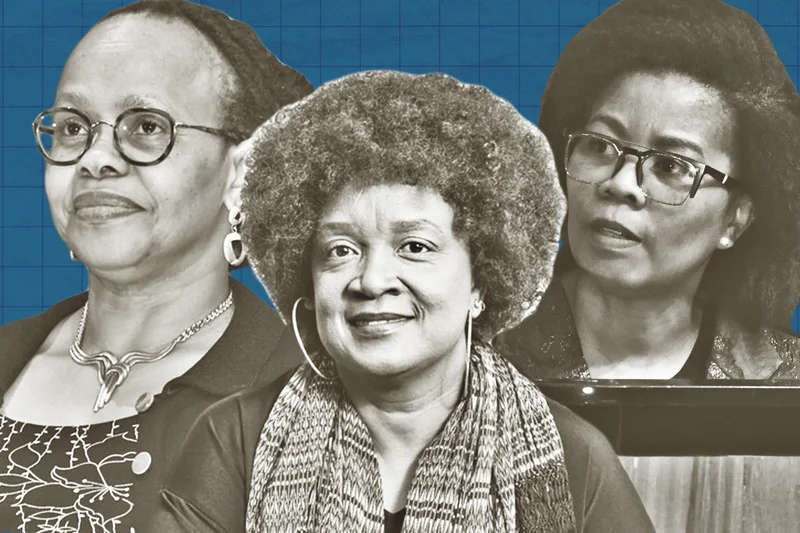
For generations of women entering South Africaâs universities, the person occupying the highest office on campus has more often than not been a man. That picture is beginning to change. Of the countryâs 26 public universities, women now lead nine institutions.
In commemoration of Womenâs Day on 9 August, Daily Maverick reached out to executive leaders across the higher education sector. The women leading these institutions detail that they did not arrive at the top by following similar paths. They reveal a familiar thread: having to prove themselves, navigate institutional politics, overcome entrenched expectations and, at times, enter spaces where leadership was not expected to look like them.
Women from three top universities, the University of South Africaâs (Unisa) Professor Puleng LenkaBula, University of Mpumalangaâs Professor Thenjiwe Meyiwa and Sol Plaatje Universityâs Professor Debra Meyer reflect on their journey to the top.
âLeadership was not always expected to look like meâ
Prof Meyiwa, who in October 2025 became vice-chancellor of the University of Mpumalanga (which along with Sol Plaatje University is one of South Africaâs first post-apartheid public universities), said the challenge was not a single dramatic obstacle. It was the accumulation of institutional traditions and unequal access to opportunity.
âAs a Black woman in higher education, I often found that I had to demonstrate my competence repeatedly, while simultaneously earning trust in spaces where executive leadership was not always expected to look like me,â Prof Meyiwa said.
Her response was to let her work build the case for her leadership. She expanded her capabilities across academic management, university administration and macro strategy, grounding her approach in the core principle of Ubuntu.
âMy resilience has always been anchored in faith, purpose, and the understanding that leadership is ultimately about service,â she said. âResearch teaches patience, evidence-based decision-making and intellectual humility, all qualities that are invaluable when leading complex institutions.â
When patriarchy tells you to wait
At the largest open distance-learning institution in Africa and one of the longest-standing dedicated distance education universities in the world, Prof LenkaBula said she faced a different kind of resistance in her journey to the vice-chancellorship of Unisa.
âI remember receiving a message from one of the male colleagues, a former principal and vice-chancellor to boot, informing me that he was not going to support my candidature,â Prof LenkaBula recalled.
âThe second hurdle [...] is that there was contestation regarding the different camps for the three short-listed candidates. [...] the kind of fierce opposition one would later endure after assumption of duty, ironically as the first female/woman principal and vice-chancellor in Unisaâs 147 years of existence then. In my first year in office, I often observed that Unisa had not been ready for my appointment, as reflected in the hostile reception I encountered in some quarters of the university community,â Prof LenkaBula said.
Despite these daunting obstacles, she refused to back down. âFaith, courage, a justice-seeking commitment, my insatiable desire to see the lives of the previously marginalised transformed by education and a strong feminist ethic all contributed to my capacity to overcome the hurdles,â Prof LenkaBula said.
Addressing resistance
Prof Meyer notes that her path to the vice-chancellorship at Sol Plaatje University was marked by various obstacles. She had to navigate institutional politics, manage limited resources and balance competing stakeholder interests, all while facing resistance to change and the ongoing under-representation of women in senior leadership roles.
âTo address resistance to organisational change, I worked on building trust, consulting widely and communicating transparently,â Prof Meyer said. âI had to transition from being recognised for my academic leadership to leading an entire university, and that required demonstrating that academic excellence can be complemented by strong strategic planning, financial stewardship and people leadership,â said Prof Meyer.
Integrity, humility, continuous learning and service have remained central to Prof Meyerâs leadership, while family, friends, mentors and colleagues have provided the support and perspective needed to survive difficult moments.
âYou belong in the roomâ
The vice-chancellors also shared advice for upcoming women leaders. They said young women should not allow other peopleâs doubts to limit their ambitions, they should not wait for permission, and that they belong in the room.
âNever allow anyone else to define the limits of your potential. Invest deeply in your education, work with excellence, remain curious and never stop learning. There will be moments when you doubt yourself, and there will be occasions when others underestimate you. Do not let either determine your future⦠Every barrier you overcome makes it easier for another young woman to believe that she belongs in the room,â Prof Meyiwa said.
âDo not wait for permission to lead or for every obstacle to disappear before pursuing your purpose.â
Unisaâs Prof LenkaBula said women should not wait for permission. âBelieve that yourself despite our hostile patriarchal/kyriarchal contexts, believe [that] your voice, your intellect and your lived experiences are valuable.
âRemember, there is no universal womenâs experience, so do justice to your own unique experience as an individual woman/female person and refuse to be somebodyâs copy. Do not wait for permission to lead or for every obstacle to disappear before pursuing your purpose,â Prof LenkaBula said.
As we commemorate the courageous women of 1956, we are reminded that every generation inherits both a legacy and a responsibility. The women who marched before us expanded the boundaries of possibility. Our task is to carry that legacy forward by leading with courage and justice,â Prof LenkaBula said.
âYou must invest in your planned career by building expertise and pursuing lifelong learning. Donât wait for perfect conditions before putting yourself forward for a leadership role.â
Meanwhile, Prof Meyer said: âTo every young woman aspiring to an executive leadership role, you must believe that you belong in the room where it happens, before anyone else will. You must invest in your planned career by building expertise and pursuing lifelong learning. Donât wait for perfect conditions before putting yourself forward for a leadership role.â
Women leading
In 2026, women are also at the helm of the Central University of Technology (CUT), Mangosuthu University of Technology, Nelson Mandela University, the University of the Free State, the University of Zululand and Walter Sisulu University.
Professor Pamela Dube is the first woman to lead the CUT and is also the deputy chairperson of Universities South Africa, the body representing the countryâs 26 public universities. Professor Nokuthula Sibiya became the first woman from Umlazi to lead Mangosuthu University of Technology when she took office in 2024.
Professor Sibongile Muthwa has led Nelson Mandela University since 2017, while Professor Hester Klopper became the first woman to lead the University of the Free State in its more than 120-year history. Professor Nokuthula Winfred Kunene became vice-chancellor of the University of Zululand in January 2026, following a career that included her serving as the universityâs deputy vice-chancellor for research and innovation.
At Walter Sisulu University, Dr Thandi Mgwebi began her term as vice-chancellor and principal in January 2026, bringing experience from the higher education, research and science sectors.
The numbers are still not equal. Men remain in the majority among South Africaâs university vice-chancellors. But the change is becoming visible. DM