Laura Cuaya calls herself a cat person. Yet the two dogs who entered her life during her Ph.D. became companions, colleagues, and research participants. Odín and Kun-kun moved with her and Raúl Hernández-Pérez, her partner since high school, from Mexico to Budapest and then Austria.
A dog brain study made the same journey. It began with preliminary findings about how dogs’ brains respond to human smiles, and additional data gathered years later in Hungary gave them enough to study how dogs process negative expressions as well.
The study, published in iScience, scanned the brains of pet dogs while they viewed photographs of human faces. Smiles produced stronger activity in a network reaching into a reward-related brain region, while fearful faces produced whole-brain activity patterns that differed from those associated with anger and sadness. The findings provide the first neural evidence that dogs can distinguish at least some negative human expressions.
“It was genuinely surprising, especially after spending so much time thinking about happiness,” senior author Laura Cuaya told Discover. “I was already very happy that the results related to happiness remained robust with the new data, but suddenly we also had enough data to study the brain processing negative facial expressions.”
Read More: Dogs May Favor a Paw — but Which One They Use May Depend on the Task
How Dog Brains Respond to Human Expressions
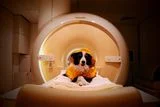
In the first experiment, eight trained family dogs lay awake and unrestrained inside an fMRI scanner while looking at unfamiliar people with happy or neutral expressions. Each dog saw the same faces displaying both expressions, helping the researchers focus on the expression rather than the person.
Smiles produced stronger activity in a network extending from the temporal cortex into the caudate nucleus, a brain structure involved in reward processing.
In the second experiment, 12 dogs, including six from the first experiment, viewed faces expressing happiness, anger, fear, and sadness. From the activity in that network alone, the researchers could tell when a dog was looking at a happy face rather than a negative one. The network could not tell the three negative expressions apart.
When the team widened its view to the whole brain, fear stood apart from both anger and sadness. Anger and sadness, however, still could not be reliably separated.
“There is a lot of evidence that dogs can perceive emotions expressed in human faces, but previous studies had compared one positive and one negative expression. So it was very exciting to find neural evidence suggesting that the dog brain does not simply categorize an emotional face as positive or negative, but can distinguish between some expressions within the same valence,” Cuaya told Discover.
Beyond a Stranger’s Photograph
The dogs were looking at still photographs of strangers, a much thinner social signal than they receive from the people they know. The fact that faces alone produced distinct brain responses left Cuaya wondering what happens when the person matters to the dog.
“It is fascinating to imagine what happens in everyday life when the person expressing happiness is someone important to them, using not only their face but their voice, body, scent, and the entire social context,” Cuaya said
Odín and Kun-kun were among the dogs in the scanner. Living with them while studying their brain activity made Cuaya reflect on how closely dogs watch people, and whether humans return that attention.
“At the same time, humans are not always very good at understanding dogs’ emotions. I think studies like this can also motivate us to make the effort in the other direction: to pay closer attention to how dogs communicate their own emotions to us,” she shared with Discover.
Read More: From Mongolia to Madagascar, Dogs Form Remarkably Similar Bonds With Humans
Article Sources
Our writers at Discovermagazine.com use peer-reviewed studies and high-quality sources for our articles, and our editors review for scientific accuracy and editorial standards. Review the sources used below for this article:
- This article references information from a study published in iScience:Dog Brain Representations of Human Facial Expressions: Encoding Happiness and Differentiating Specific Negative Expressions