From a loved old clunker to driverless cars: What are we losing on this road trip?
Save
You have reached your maximum number of saved items.
Remove items from your saved list to add more.
AAA
At a time when regulators are assessing when to let driverless cars loose on our streets, when one in four new cars sold in Australia is electric and just about the last internal combustion conveyances are family SUVs or giant utes, I still get a kick out of remembering the day I bought my first car.
It was an old Holden built in the wrong year with the wrong motor to be properly cool, and I didn’t exactly buy it; I talked my dad into handing over the cash.
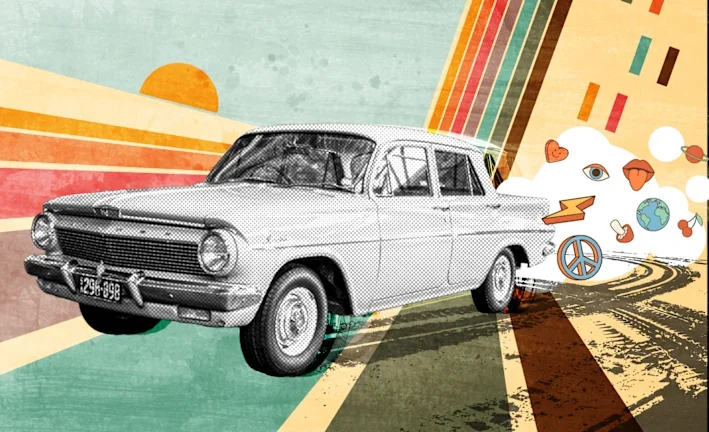
The joy of owning a classic old Holden.Artwork: Matt Davidson
I’d just finished school and holiday jobs were never going to pay for even this 1963 Holden EJ with so many miles on the clock I avoided looking at the number.
My father tried to steer me towards an Austin, a Vauxhall or a Volkswagen.
Nothing doing. They were all impossibly daggy.
And there it was.
A car had its own personality – its own credibility – transferred to its owner, starting with the brand. A Holden was Australian, and it wasn’t a Ford. Young Australian men those days identified themselves as Holden blokes or Ford boys. It was as important as choosing a footy team.
I felt as if I were floating six inches above the vinyl bench seat as I drove out of the car yard.
The road was mine.
Why, life was mine! I could choose any destination I wished. It was simply a matter of mashing the clutch, choosing a gear (the gearstick stuck out of the steering column, an arrangement known as “three on the tree”) and pointing the front wheels in the right direction.
Here was independence. Autonomy with a steering wheel and an accelerator.
Freedom.
Holden EJ, a little worse for wear, but to the author’s teenage eyes, such a machine spelled freedom.
The old motor chewed oil and the radiator was given to boiling on long uphill stretches, but it took me to dances in towns all over the place, to the drive-in, to surf beaches and late-night hamburger joints.
When I got a job as a cadet journalist at the local paper, my weekly pay was $26.50. It stretched OK: petrol was 33 cents a gallon, or nine cents a litre. A six-pack of beers was about $1.40, a hamburger with the lot was 30 cents and a pack of cigarettes was 40 cents. I lived rent-free at my parents’ house, and it came with my mother’s cooking.
Life, in short, rolled out like a smooth road waiting to be driven, and I drove lots of them, though most were rough.
Soon, in hopeless pursuit of more cool, there came a Mini Cooper, an Austin-Healey Sprite – both driven with too much enthusiasm and not much care by previous owners – and later Fiat 124 sports machines, which spent a lot of expensive time sitting in workshops. Motorbikes came along and I was captured by wind in the face, a satisfying burble following everywhere and an even greater sense of freedom.
The best machine of all was also the worst from any sensible perspective.
It was a little box on tiny wheels. A canvas roof theoretically kept out some of the rain and the wind of winter, and was removed to ensure you were burned by the sun all summer. The brakes were close to non-existent until one at the front grabbed hard and spun the vehicle in a perfect 360-degree tyre-shredding loop.
It was dangerous, but the biggest danger was dying from smiling with pleasure.
It was a Mini-Moke.
A Mini-Moke. A magnificently dangerous smile-inducing machine.Instagram @woogsworld
One freezing winter’s day I drove the Moke up the Hume Highway from Albury to Canberra. I tucked in behind a big tourist coach in the futile hope I’d get a bit of heat from its exhaust and some protection from the needles of slicing rain. It was white-knuckle driving, until the knuckles turned blue.
But oh, the sense of achievement when I arrived alive at my destination! I’d done something that set every nerve teetering at its farthest edge. For unrelenting hours.
Ancient history, of course.
Lots of young people, for many good reasons (Uber, for one), are not excited by cars and don’t bother getting a driver’s licence these days. The idea of using a stick shift to change gears disappeared shortly after the dinosaurs died out.
Cars no longer have personalities, whatever efforts advertising agencies take to persuade us that they do.
Designers, constrained by the need to make large passenger vehicles slip through the air with maximum efficiency, have settled on a universal style. It has become hard to tell one SUV or sedan from another.
You don’t so much drive newer cars as sit in them and let squadrons of sensors and cameras and radar do the work. Electric vehicles have become computers on wheels.
It means safety has taken giant leaps. Comfort, too.
Next will be driverless cars. Driverless robotaxis are already navigating the city streets of the United States and China.
In an age of artificial intelligence, it fits.
Cartoonist Cathy Wilcox’s view of a driverless car.Cathy Wilcox
We no longer need to strain our brains or leaf through books in search of the combined knowledge of humanity. It’s in the Cloud, accessible with a few prompts on a keyboard.
We no longer need to listen to a motor’s revs to gauge when to change gears, to avoid skidding sideways on a bend or even be prepared every second of a journey to hit the brakes. Those hundreds of sensors take care of all that.
Sometimes, though, the happy memory of slugging through the gears on an old Holden or a Moke in search of freedom leaves me wondering how much personal autonomy and how much raw sensory experience we should surrender to the easy passivity of artificial intelligence – which is seamlessly pilfering human jobs as we speak – and its wheeled metaphor, the driverless vehicle.
It’s over, of course. As over as it was for the Luddites desperately smashing the machines of an industrial revolution stealing their livelihoods, crafts and skills.
Save
You have reached your maximum number of saved items.
Remove items from your saved list to add more.
Tony Wright is an associate editor and special writer for The Age and The Sydney Morning Herald.Connect via email.