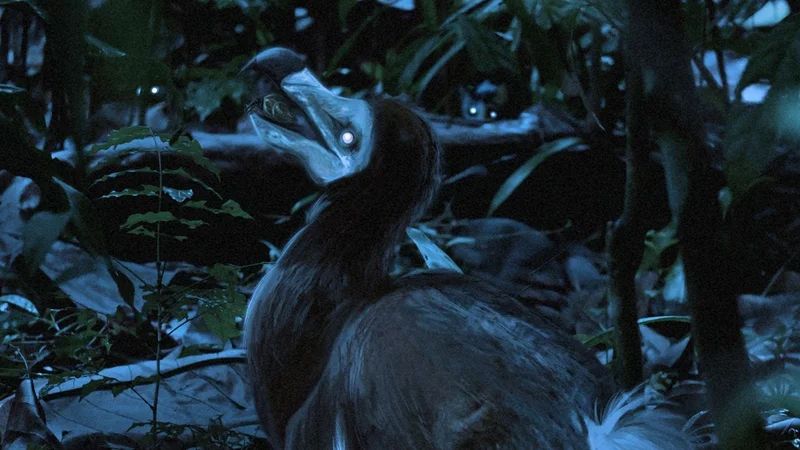
Despite historical portrayals, the dodo was a relatively intelligent bird that might have spent much of its life in the dark, new research suggests.
Dodos were traditionally portrayed as dumb, bumbling birds. But now, scientists have scanned dodo skulls and found nothing to suggest these birds were stupid. What they did find, however, was that the part of the dodo's brain that's responsible for visual processing was small — comparable to that of some nocturnal birds.
"Our interpretation is that this species was really, really not relying much on sight," study first author Sara Citron, a doctoral candidate in behavior and evolution at the University of Lethbridge in Canada, told Live Science. "And the only situation where you're not relying on sight is when there is no light available."
Dodos were wiped out within a century of humans settling on their island home of Mauritius in 1598. However, it wasn't just hunting that drove them to extinction. The sailors introduced dogs, cats, pigs and rats, which would have likely killed the birds and eaten their eggs. These invasive species wreaked havoc on the dodo's ecosystem and continue to plague Mauritian wildlife to this day.
In the new study, published Aug. 5 in the Zoological Journal of the Linnean Society, researchers found that dodo brains scaled with their body size as would be expected for their group, which is made up of pigeons and doves. In other words, their brains weren't especially small for their size, with no evidence of inferior intelligence compared to their relatives.
This isn't the first time researchers have poured cold water on the stereotypical depiction of dodos. A 2024 study found that dodos were likely fast and powerful, rather than slow and bumbling. The new research also builds on a 2016 study that concluded dodos were likely as smart as modern pigeons, which can solve problems and understand abstract concepts like space and time.
The dumb-dodo myth likely stems from accounts that these birds had no fear of humans and tended to run toward trouble. Sailors figured out that if a dodo was in distress, other dodos would run toward their calls, which meant the sailors could catch even more of the birds.
Get the world’s most fascinating discoveries delivered straight to your inbox.
"Apparently, they would just grab one, let it scream and wait, and all the other dodos would run towards this one to see what was the cause of the distress," Citron said.
This might seem like an incredibly stupid survival strategy, but it's not a failure of dodo evolution. Dodos, like many isolated island animals, evolved in an ecosystem that didn't have any mammalian predators, so they were not equipped to deal with humans or the other animals they brought.
Inside the dodo's brain
To better understand dodo biology, the researchers embarked on an international collaborative effort to study as many CT (computed tomography) scans of dodo heads as they could to deduce the size and shape of their brains, starting with one at the University of Lethbridge.
"As soon as we started looking into it, we realized that the optic lobe, which is the part of the brain that processes visual information in birds, was extremely reduced," Citron said. "And that's typically a very good indication of something completely different in the behavior of a species."
The team compared the dodo scans to those collected on 36 living species of pigeons and doves, as well as the extinct Rodrigues solitaire (Pezophaps solitaria), a close relative of the dodo that lived on Rodrigues Island — east of the Mauritius mainland — and suffered the same fate. Unlike dodos, the solitaire's brain was what researchers would expect from a giant pigeon.
The researchers concluded that the difference in visual processing abilities seen in dodos, along with an enhanced sense of smell, might be evidence for the bird being crepuscular — active during twilight — or nocturnal. There weren't any historical accounts of the dodo being active in the dark, Citron said, but that wasn't surprising. Other than the accounts of sailors using dodo cries as bait, researchers don't have any reliable records of the bird's behavior.
RELATED STORIES
"The most absurd thing is that the dodo is this famous bird," Citron said. "Everyone knows what a dodo is, what it looks like. However, we don't know absolutely anything of its behavior or its ecological niche. If you look at the historical accounts, we have more information about how it tasted."
For now, interpretations of the dodo's behavior remain speculative. However, Citron said she wishes the dodo would stop being portrayed as a "stupid thing that is doomed to go extinct because of how inept it is." She argued that animals on the brink of extinction today, especially when they're not like humans, are also dismissed for the same reason.
"[Endangered animals] are intelligent, they are adapted to their environment for millions of years, and the fact that we are destroying it now doesn't mean that they are stupid or they don't deserve to keep living," she added.
Citron, S., Hipsley, C. A., Hume, J., James, H., Hosner, P. A., Czeibert, K., Keirnan, A., Silva, A. C. C. R., Walsh, S., Weisbecker, V., & Iwaniuk, A. N. (2026). The sensory world of the Dodo and Solitaire revealed by endocast and skull anatomy. Zoological Journal of the Linnean Society, 207(4). https://doi.org/10.1093/zoolinnean/zlag123
Patrick Pester is the trending news writer at Live Science. His work has appeared on other science websites, such as BBC Science Focus and Scientific American. Patrick retrained as a journalist after spending his early career working in zoos and wildlife conservation. He was awarded the Master's Excellence Scholarship to study at Cardiff University where he completed a master's degree in international journalism. He also has a second master's degree in biodiversity, evolution and conservation in action from Middlesex University London. When he isn't writing news, Patrick investigates the sale of human remains.