- READ MORE: Last month was driest July on record for England and Wales
- See more Daily Mail on Google - save us as a Preferred Source
Britain's worsening drought could trigger outbreaks of infectious diseases, scientists have warned.
Researchers say prolonged dry spells can make potentially deadly diseases spread more easily.
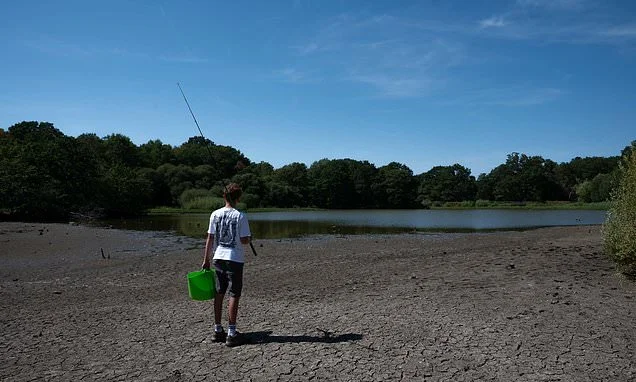
As rivers and ponds dry up, animals and disease-carrying insects can be forced into ever-smaller pockets of water, creating potential hotspots for infection.
A new review has examined almost 100 previous studies to investigate how increasingly dry conditions could reshape the spread of infectious diseases.
Britain is not immune to the disease risks created by drought, although the threats here would be different from those seen in other parts of the world.
One of the biggest concerns is leptospirosis, also known as Weil's disease, which is a bacterial infection already found in the UK.
The disease is spread by bacteria carried in the urine of infected animals, particularly rats and livestock, which can contaminate rivers, lakes and other waterways.
An infected human can experience symptoms from mild flu-like aches to life-threatening organ failure.
As rivers and ponds dry up, animals and disease-carrying insects can be forced into ever-smaller pockets of water, creating potential hotspots for infection. Pictured: The exposed, cracked and dried mud bed of Hollow Pond in east London
The researchers, from the University of Colorado at Boulder, warn that climate change is making droughts more frequent, extreme and unpredictable, creating a new challenge for controlling disease.
They warned that in the US and parts of Europe, West Nile virus and cholera could become more common thanks to increased dry spells.
While West Nile virus is not currently circulating in British mosquitoes, experts are already monitoring the possibility of it becoming established as the climate changes.
The UK Health Security Agency detected fragments of West Nile virus genetic material in British mosquitoes for the first time in 2023, although officials stressed there is currently no evidence of ongoing transmission in the UK.
Weil’s disease, on the other hand, is already present in the UK and is carried by animals including rats and livestock.
The bacteria can contaminate rivers, lakes and other surface waters through animal urine, and people can become infected when contaminated water gets into cuts or through the eyes, nose or mouth.
Symptoms range from mild flu-like aches to severe, life-threatening organ failure.
A similar concern applies to cryptosporidium, a parasite that can spread through contaminated drinking or recreational water. It can trigger stomach cramps, severe diarrhoea, vomiting and dehydration.
Britain is not immune to the disease risks created by drought, although the threats here would be different from those seen in other parts of the world. Pictured: Stoke Park in Bristol is pictured today after being left with parched grass by the dry weather
It's official – last month was the driest July ever recorded in England and Wales, the Met Office has confirmed
‘We are expecting to see shifts in the types of parasites and diseases that predominate in a drying world,’ they wrote in the journal Trends in Ecology & Evolution.
‘Some infections will disappear in certain places, but under different conditions, transmission can become so intense that it offsets the loss of infection elsewhere.’
They said that as drought shrinks water sources, animals may become concentrated around the remaining pools and rivers, potentially increasing opportunities for pathogens to circulate.
In North America, mosquito-borne illnesses such as West Nile virus and St Louis encephalitis virus have become more prevalent under some drought conditions.
Drier conditions can also increase the amount of contaminated dust in the air, potentially helping diseases such as Valley fever to spread.
Professor Pieter Johnson first witnessed the effect while studying frogs in California infected with a waterborne parasite that causes them to develop extra limbs.
When a severe drought struck in 2014, the shrinking ponds forced the amphibians into fewer remaining bodies of water.
The result was more severe infections and higher infection rates among the frogs.
With more than three-quarters of the world's land experiencing drier conditions in recent decades, the researchers say understanding these changes could be crucial for predicting future outbreaks.
Canals have been left running dry across England and Wales as Britain continues to bake in what could become its hottest summer ever.
It was the driest July on record, with the Met Office describing the month as an extraordinary period of heat, sunshine and almost complete lack of rain.
Water supplies are coming under increasing pressure, with hosepipe restrictions now affecting millions of people and further restrictions being considered in some areas.