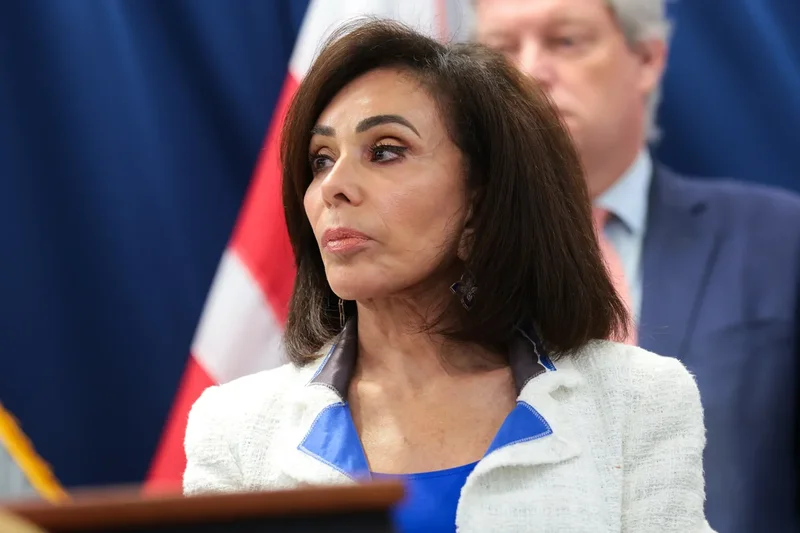
Donald Trump has spent several days criticizing his top federal prosecutor in Washington, D.C., Jeanine Pirro, after she dropped charges against a man accused of vandalizing the Lincoln Memorial Reflecting Pool in a stunning rebuke of the administration’s allegations against him.
Pirro’s job appeared to be on the line; the president has not confirmed whether he plans to fire her, and the White House has pressed her to deliver on cases that Trump wants to prosecute. He most recently urged her office to revive the case against David Hearn despite there being no evidence against him.
The former Fox News personality — who now answers to Trump’s former criminal defense attorney Todd Blanche after his confirmation as U.S. Attorney General this week — now appears to be leading a special grand jury that could be used to investigate the president’s political enemies, according to The Washington Post.
Pirro’s office has repeatedly failed to land criminal convictions in cases stemming from the Trump administration’s federal takeover of the nation’s capital and other politically charged cases. She is also now tasked with deciding whether to charge Dr. Anthony Fauci, another target among Trump’s allies, after House Republicans accused him of lying to Congress.
After repeatedly losing cases in D.C., the Trump administration could have a workaround in the form of Pirro’s office. With a rare and secretive special grand jury at the disposal of Trump’s Justice Department, Pirro’s office could be used to draft damaging reports about Trump’s critics, including current and former Democratic officials.
The subject and scope of the special grand jury’s inquiry is unclear. The Independent has requested comment from Pirro’s office and the Justice Department.
“We don’t confirm or deny the existence of investigations,” a spokesperson for Pirro’s office told The Independent.
But special grand juries are typically convened to investigate wider conspiracies and organized crime, including corruption among government officials.
Unlike a typical grand jury, a special grand jury could release a damaging report after an investigation, even if prosecutors fail to develop evidence to bring a case to a trial, and giving Trump valuable political ammunition.
The 23-person body needs only to show a “preponderance of evidence” to draft a report, which would need to be approved by a judge.
In D.C., that request would need to go before Chief Judge James Boasberg, who has overseen several high-profile cases targeting the Trump administration. Trump has demanded his impeachment.
A final report, like those from a special counsel, could then be used to implicate high-profile figures that Pirro’s office could not otherwise charge.
Critics fear those allegations could then be weaponized by Trump and his allies before midterm elections and the 2028 presidential election.
According to The Post, the grand jury will be overseen by Steven Vandervelden, who previously led controversial investigations into now-former Federal Reserve Chair Jerome Powell and D.C.’s Metropolitan Police Department.
Pirro’s office is in the middle of a streak of losses. Grand juries in D.C. have repeatedly declined to indict people at the center of politically loaded cases, and juries at trial have also rejected the government’s efforts to prosecute protesters caught up in the administration’s military occupation of the capital.
But her motion to dismiss the case against Hearn, weeks after she publicly accused him of “forcefully and violently” ripping out the Reflecting Pool’s Trump-requested blue liner, has outraged the president, who has spent days disputing the lack of evidence that Hearn vandalized the monument.
In a court filing asking for charges to be dropped, Pirro’s office admitted that the sealant started to peel “almost immediately” after the work was completed It was not until after the indictment was filed that the Department of Interior determined that the “damage was the result of a botched installation and not vandalism,” according to Pirro.
Last week, the judge overseeing the case agreed to dismiss charges against him and will hold a hearing next month on whether the dismissal should be granted “with prejudice,” which would prevent the Justice Department from charging him for the same alleged conduct.