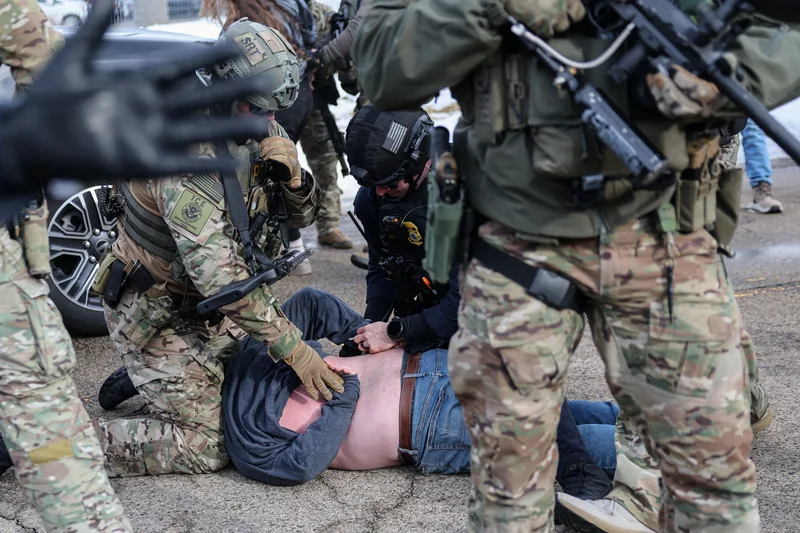
Since Donald Trump returned to the White House, agents with U.S. Immigration and Customs Enforcement (ICE) have grabbed people by the neck and pinned them down with their knees or hands on their backs 52 times during enforcement operations. They have restrained or dragged people by the neck on 19 occasions and used chokeholds at least 10 times. In at least 81 incidents, federal agents employed tactics so dangerous that many law enforcement agencies have restricted or outright banned them because they can cut off breathing, impede blood circulation and prove fatal.
The report Agents of Chaos and Cruelty, published by the American Civil Liberties Union (ACLU), analyzes more than 1,200 incidents in 2025, some recounted by Mexican nationals, involving the use of force and threats by ICE. It concludes that such practices have become routine tools of immigration enforcement.
The report, which reviewed incidents between January and December 2025 in Arizona, California, Colorado, Florida, Illinois, Louisiana, Maryland and New Mexico, identified 432 instances of misconduct by immigration agents. “We define misconduct as the use of force or threatened force, the use of intimidation tactics and retaliatory actions taken against those observing or documenting operations,” the report explains.
One of the cases highlighted involves Ricardo Aguayo Rodríguez, a 54-year-old construction worker from the Mexican state of Zacatecas and the father of two deaf teenagers. He was riding his bicycle home from a supermarket in Melrose Park, Illinois, when Border Patrol agents stopped him at the entrance to a house and sprayed him with pepper spray.
According to the complaint filed by his family, based on witness statements and videos, Rodríguez surrendered and posed no threat when one of the agents struck him in the head and placed him in a chokehold. A recording, widely circulated by U.S. media, captures him gasping in Spanish: “Por favor, amigo.”
Federal agents detain a person amid tear gas in Minneapolis, Minnesota, on January 21, 2025.Leah Millis (REUTERS)
In the report on the incident, Border Patrol agents said Rodríguez had “moderate injuries,” which they described as a “cut above his right eye.” Rodríguez’s family learned what had happened through acquaintances and tried to visit him in the hospital. Federal agents, however, denied them access. According to relatives, Rodríguez was discharged from the hospital in the early hours of the following day and taken to the Broadview detention center. He was later transferred to detention facilities in Indiana, Oklahoma and Texas before being deported to Ciudad Juárez, Mexico, with only the clothes he was wearing.
He spent approximately four months in immigration custody, during which, his family says, he was denied adequate medical care for his injuries. According to their account, he was also forced to sleep on the floor, and staff gave him pills that caused him to cough up blood.
According to the ACLU report, family members who recently visited Rodríguez in Mexico said that he had lost several teeth and suffered broken ribs, a dislocated collarbone, and severe injuries to his hand and other parts of his body.
“The incidents we reviewed indicate agents used force and the threat of force as default tactics and tools to coerce immediate compliance rather than to respond to a threat. Agents also turned to intimidation tactics — bullying, harassing, humiliating, and deceiving people — as they conducted enforcement, creating greater fear in communities and further undermining trust in law enforcement," ACLU states in the report.
The ACLU also documented 375 incidents involving the use or threat of force by federal agents. Of those, 241 involved physical force, while 128 involved threats of force, including the display of weapons or verbal threats. In 105 cases, agents used weapons such as batons, Tasers and flash-bang grenades. The report also recorded 86 incidents involving chemical irritants and 82 in which agents used their vehicles, including by boxing in or ramming other vehicles.
Another case highlighted in the report is that of Julio César Peña, a Mexican immigrant suffering from end-stage kidney disease. After federal agents detained him in the yard of his home in Glendale, California, he suffered a minor stroke and was hospitalized.
“He was shackled to the hospital bed by his hand and foot, and agents in the room listened to his calls,” the report states. “When his wife asked what hospital he was at, he said he could not tell her. His attorney could not get an answer either.”
Agents force the door of a house to make an arrest in St. Paul, Minnesota, on January 18, 2025.Leah Millis (REUTERS)
Authorities charged Peña with illegally reentering the country in 2005 after a prior deportation. His family denied this and was attempting to legalize his status because his son is an active member of the U.S. Army. After spending two and a half months in ICE detention and with his health deteriorating, he was released. He died at home after several weeks in the hospital.
In Oceanside, California, the Robles Ortega family was awakened in late June 2025 by armed agents who shattered their windows, deployed flash-bang grenades and sent a drone into the house. Video recorded by a neighbor who witnessed the operation shows heavily armed agents with weapons drawn, surrounding the house and breaking windows while announcing in Spanish that they had a warrant.
“I told them, ‘You’re acting as if you’re taking down a drug cartel or investigating a murder or something. This is crazy,’” said Ada Rocha, a neighbor of the family.
The parents, Arnoldo Robles and Angélica Ortega, were detained. Agents were executing a federal arrest warrant for Arnoldo, who was accused of being “a deported alien found in the U.S.” Court records show that he was convicted of driving under the influence in 2023 and, according to the San Diego County District Attorney’s Office, received a sentence of 358 days in jail and five years of probation.
Kevin Robles, the couple’s 17-year-old son and a U.S. citizen, and his 14-year-old sister, Raquel, were taken from the house in handcuffs. They were released only after neighbors intervened and reminded agents that they were minors and should verify their citizenship status.
“The handcuffs were as tight as they could be, and I kept asking if they could loosen them,” Kevin recalled. “They insulted me and said things like, ‘Stop being a bitch. You can handle it.’”
Kevin said his mother is currently fighting deportation and, while in detention, has yet to receive medical care she needs. He also said his father remains in federal custody and that he has been unable to contact him since both parents were taken away.
“It was very hard to process,” said Robles. “Knowing they had taken my parents... I couldn’t even say goodbye... Not a single word. The only thing they said was, ‘I love you.’ That was the last thing they said.”
Moment of Alex Pretti’s detention, before he was killed by agents, in Minneapolis on January 24, 2025.VIDEO OBTAINED BY REUTERS (via REUTERS)
The ACLU report notes that incidents like those experienced by the Robles family, in which ICE agents pushed, wrestled with, knocked down or physically restrained individuals, occurred 418 times in 2025. Agents also deployed chemical irritants on 361 occasions, including 132 times directly against individuals. They fired kinetic impact projectiles, such as rubber bullets, 75 times, with 50 of those instances targeting individuals directly. The report also recorded the use of flash-bang grenades in 59 cases and Tasers in 33.
The Mexican government has filed complaints in U.S. courts over the deaths of at least 17 Mexican nationals who died while in ICE custody or during immigration enforcement operations. On Wednesday, Mexico’s Foreign Affairs Ministry (SRE) said it has filed 20 criminal complaints in the United States: eight with state prosecutors and 12 with county prosecutors, over the deaths of Mexican citizens since May 2025.
“These lesser-known stories show that the horrific abuses our nation witnessed in Minneapolis were not an aberration — in fact, they are the tip of the iceberg," says the ACLU report. “What happened in Minnesota did not start in Minnesota, and it continues in communities across the United States as ICE and CBP’s funding and footprint continues to expand to a degree never before seen.”
Sign up for our weekly newsletter to get more English-language news coverage from EL PAÍS USA Edition