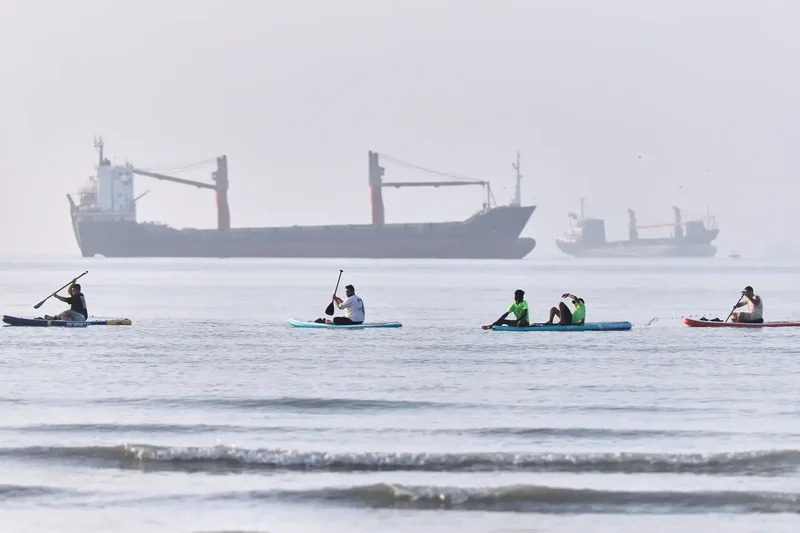
For decades, the Strait of Hormuz has been the world's most critical oil gateway, with millions of barrels of crude passing through it every day. But repeated disruptions to oil supplies across the globe have exposed just how vulnerable that dependence is, prompting Gulf nations to resort to an ambitious network of pipelines designed to move oil without relying on the narrow waterway.
From UAE to Iraq, governments and state-owned energy companies are accelerating projects worth billions of dollars to create alternative export routes linking oilfields to ports on the Gulf of Oman, the Red Sea and the Mediterranean. According to government officials, oil companies and analysts, at least seven major pipeline projects are either under construction, being planned or under discussion.
Before the war, around 15 million barrels of Persian Gulf oil passed through the Strait of Hormuz each day. Within the next few years, a sizeable share of those supplies could instead be transported through these new corridors, reducing the region's dependence on a route that runs alongside Iran's coast.
The urgency has grown as chokehold of the crucial strait continues and oil prices remain elevated. While alternative routes are not immune to disruption, Gulf producers increasingly see them as essential to protecting exports.
Even those alternatives face risks. Iran-backed Houthi rebels in Yemen have this week declared a blockade on Saudi-linked vessels attempting to transit the Red Sea, highlighting that bypassing Hormuz does not guarantee safe passage.
Still, Gulf producers believe diversification is necessary despite the prospect of longer shipping routes and higher transport costs.
Relying so heavily on the Strait of Hormuz "is no longer a prudent long-term strategy," said Victoria Grabenwoger, a senior researcher at the data and analysis firm Kpler.
Existing routes are carrying more of burden
Saudi Arabia already has one of the region's most important alternatives in place. Its East-West pipeline, built during the Iran-Iraq war in the 1980s, transports crude from the processing facility at Abqaiq to Yanbu on the Red Sea coast, where it is loaded onto tankers bound either for the Arabian Sea or the Suez Canal.
The UAE has also increased shipments through Fujairah, its key export terminal on the Gulf of Oman, about 145 kilometres (85 miles) south of the Strait of Hormuz.
Before the war, these two pipeline systems together had spare capacity of between 3.5 million and 5.5 million barrels a day, according to the US Energy Information Agency. That spare capacity has now largely been absorbed, with both routes operating close to full capacity.
UAE accelerates Fujairah pipeline
Abu Dhabi's state-owned oil company is speeding up work on a $3 billion, 300-kilometre (200-mile) pipeline that will run alongside an existing line to Fujairah.
The project is expected to increase supplies reaching the port by more than 1.2 million barrels a day.
Although construction began before the war, Kpler estimates the pipeline is about halfway complete. It is officially targeted for completion in early 2027, though Kpler expects mid-2027 to be more realistic because Fujairah's port infrastructure also needs to be expanded.
The ambitious timeline "has only become feasible against the backdrop of the Strait of Hormuz blockade," Grabenwoger said.
Iraq revives alternative export plans
Iraq, whose southern oil exports depend heavily on Hormuz, is also stepping up efforts to diversify export routes after the disruption forced it to scale back production.
The government, which derives around 90% of its revenue from oil sales, is working with US companies on pipeline proposals that would transport crude from Basra to the Turkish Mediterranean port of Ceyhan.
The proposed system would also include a branch to Syria's Mediterranean port of Baniyas, allowing up to 2 million barrels of oil a day to reach the terminal, which the US state department has described as "a critical energy corridor."
At the same time, Iraqi officials are discussing with Jordan the long-planned Basra-Aqaba pipeline, which would allow exports to move through the Red Sea or the Suez Canal.
Diversification comes with trade-offs
Analysts at Goldman Sachs estimate that the planned bypass projects could carry 3.8 million barrels of oil a day by the end of next year, rising to 7.3 million barrels a day by the end of 2028. That would shield around 60% of the Gulf's pre-war oil exports of 23 million barrels a day from any disruption in the Strait of Hormuz.
The new routes, however, will increase both shipping time and costs.
Pipelines carrying crude to the Mediterranean move oil away from Asian markets, meaning tankers must travel around the southern tip of Africa to reach their final destinations.
Supplies routed to Saudi Arabia's Red Sea coast also remain exposed to attacks by Houthi rebels, who have previously disrupted shipping at the Bab el-Mandeb Strait linking the Red Sea and the Gulf of Aden.
Although oil loaded at Yanbu can pass through the Suez Canal, the canal cannot accommodate the largest crude tankers, each capable of carrying up to 2 million barrels and often the most economical option for long-distance transport.
Even infrastructure farther from Iran remains vulnerable. Saudi Arabia's East-West pipeline was shut down after a Houthi drone strike in May 2019, illustrating that pipelines can also be targeted by the Revolutionary Guard or militant groups allied with it.
While Gulf countries work to secure alternative routes for crude exports, another challenge remains unresolved. Before the war, about one-fifth of the world's liquefied natural gas, much of it from Qatar, also transited the Strait of Hormuz, leaving LNG exports exposed to the same disruption.