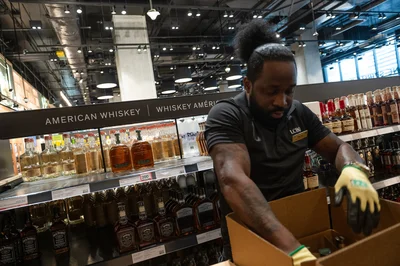

An LCBO employee removes American whiskey from the shelves at an LCBO in Toronto in March, 2025. Prime Minister Mark Carney says the decision to ban the sale of U.S alcohol was made in response to U.S. tariffs and 'threats to our sovereignty.'Laura Proctor/The Canadian Press
The decision to put U.S. alcohol back on the shelves in most provinces should be part of an overall agreement with the United States, Prime Minister Mark Carney said Tuesday, as Canada faces the threat of 50-per-cent tariffs from U.S. President Donald Trump.
Mr. Carney also said it will be up to the provinces to decide, as premiers meet this week in Prince Edward Island, where the alcohol ban is expected to be the source of heated debate.
The Prime Minister told reporters in Ottawa on Tuesday that banning the sale of U.S alcohol was done in response to U.S. tariffs and “threats to our sovereignty,” and is supported by provincial citizens.
“The decision to change that first and foremost will be taken by the provinces themselves, each individually, and should only be taken, in my judgement, as part of an overall agreement. And that’s what we’ll work to accomplish,” he said.
The premiers’ annual summer gathering is happening as the United States is escalating its trade war against Canada. The Trump administration announced Monday that it plans to impose new tariffs on a range of goods in response to Canada curbing imports of U.S. autos, alcohol and dairy.
A major irritant for the Trump administration has been the decision of most provinces to remove U.S. alcohol from store shelves in response to American tariffs on steel, aluminum and autos, which disproportionately hit Canada because of the two countries’ integrated economies.
One of the orders from the U.S. says Canadian imports of U.S. alcohol dropped by 81 per cent since the bans took effect.
Views about the booze ban are split among the provinces, with Alberta and Saskatchewan allowing the sale of U.S. alcohol, while Ontario and British Columbia have stood firm on the exclusion.
“There is not a chance in hell that U.S. alcohol is going back on the shelf in British Columbia,” B.C. Premier David Eby told reporters in Charlottetown on Tuesday.
The idea that the President “can bully us into whatever he wishes is incorrect,” he said.
He added that this is not the time for Canada to capitulate.
Ontario Premier Doug Ford is set to speak with reporters later Tuesday morning.
Saskatchewan Premier Scott Moe said Tuesday that he expects the ban will be raised among the Premiers. He said it will be up to the federal government to request that it be lifted -- and that it’s his understanding that Ottawa has already made such an ask in the past.
“I won’t say I won’t expect that ask to come. I think it’s already been made in some cases,” he said.
Mr. Moe said he chose not to ban U.S. alcohol from his province as he didn’t see the benefit.
“What we found in Saskatchewan was there wasn’t going to be an advantage in putting that particular ban in place in our province,” he said.
Mr. Carney is set to hold a virtual meeting with the Premiers on Tuesday afternoon to update them on the tariffs. He is scheduled to join the group later in PEI later this week.
PEI Premier Rob Lantz, who is this year’s chair of the premiers’ group known as the Council of the Federation, said he spoke with Canada-U.S. Trade Minister Dominic LeBlanc and chief trade negotiator Janice Charette on Monday evening.
He said the new tariffs, which are set to take effect on Aug. 19, present Canada with a new opportunity to hammer out a deal with the U.S.
Mr. Lantz added that it’s “yet to be seen” whether American alcohol will be sold again in PEI.
“That’s an irritant for the United States, but there’s certainly many irritants for Canadians,” he said.