The “outrageous” handcuffing of a New Orleans journalist covering the indictment in July of Louisiana’s attorney general – a case that ultimately was dismissed – conveyed “a chilling message to members of the press and the public” for which there is no excuse, according to a prominent media rights advocacy organization.
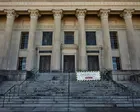
An attorney for the Reporters Committee for Freedom of the Press (RCFP) made those assertions in a recent letter to the New Orleans criminal district courthouse where deputies temporarily detained WWL Louisiana investigative producer Danny Monteverde and outlet lawyer Elana Beiser in the course of their duties in early July.
Beiser and Monteverde, whose station is a Guardian reporting partner, were trying to object to judge Leon Roche’s closure of the courtroom where a grand jury had handed up an indictment against state attorney general, Liz Murrill, on accusations that she had threatened the jobs of Democratic New Orleans officials who fought a Republican-led overhaul. A 5 August letter from RCFP attorney Virginia Hamrick to New Orleans criminal court chief judge contended that there were “no findings justifying closure” and urged the courthouse to “properly hear and consider objections of the public and the press before any … proceedings are closed”.
“Refrain from detaining reporters (or their counsel) who are simply exercising their constitutional rights,” which include the access to court proceedings, Hamrick’s letter continued. The missive added that such “outrageous actions send a chilling message to members of the press and the public who may seek to object to closure in the future”.
“Members of the public – including journalists – should not fear being hauled away in handcuffs merely for asserting these basic rights,” Hamrick went on, saying open access to court proceedings “informs the public, ensures an accurate portrayal of proceedings and promotes government accountability”.
The letter alluded to arguments from Roche that he closed the courtroom where the indictment had been handed up – and outside which Monteverde and Beiser were handcuffed – in order “to protect grand jurors’ safety and anonymity”.
“But such concerns do not warrant the closure of a courtroom without hearing objections to such closure,” Hamrick’s letter said. “Moreover, there is no excuse for deputies to handcuff reporters and counsel asking to be heard.”
Hamrick’s letter also offered the New Orleans criminal courthouse “comprehensive and collaborative training regarding the importance and legality of access to judicial proceedings” from the RCFP, whose steering committee members include highly regarded former Washington Post editor-in-chief Marty Baron and Atlantic editor-in-chief Jeffrey Goldberg.
The Guardian reached out to Lombard, Roche and WWL for comment.
Prior to Monteverde and Beiser’s handcuffing, there had been months of political tensions between Louisiana Republicans and New Orleans Democrats over a law that eliminated a court clerk position won in an election by Calvin Duncan, who spent nearly three decades in prison in connection to a murder that he was exonerated of having committed.
New Orleans leaders opposed the elimination of that office, which was consolidated with another post. And they unsuccessfully attempted to schedule an election that would have given Duncan a chance to win the consolidated clerk job.
Amid that politicking, Murrill issued letters to New Orleans officials warning them that their offices could be taken from them as well for purportedly violating state “usurper” laws, which prohibit supporting an unauthorized officeholder.
A New Orleans grand jury then voted to return an indictment against Murrill charging her with intimidation and malfeasance. Louisiana law requires grand jury returns to be made in open court. So when Roche tried to clear out and close the courtroom where Murrill’s indictment would be returned on 2 July, Monteverde and Beiser protested.
The courtroom was nonetheless emptied and closed. Deputies then ordered Monteverde and Beiser to leave the courthouse – a public building – entirely, and temporarily handcuffed the pair after they protested again.
A statement issued on 3 July by WWL said “no … journalist should be detained for seeking transparency or asking questions about access to a courtroom, particularly when state law provides for proceedings to occur in open court”.
Roche later indicated in court filings that he never instructed deputies to “detain any members of the media”. The sheriff’s office, which provides courthouse security, for its part said that its deputies “acted in accordance with the directives they received” to protect grand jurors and other proceeding participants.
Louisiana’s state supreme court put the case against Murrill on hold almost immediately, ruling that procedures surrounding the indictment had not been properly followed. A special prosecutor brought in to handle the case then dismissed the case against Murrill on 22 July – a day after she was urged to do so by a letter from New Orleans district attorney Jason Williams, mayor Helena Moreno and five city council members.
Murrill reacted to the dismissal of the case by saying: “What I did was not a crime – it was never a crime. I think this was a malicious prosecution.”
Meanwhile, the letter from Williams, Moreno (herself a former broadcast journalist) and the others said: “The people of New Orleans are not served by this prosecution, which continues to alienate the city from the rest of the state and distract from the important work we have ahead.”
The Associated Press contributed reporting