Soviet-era architecture is much maligned with its concrete, utilitarian forms often seen as representative of the rigid authoritarian regime that spawned it.
But it is that very representation that has made the style valuable to the architectural canon. It tells its origin story loud and clear, and where it survives, its present-day use shows how communities build on history.
Now, there’s a new star of this design movement.
Tashkent has just achieved UNESCO World Heritage status for its collection of 20th-century modernist architecture. But Tashkent’s buildings are outliers.
On April 26, 1966, a catastrophic earthquake destroyed much of the ancient capital of then-Soviet Uzbekistan. The disaster left hundreds of thousands homeless.
The latest travel news, tips and inspiration delivered to your inbox. Sign up now.
Architects and workers from across the USSR descended to rebuild it as a utopian socialist model city of the “Soviet East”. The result was an experimental hybrid style known as Tashkent Modernism (or Seismic Modernism), which combined earthquake-resistant Soviet modernism with centuries-old Central Asian Islamic motifs.
But more than 30 years have passed since the fall of the Soviet Union and the 2000-year-old city is changing again. Amid the progress, the Uzbekistan Art and Culture Development Foundation (ACDF), led by Gayane Umerova, has been working towards the preservation of this mid-century chapter. With the help of historians and architects, it made the successful bid for UNESCO listing.
“This inscription brings a vital part of Uzbekistan’s recent architectural history into the international account of 20th-century heritage and the global modernist movement,” says Umerova.
“These buildings record how Tashkent imagined public life, collective identity and the future through architecture. The UNESCO recognition also carries a long-term responsibility: to conserve these buildings with rigour, keep them part of the life of the city and pass their knowledge to future generations.”
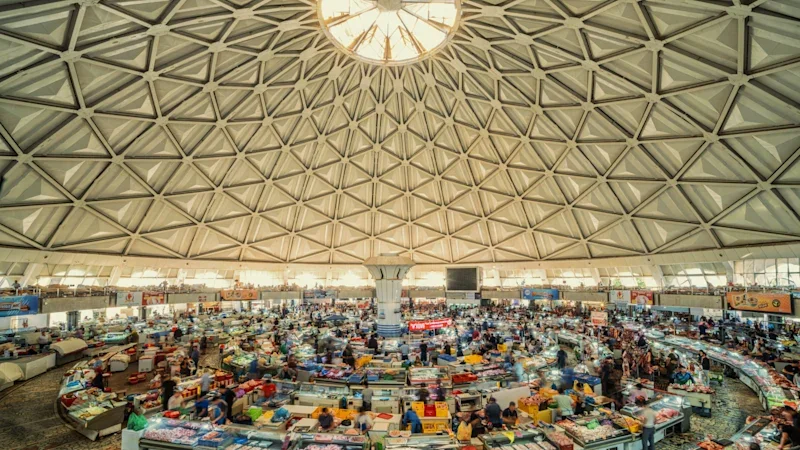
The listed buildings include Chorsu Bazaar with its shiny ceramic bowl-shaped roof, Tashkent Circus, a flying saucer-like circular building topped by a blue dome and one of the city’s best-known modernist landmarks; and Kosmonavtlar metro station, whose shimmering blue interiors pay tribute to the Soviet space program and the cosmonauts of the Space Age.
With Central Asia’s “Stans” having a travel moment, the listing gives visitors another reason to explore a capital some have perhaps rushed through. It is the gateway to Uzbekistan’s Silk Road jewels of Samarkand and Bukhara.
The listing is the latest development in a story of optimism. Since Uzbekistan began opening up to tourism under President Shavkat Mirziyoyev in 2016, investment has flowed into improved visitor infrastructure, making it increasingly a place to explore in its own right.
Uzbekistan welcomed a record 11.7 million international visitors in 2025, the majority from neighbouring countries but with growing numbers arriving from further afield.
Intrepid Travel says Central Asia is now one of its fastest-growing regions. Compared with pre-pandemic bookings, it says Kazakhstan bookings are up 1550 per cent and Uzbekistan 137 per cent. More broadly, Intrepid reports bookings across Central Asia have continued growing at about 30 per cent year-on-year.
Some might think of countries like Afghanistan, Iran or Pakistan in their perception of the broader region, but the main places tourists visit in Uzbekistan – Tashkent, Samarkand, Bukhara and Khiva – are reasonably well-removed from all that.
Of course, it’s always a good idea to check the latest travel advice (Smartraveller currently recommends travellers “exercise a high degree of caution” for Uzbekistan) but the country has been working hard to make visitors feel welcome over the past 10 years.
Central Asia rewards travellers with a mix of experiences. Ancient Silk Road cities give way to mountainous wilderness, while metropolises such as Tashkent offer modern urban life. Each of the five “Stans” also offers their own unique culture and environment.
With Uzbekistan now home to eight UNESCO World Heritage properties and the five Central Asian republics collectively home to nearly 30, the region’s emergence as a mainstream destination may simply be a matter of time.