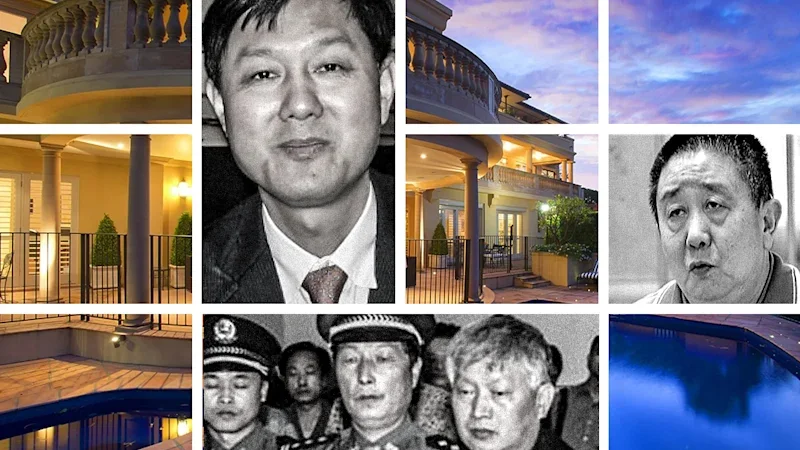
Phillip Dong Fang Lee has long been an enigma among his fellow rich listers. First there was the $39.9 million in cash he paid for his Point Piper mansion. Then there was the more than $2.2 billion he ploughed through Star’s Sydney casino. Last month, his 25-year-old son Felix Ming Ze Lee hosted a fundraiser for Prime Minister Anthony Albanese at the family home Mandalay.
One mystery has pervaded it all: how did a reclusive businessman of such obvious financial means become one of the country’s wealthiest people without ever starting a major corporate enterprise in Australia?
Under scrutiny from the Australian Taxation Office over a $280 million debt, Lee said the hundreds of millions of dollars sent to his Australian bank accounts from China were, by and large, loans from his wealthy mother, Zhangzhu Li.
It is not a story the tax office accepts. In a detailed affidavit before the Federal Court, the ATO alleges Phillip Lee secretly controlled business and financial interests in China despite vowing to Australian authorities that he had sold his Chinese business assets, and that the purported loans from China were “sham arrangements” designed to conceal the true source and character of foreign income. There is no suggestion by this masthead that the allegations are true, only that they were made.
His son, Felix Lee, who hosted Albanese along with Commonwealth Bank chief executive Matt Comyn and former Victorian premier Dan Andrews for the $10,000-a-head Labor fundraiser at his mansion last month, echoes the claim that his 92-year-old grandmother controls the family wealth.
Former federal treasurer Joe Hockey, now chairman of Felix Lee’s family office, harbours no doubts about the provenance of the Lee family’s wealth, describing it as “very genuine, very real”.
“His family made money out of infrastructure in China. So what? What’s wrong with that?” Hockey told the Australian Financial Review on August 3.
What Phillip Lee did not tell the tax office – despite three interviews with officials throughout its four-year investigation – were details about his relationship with Niu He’en, an infrastructure tycoon known in China as the “Bull Demon King” and “Ox Head”, who made his fortune overseeing highways between Shantou and the emerging metropolis of Shenzhen.
In the mid-1990s, Niu was the transport chief of Guangdong, a province with four times Australia’s population. He was also a provincial member of the Chinese People’s Political Consultative Conference, the Chinese government’s top advisory body.
He is also Phillip Lee’s father-in-law.
Niu was accused in 2005 of abusing his position as a high-ranking party official to approve excessive charges in favour of Lee’s company Guangdong HuShen. In Chinese media coverage of the trial, Niu earned the nickname “generous father-in-law”.
Like Lee, Niu was also well known for his fondness for gambling. Business publication Caixin reported he always kept a mahjong set in his car when he travelled.
The high-profile corruption trial laid bare how Niu had overseen state losses of more than $20 million. It also landed him a 13-year prison sentence.
Lee was a key figure in the trial but he was not charged by Chinese authorities.
In response to detailed questions, Felix Lee said many of the matters raised relate to historical events, allegations and individuals other than him. “I was born in Australia and am focused on building a business that contributes to Australia’s economic success,” he said.
Hockey dismissed concerns about the criminal past of the Lee family and said people should be judged on their own conduct, character and achievements.
“Frankly, many of the matters raised are highly speculative, relate to events that allegedly occurred in another country decades ago, and are being assessed through the prism of limited public records,” Hockey said. “I do not believe that is a fair basis on which to judge Felix or the business he is building today.”
Phillip Lee and his wife Xiaobei Shi could not be contacted through their lawyer or at their Point Piper home.
Romance blossoms
Phillip Lee was known by his Chinese name Xie Fei when in the mid-1990s he first obtained Niu’s favour after he romanced his now-wife, according to a report published by the Guangdong Provincial Commission for Discipline Inspection.
“[Lee] shifted his attention to Niu’s daughter [Xiaobei] Shi, who was then studying at university,” according to a report in Caixin.
“He frequently drove her to and from school, taught her how to drive and gave her a mobile phone. Before long, the two began a romantic relationship.”
The relationship paid dividends for Lee, Caixin reported, when it emerged Niu had awarded him an overinflated 180 million yuan contract to build guardrails along the highway.
The stretch between Shantou and Shenzhen had become synonymous with shoddy infrastructure and unchecked corruption that characterised the Gaizhi era of China’s opening up period, when state-owned operations were transferred to private operators.
By 2004, 280 people a year were dying on the highway between Shantou and Shenzhen, Chinese state media reported, earning it the reputation of a “blood-stained road of death”.
That same year, prosecutors in the Guangzhou Intermediate People’s Court said a comparison of the guardrail projects on the eastern and western sections of the expressway found the eastern section constructed by Guangdong HuShen averaged 1.287 million yuan per kilometre – more than double the average 567,200 yuan per kilometre of the western section.
“The losses and waste caused by this project amounted to no less than 110.9463 million yuan,” the Guangdong Provincial Audit Office concluded.
By the time it was finished in late 1996, the scandal ultimately led to the downfall of nearly 30 public officials.
Others escaped. The People’s Bank of China estimated that during China’s mid-1990s infrastructure boom, thousands of corrupt officials had stolen nearly $174 billion and had fled overseas.
During his corruption trial, Niu had sought to distance himself from his son-in-law by stating that “when the project was being carried out, [Lee] was a contractor, not my son-in-law”.
Niu argued that his offences did not carry “criminal responsibility but administrative responsibility”.
He did not convince the judges. Niu was sentenced to jail in 2005 for 13 years for accepting bribes. He was convicted of an abuse of power that caused state losses of more than 100 million yuan.
Compared to other officials, Niu got off lightly. According to Caixin, the case that led prosecutors to Niu in the first place was a separate deal involving Lee and another of his relatives, Lu Wanli, the transport chief of the nearby Guizhou province.
Lu had arranged a 470 million yuan contract for Lee’s company to install guardrail clamp blocks along another highway in Guizhou in 1999.
It was the same clamp block system to stabilise concrete posts Lee had used between Shenzhen and Shantou, priced at several times higher than its cost, causing economic losses totalling hundreds of millions of yuan in the two highway construction projects, Caixin reported.
After Lu was charged with corruption over bribes worth $4.5 million in 2004, he fled to Fiji via Hong Kong on a fake passport. He was later caught and was executed the following year.
Lee was not accused of wrongdoing, but his involvement in both cases connected two of the most senior transport chiefs in southern China.
By the time Lee’s relatives had been jailed and executed in China’s corruption purge, he and Niu’s daughter Xiaobei Shi had married and moved to Australia. The couple tied the knot in early 1999, according to the ATO. She was 22, and Lee was 32.
Life in Sydney
By 2015, the couple were well established in Sydney. Among their most significant acquisitions was their Point Piper trophy home, Mandalay, which set a then non-waterfront record of almost $40 million.
The couple’s prized holiday retreat is a 400-hectare bushland property on the NSW Mid-North Coast, purchased 20 years ago with no need for finance for $8.8 million, and which has since become renowned among locals for its history of fines and court orders over environmental protection breaches.
Lee and Shi’s other significant trophy is the Terrey Hills Golf and Country Club, a prestigious championship course of which Felix Lee is now chairman. Former Victorian premier Dan Andrews, a golf fanatic, was spotted at the course a day after attending Felix’s Labor fundraiser at the family mansion.
In a 2021 business loan for the golf club, cited by the tax office, Lee allegedly said his infrastructure construction business had over 20 subsidiaries and an asset portfolio of $2 billion and 60,000 staff across China.
Chinese corporate records show Lee’s company Guangdong HuShen was once the owner of Xinjiang Transportation Development Co, and the majority shareholder of Xinjiang Miquan Transportation Chemical Co and Xinjiang Miquan Traffic Signage Co. All three entities were headquartered in the far western Chinese province of Xinjiang, where the Chinese government has denied allegations of widespread human rights abuses.
Guangdong HuShen’s licence was revoked by authorities in 1998 for failing to pass annual inspections the previous two years. Miquan’s business licence was revoked in 2005, according to the tax office.
Albanese, who attended the $10,000-a-head fundraiser at Felix Lee’s mansion on behalf of the Labor Party, did not respond to questions about the Lee family’s history. His office also did not answer questions about whether it was aware of Phillip Lee’s links to corrupt family relatives, what due diligence had been carried out before the fundraiser on his hosts or whether the Labor Party will keep the donations from the dinner.
Family ties
While Phillip Lee has never publicly spoken about his father-in-law in Australia, he has spoken at length to the tax office about his mother Zhangzhu Li and his late father Shiwen Xie, who died suddenly in 2010.
Last week, Felix Lee also opened up about his paternal grandparents for the first time. He told the Financial Review they were infrastructure magnates whose business, Hainan Baotong Construction Co, built swaths of highway around the island province.
Felix Lee did not respond to questions asking for evidence of the infrastructure the company built.
“My grandfather worked extremely hard. He built everything, and he was in civil construction, so highways, tunnels, all the connecting infrastructure in China,” Felix told the Financial Review. “He had a really successful career, and, you know, when he passed, he passed that on to my grandmother. She’s enjoying the fruits of her and my grandfather’s labour. And I’m incredibly fortunate to be her grandson.”
The ATO sees things differently. In its evidence to the Federal Court, the tax office affidavit described the 92-year-old family matriarch and her late husband as people who had never lodged tax returns in China and were therefore unlikely to have ever earned substantial incomes.
The tax office not only alleged Phillip Lee used “sham arrangements” to funnel funds from China to Australia to finance his Australian business, property and gambling activities, but it also suspected he still had business and financial interests in China despite his earlier telling the authorities he had sold his Chinese business assets. The allegations have not been tested in court.
Despite putting $2.2 billion through Star City casino over 15 years, Lee incurred only $57 million in losses over the same period.
The tax dispute was settled in 2023 for an undisclosed amount, but Lee and his wife’s property empire remains under the control of the Commonwealth government, given the debt is yet to be paid in full.
In interviews with the tax office about his father’s business interests cited in the affidavit, Phillip Lee recalls only two companies, one of which is Shanghai Baotong.
Company reports obtained by the tax commissioner show Shanghai Baotong was registered in August 2011, a year after Phillip Lee’s father died. Lee told the tax office it was set up to receive money from the sale of his father’s businesses.
“Notwithstanding that Mr Lee advised that his father was a businessman, no companies have been identified with Mr Lee’s father being registered either as a shareholder or a legal representative,” the tax office affidavit says.
Two months ago, Lee’s mother, Zhangzhu Li, was appointed as the legal representative of a new company in China, Shanghai Chenyao Dingyong Construction Co. She had just turned 92.