How Adriano put up a small home in a day - and made it fire-resistant
Save
You have reached your maximum number of saved items.
Remove items from your saved list to add more.
AAA
The morning after a ferocious bushfire tore through a NSW South Coast community, architect Adriano Pupilli returned to find out what was left of his holiday cottage and the innovative prefab flatpack bush cabin he’d invented, designed and built himself.
Both were still standing but, as he set about doing repairs, he decided he’d pivot to creating an easy-to-construct modular tiny house that would also be bushfire resistant instead.
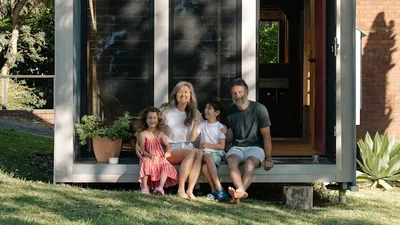
Adriano and his family at their tiny home.Adriano Pupilli Architects
“My pregnant wife and our three-year-old son escaped when they were picked up by a fishing group from down the coast at Ulladulla,” said Pupilli. “Then I had to get out when everything was on fire just before the front came. It was pretty scary.
“I went back, thinking everything will have gone, but the fire jumped over the site, so the buildings were damaged and charred but, crazily, had survived. So this time, I thought I’d design a self-contained cabin that was highly resistant to bushfire.”
The final Casa Manyana tiny house prototype has been rated a lofty Bushfire Attack Level (BAL) 40 – suitable for a very high bushfire-risk environment, capable of withstanding extreme radiant heat and probably direct exposure to flames.
Just like his first IMBY (in my back yard) model, it continues the same spirit of DIY assembly, sustainable materials and a modular kit of parts that all slot perfectly together, with no need for nails, screws or glue in the structure.
The home is made from a modular kit. Adriano Pupilli Architects
As such, it could be an adjunct to a regular house in a bushfire area, increasing space or providing safe accommodation for guests, or could be used after a fire when a family needs somewhere to live while rebuilding.
“It’s a great idea,” said Dr Hugo Moline, lecturer in architectural practice \& design at Newcastle University, who has followed the progress of the project. “With the housing crisis, we really need a lot more dwellings, and this can be erected quickly on a little plot of land, can work for multi-generational families and can help people back onto their land after a disaster.
“It’s so much more comfortable and dignified and safe than a caravan or camping or living out of a shipping container. The components can be brought easily onto a site, it’s affordable and accessible and you don’t have to be massively skilled to put it together.”
The retail price for a Casa Manyana – named after the village 215km south of Sydney where Pupilli built it after the devastating fires of 2019-2020 – would be about $75,000 to $120,000 depending on size and design options.
The kitchenette and sleeping loft.Adriano Pupilli Architects
The form of his own 18-square-metre cabin, with a two-square-metre deck, a living space with a sofa bed, sleeping loft, a kitchenette and bathroom was put up, with the help of two friends, in a day, and turned into a fully clad structure in four. Tiling, electrical work and plumbing took extra.
A protective outer layer of zincalume-rolled cladding and fibre cement creates a resilient structure, while plantation pine and plywood ensure a warm, welcoming interior. There’s high-performance insulation for thermal comfort, and operable louvre windows are meshed for bushfire resistance and cross-ventilation.
At Ember Bushfire Consulting, Peter Hague says much of his work lies in assessing the risks of new development in bushfire zones. “But this could be a good idea and, with such a high BAL rating, especially for people already affected by bushfires,” he said.
Archicentre Australia director Peter Georgiev says anything that can assist people in bushfire-prone areas is welcome.
The home is fast to construct but plumbing took extra time.Adriano Pupilli Architects
“That’s especially if it’s something that keeps the cost down, and allows them to keep a foothold on their property,” he said. “We’re really trying to deal with these sorts of issues, so anything we can do to encourage these kind of innovations.”
Dr Iftekhar Ahmed, associate professor in construction management/disaster resilience at the School of Architecture and Built Environment at Newcastle University, says it’s important to have structures that can minimise bushfire damage, give people time to escape and help them to return and rebuild.
“We need better options than what’s already available in the market,” he said. “This could be a good idea but it needs testing in bushfire conditions and needs to be explored in greater detail to see if it’s a viable option.”
Pupilli is keen to cooperate with national or state organisations looking for good options in bushfire areas.
“I wanted to do emergency housing or additional housing that would be different to the typical dongas and shipping container pods,” he said. “At the same time, they are also resilient to danger and more sympathetic to the landscape and a delight to be inside.
“They are architect-designed, site-specific options that allow people to get back on the land and rebuild quicker and be safer in the elements.”
Save
You have reached your maximum number of saved items.
Remove items from your saved list to add more.
Sue Williams is a Sydney-based freelance travel writer, author and journalist who's filed for newspapers, magazines, radio and TV stations around the world.Connect via email.