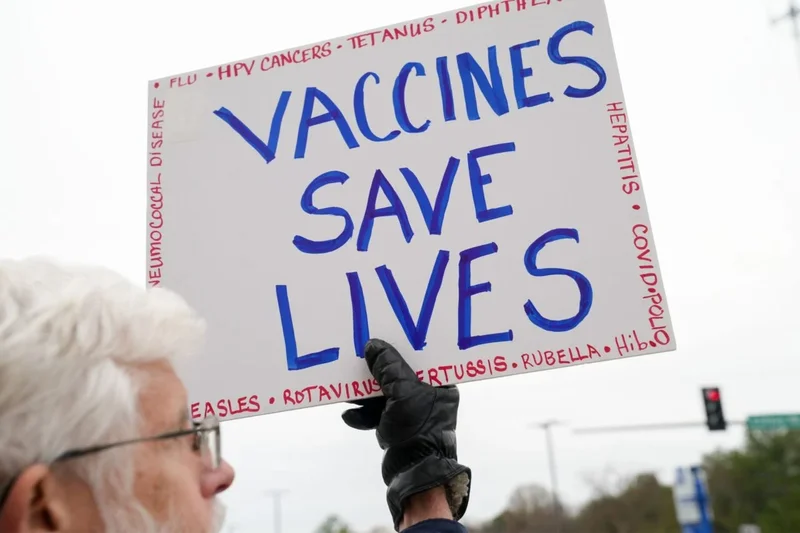
Vaccines are one of the most important medical advances humanity has ever made, so it’s troubling then that more children in America are going unvaccinated according to new data from the Centers for Disease Control and Prevention.
On Monday, the CDC released its latest figures on the vaccination coverage of U.S. kindergartners. Though a large majority of children are still being vaccinated for diseases like chickenpox and measles, the national vaccination rate continued to decline during the 2025 to 2026 school year, the CDC found. Vaccine exemptions are also on the rise, most of which were for non-medical reasons.
Vaccine coverage dropping
The CDC tracks the uptake of several vaccines widely mandated by states for children to enter public school. These vaccines cover polio, pertussis, diphtheria, tetanus, hepatitis B, chickenpox, measles, mumps, and rubella.
Overall, nationwide coverage of these vaccines is still very high, at over 90%. But there has been a noticeable decline in the rate over the past few years. And compared to the previous year, coverage among kindergartners in the U.S. decreased for all reported vaccines during the 2025 to 2026 school year, the CDC data shows. These rates ranged from 92.0% for the diphtheria, tetanus, and acellular pertussis vaccine (DTaP) to 92.4% for the measles, mumps, and rubella vaccine (MMR) and the polio vaccine. Roughly 280,000 children were missing the MMR vaccine in particular.
Conversely, explicit exemptions for vaccines have also increased. During the 2025 to 2026 school year, exceptions covering at least one vaccine were issued for 4.2% of kindergartners, up from 3.6% the prior year. Last year, only 0.2% of exceptions were for medical reasons, in line with recent trends. Exceptions rose in 41 states and nearly half the country (24 states) had exception rates over 5%.
The return of vaccine preventable diseases
Vaccines have helped virtually eliminate many of the diseases once common to the U.S., including measles, chickenpox, and polio. And obviously, the lower that vaccination rates drop, the greater the chance at least some of these diseases can regain a foothold in the country, which is something we might already be starting to see with measles.
For the past two years, the U.S. has been in the midst of the worst measles outbreak in decades. These outbreaks are so far largely centered around communities with very low vaccination rates; however, because measles is so contagious, even a small drop in the rate can allow the viral infection to continue spreading widely. Right now, the country is below the threshold expected to provide sustained herd immunity from measles (around a 95% vaccination rate). Below that threshold, measles will not only spread more easily among families whose children are willingly unvaccinated, but also to children who are too young or medically not able to be vaccinated.
Unfortunately, this situation isn’t likely to get better anytime soon. Just last week, President Donald Trump issued an executive order aimed at cutting short the CDC’s list of recommended childhood vaccines. The order also pushes for states to be more permissive in issuing vaccine exceptions and for splitting up the MMR vaccine into three separate vaccines, a move that would almost certainly lead to less vaccinations of all three diseases. Trump has also reportedly signaled that he wants health secretary Robert F. Kennedy Jr. to be more aggressive in validating the debunked link between vaccines and autism, which is likely to increase vaccine hesitancy even further.