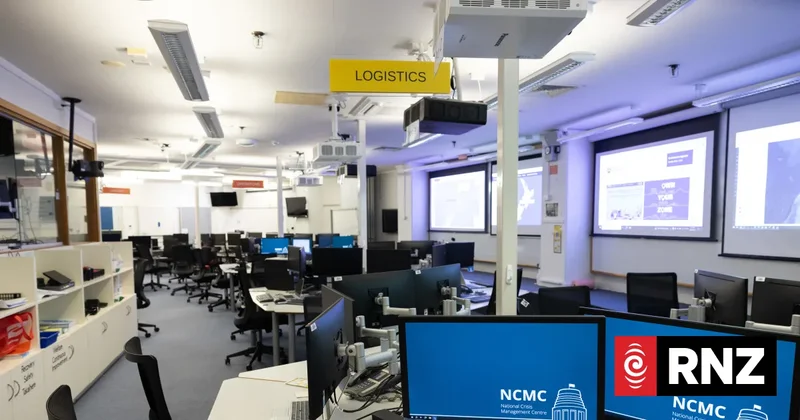
Documents show with a destructive storm bearing down on the South Island last October, some laptops in the Beehive bunker could not access the emergency management system.
The National Emergency Management Agency (NEMA) says now that it didn't matter, that staff had other devices that did work.
The problem has come to light in a review released under the Official Information Act of how NEMA was shifted from the Department of Prime Minister and Cabinet to the Department of Internal Affairs (DIA) late last year.
The reshuffle, costing just over its $2 million budget, was effective but done hastily over three months and a host of difficulties were underestimated.
"The transfer was framed as a 'lift and shift of NEMA' ... The reality was substantially different to 'lift and shift'," said the review done last November.
"The post-transfer technology support and project structure was underestimated."
In one case this meant that a vendor company failed to fully finish a job leading to the problem with new DIA laptops staff had been issued.
This was not apparent till states of emergency were declared in late October in Canterbury, Southland and parts of Otago.
"It became apparent in the lead-up to an emergency activation that some aspects of the transfer had not been adequately completed by the vendor, meaning NEMA staff were unable to access the emergency environment in the bunker through their DIA devices," said the short review.
But other laptops linked to the National Crisis Management Centre (the bunker under the Beehive) did work.
"Our response activities weren't impacted, which is a good thing," NEMA told RNZ.
"Staff had full access to all applications and tools required to support response activities, and there were no impacts to response operations, support to [Civil Defence] groups or access to systems."
DIA said it was accountable for making sure the tech worked. Since then it had got Datacom to make technical changes to allow access.
NEMA made the shift between departments in just 10 weeks when it had a lot on its plate.
It had recently embarked on a five-year overhaul of old, fragmented disaster response technologies and introducing new ones, such as a new national warning system, in response to Cyclone Gabrielle. An internal report suggested alongside the tech it must also helm a really big and uncertain cultural shift to be sure of lasting change in the previously fragmented sector.
Last week the agency's fledgling tech failed under pressure, with the civil defence website crashing during a tsunami alert near Te Anau, and its just-launched emergency mobile alert map not quickly updating about either the tsunami or flooding the previous week in Wairoa.
Emergency Management Minister Mark Mitchell said he would be meeting NEMA this week to make sure the website was fixed.
Last year's shift demanded that four agencies cooperated, including Treasury.
Cabinet agreed in April 2025 on the shift and wanted it done fast, starting in June and done by September 25.
"Agencies successfully completed a significant level of work to transfer people, data, and
information," said the 10-page review.
"The overwhelming feedback from NEMA staff is the transfer was well communicated, the
products and services are of a high standard, and the project was delivered by DIA in a
very tight timeframe with minimal disruption to NEMA's core business."
However, there was a very big "but" - the review's section on what went well had seven bullet points and what did not go well had 28 bullet points, for instance:
- "As the project progressed, major issues arose relating to information technology and
- "Outgoing host agencies [primarily DPMC] were unprepared for the level of work required to transfer NEMA's data out of their agencies and were slow to provide data necessary for a transfer, had not checked data for accuracy, prevented access to trusted vendors to assist with the work, and were critical of DIA for creating more work on limited resources."
- "When DIA took over the project leadership, very little of the detailed discovery had been undertaken, requirements were not gathered and a clear scope had not been documented or agreed. This left insufficient time to determine the best transfer approach."
- "The budgets did not fully capture the scale of the work."
The lessons learned for future such shifts revolved around not underestimating the scale of it and making clear who was in charge.