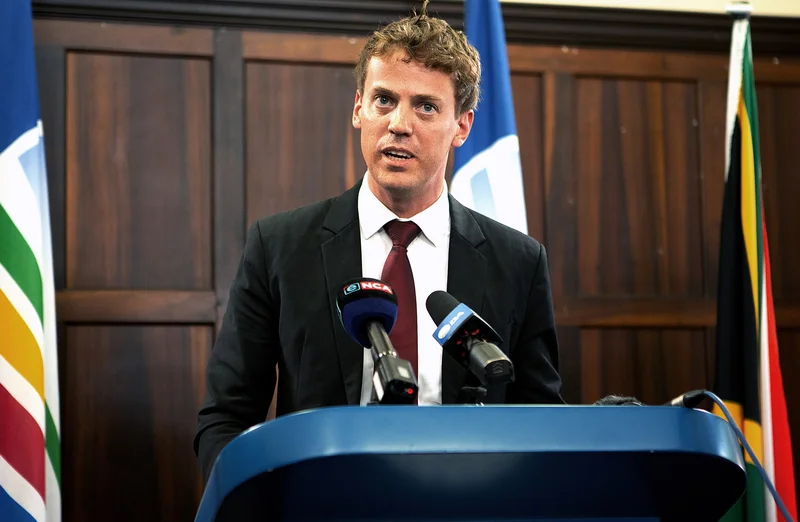
The DAâs head of finance, Dr Mark Burke, stepped down from his oversight roles on two powerful parliamentary committees on Wednesday, 19 August. The partyâs caucus moved in to set right its first instinct to tough out a damaging revelation.
Deputy Finance Minister Ashor Sarupen, who is also DA Federal Council chairperson, the second-in-command to party leader Geordin Hill-Lewis, initially protected Burkeâs roles.
Business Day first reported that the SA Reserve Bank (Sarb) had frozen fintech company Kasteloâs accounts. Burke co-founded the company with his brother, Nicholas, who is CEO.
Kastelo rode high on the red-hot crypto market and engaged forex arbitrage at a mass scale by cutting in investors with access to forex allowances, but not necessarily the cash to use them. By Business Dayâs account, it transferred R4-billion out of the country to trade crypto.
âThe initial response was based on the initial media reports that attempted to attribute acts to Mark personally. The party, as well as Mark, considered the conflict of interest matters very seriously and Mark voluntarily agreed to step out of the finance cluster,â Sarupen told Daily Maverick.
TimesLive reported that Burke was summoned to a meeting with Hill-Lewis on Tuesday ahead of a DA Federal Executive meeting on Wednesday that would consider the matter.
Sarupen said that Burke had declared the litigation against the Sarb in October 2025, while the MP said that he had recused himself from any meetings of the central bank at Parliament. A source in the DA caucus who is not authorised to speak to the media said there had been some debate about whether the partyâs finance chief should step down.
The Kastelo application to have its account unfrozen also cited Finance Minister Enoch Godongwana as a respondent, requiring a wider recusal regime. News24âs Carol Paton reported here that Burke did not always recuse himself from all relevant meetings.
Alleged exchange violations
In a January 2026 judgment handed down after Kastelo sought an urgent application against the Sarb, the companyâs method is detailed.
Sarbâs Financial Surveillance Department (FinSurv) alleges that Kasteloâs cryptocurrency arbitrage business may have contravened South Africaâs exchange control regulations, after receiving information from Kasteloâs bank, whistleblowers and some clients.
The arbitrage exploited the difference between offshore and South African crypto prices. Kastelo converted its clientsâ rands into foreign currency, bought cryptocurrency more cheaply on an offshore exchange, transferred the crypto to South Africa and sold it locally at the higher price, with the profit shared with the client after Kasteloâs charges or interest.
The transactions relied on South Africansâ legal foreign-exchange allowances: an individual may take up to R1-million offshore under the Single Discretionary Allowance and up to R10-million under the Foreign Investment Allowance.
Kastelo could also lend money to qualifying clients who did not have their own funds to participate. Successful participants were promised an annual bonus of between R2,000 and R10,000, in addition to sharing in the arbitrage profit.
FinSurv suspected that the way these allowances and transactions were being used breached exchange control rules and froze Kasteloâs bank account on 24 November 2025 while it investigated.
Crucially, the high court did not decide whether Kastelo had actually broken exchange control laws: it struck Kasteloâs challenge to the freeze from the urgent roll because the company had failed to establish urgency.
Burkeâs defence
While the Sarb investigation is continuing, Burke is no longer a Kastelo director, according to CIPC company records. In Parliamentâs most recent Register of Membersâ Interests, the MP listed multiple Kastelo companies under âdirectorships and partnershipsâ.
Burke did not respond to questions on Wednesday evening on whether he was still a non-executive director at Kastelo or continued to receive financial dividends.
In a statement, Burke denied wrongdoing and said heâd distanced himself from the company.
Burkeâs positionâI am not the chairperson of Kastelo Proprietary Limited, the company that is the subject of the litigation, and I am not involved in its daily operations. I previously served as chairperson of the broader Kastelo group but have since ceased serving in that position in February 2026. I resigned from Kastelo in 2024 to pursue a political career.
âThe High Court judgment does not make any finding of wrongdoing against Kastelo, nor myself.
âNor does the judgment constitute a finding that exchange control contraventions have been proven. The matter before the Court concerned whether the Reserve Bank had grounds to issue a blocking order while its investigation continues. The Court found that it did.
âAt all times I have and will act ethically and lawfully, and I am confident that once the Sarbâs inquiry is complete, it will find no wrongdoing on my part.â
Sarupen first told the media that Burke, who is also DA federal finance chairperson, had no case to answer and would stay on in powerful oversight roles.
Burke was, until he stepped aside on Wednesday, a member of the Standing Committee on Finance and held alternate membership positions on the Standing Committee on Appropriations and the Standing Committee on Public Accounts. These are Parliamentâs most important committees for oversight.
As the DAâs head of finance, Burke holds a crucial role as the party is one of South Africaâs most well-resourced and well-oiled political machines.
The Sarb is phasing out forex regulations as part of a wider modernisation phase, and is also deliberating on how to regulate crypto. Judge Stuart Wilson in the Gauteng high court in June 2026 found that cryptocurrency â specifically Bitcoin â is both money and capital under the existing exchange control regime. DM
*We used ChatGPT to help summarise the Kastelo urgent application judgment. This was checked by a human editor before and after. *
Who is Mark Burke?Dr Mark John Burke was born on 18 September 1989 in Kroonstad in the Free State and attended North-West University, where he completed BA and BSc Honours degrees. He then moved to the University of Cape Town, where he completed a Masterâs degree in computer engineering. His Masterâs degree studies focused on enabling anonymous crime reporting on mobile phones in the developing world.
Burke then spent a year researching cryptography, artificial intelligence and pattern recognition at the Catholic University of Leuven in Belgium. He received an Oppenheimer Scholarship to continue his studies at Cambridge University, where he completed a Master of Philosophy (MPhil) in technology policy.
Burkeâs studies focused on meeting the challenges of integrating technology, management, and policy. He also received the Shaun Johnson Memorial Scholarship and completed a PhD in econometrics and quantitative economics at the University of Cambridge. In 2010, Dr Burke was named as one of South Africaâs â100 Brightest Young Mindsâ.â LinkedIn