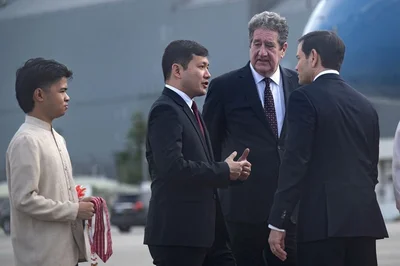
MANILA, Philippines — US Secretary of State Marco Rubio is set to meet Chinese Foreign Minister Wang Yi in Manila on Wednesday, July 22, with the latest clash at Ayungin Shoal sharpening tensions around this week's ASEAN meetings in Manila.
Washington condemned what it called China's "dangerous and aggressive" actions near Second Thomas Shoal, locally known as Ayungin Shoal, where the Philippine military said a Filipino sailor was injured after being clubbed with a baton by a China Coast Guard member.
Beijing has pushed back by accusing Philippine forces of provocation.
During a meeting with ASEAN Secretary-General Kao Kim Hourn in Manila, Wang said "some forces within the Philippine military and police have deliberately engaged in provocations and created incidents at sea," Chinese state-run news outlet China Daily reported.
Wang, who is in Manila for the China-ASEAN Foreign Ministers' Meeting, said the South China Sea "should not become an obstacle to China-ASEAN relations," according to the state media report.
He also said Beijing was willing to work with ASEAN to eliminate disruptive factors and speed up consultations on the Code of Conduct in the South China Sea.
Wang is also expected to meet Philippine Foreign Affairs Secretary Theresa Lazaro on the sidelines of the ASEAN meetings.
US condemnation
Shortly after Rubio arrived in the Philippines, meanwhile, the US State Department called on Beijing to "immediately cease its destabilizing conduct."
"China's troubling pattern of provocation against lawful Philippine maritime operations undermines regional peace and stability and directly contradicts China's repeated commitments to resolve disputes peacefully," State Department spokesperson Tommy Pigott said.
Rubio also emphasized Washington's commitment to "freedom of navigation in Southeast Asia" in an op-ed published in Philippine media outlets Tuesday, while reaffirming US security commitments in the region.
"If these waters were to fall under the control of a power willing to use trade as a geopolitical weapon, both the United States and the ASEAN states would face serious new threats to their sovereignty, security, and economic future," Rubio wrote, in a reference to China.
Competing accounts
The Philippines and China gave differing accounts of Monday's incident.
Manila said China Coast Guard personnel assaulted Filipino sailors near BRP Sierra Madre, the grounded vessel that serves as the Philippines' outpost at Ayungin Shoal.
Beijing, however, said the Philippines instigated the encounter by sending men in small rubber boats to approach a Chinese vessel.
China claims almost the entire South China Sea, a vital global trade route, despite a 2016 arbitral ruling favoring the Philippines' case that found its sweeping claims had no legal basis.
Rubio and Wang are likely to discuss issues beyond the South China Sea, including the Middle East and US President Donald Trump's recent claims that China meddled with American election data. China has called the allegations "pure fabrications."
Before leaving Washington, Rubio declined to say whether he would specifically raise the election issue with Wang.
"Those are delicate matters," Rubio told reporters. "We'll see how the meeting goes. We'll talk about things that are important, certainly." — with reports from Agence France Presse