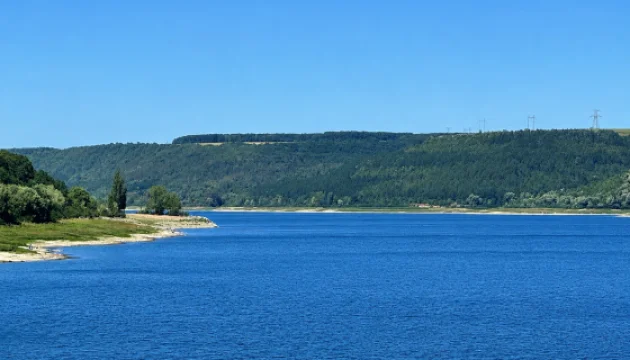
According to Ukrinform, this information was reported by PJSC “Ukrhydroenergo.”
Citing data from the Ukrainian Hydrometeorological Center, the report notes that the total inflow into the Dniester Reservoir has fallen to about 20% of the normal level, which for August is 256 cubic meters per second.
“At the same time, water reserves in the Dniester Reservoir are decreasing. Since the beginning of August, its level has dropped by 76 cm and, as of August 20, stands at 112.34 m according to the Baltic height system. For this calendar date, this is the lowest level in the entire history of observations,” Ukrhydroenergo notes.
It is emphasized that under such conditions, the primary objective is not to utilize the reservoir’s available resources, but rather to conserve them and distribute them as judiciously as possible. In particular, consideration is given to water needs for both electricity generation and the operation of water intakes, as well as the needs of local communities and the necessary flow regime of the river downstream.
“That is precisely why the hydroelectric complex’s operating regime is determined with regard to the water management situation throughout the entire basin. Under these conditions, electricity generation is subordinate to the established water resource usage regime, not the other way around,” Ukrhydroenergo reported.
Read also:Moldova reports record-low
waterlevel in Dniester Reservoir
The company noted that the longer the low natural inflow persists, the more important it will become to use the resources stored in the reservoir sparingly. Ukrhydroenergo is operating in accordance with established protocols and is constantly monitoring the hydrological situation. Further decisions will depend primarily on the actual inflow into the reservoir.
As previously reported, on August 11, Ukraine and Moldova reached an agreement to set the water discharge from the Dniester Integrated Hydropower Complex at 75 m³/s.
Photo from uhe.gov.ua