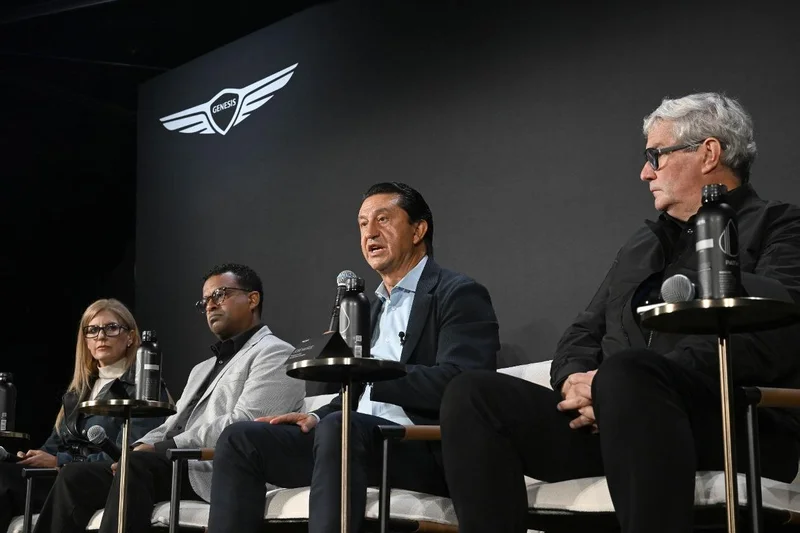
Cost-cutting across engineering, manufacturing and sourcing seen as key to protecting margins
SAN FRANCISCO — Genesis will shore up profitability against tariffs from the United States by deepening engineering and manufacturing ties with Hyundai Motor Group, key executives from the Korean auto brands said Thursday (local time).
Hyundai Motor CEO Joze Munoz pointed to what he described as long-running technical cost reduction programs, which he said allow the group’s auto brands — Hyundai Motor, Kia and Genesis — to standardize parts and improve quality while lowering expenses at the same time.
Munoz outlined a broad list of areas where the carmakers are pursuing shared savings — engineering, manufacturing, design, production, supplier contracts and distribution.
"It is fair to say that the group has done way better than most of our competitors (despite the tariff shock)," Munoz told reporters during a press conference, a day after the Genesis GV90 world premiere.
He cited continued growth of Hyundai Motor sales to back up the strategy. The carmaker reported record quarterly sales of 49.21 trillion won ($35.28 billion) between April and June. The sales include ones from Genesis.
The renewed focus on synergies and cost discipline follows a period of margin pressure tied to the 15-percent auto import tariff the Korean automakers face in the U.S.
Munoz described the cost reduction and group-wide synergy measures as part of an effort to reinforce the group's ability to meet its broader multi-year strategic commitments.
"We are trying to utilize every single factor, whether external or internal, as an opportunity to get our company stronger," he said.
GV90 to anchor Genesis' US expansion push
Genesis is continuing its growth in the U.S. market, driven by competitive products and a localized branding strategy.
Since entering the U.S. market in 2016, Genesis has sold more than 454,000 vehicles through July this year. Annual sales have set new records for five consecutive years since 2021.
SUVs have been the key growth driver, accounting for 61.5 percent of Genesis’ cumulative U.S. sales until July. The GV70, including its electrified version, and GV80, including the coupe, rank first and second in Genesis’ U.S. sales, with combined sales for both models exceeding 268,000 units.
Genesis plans to expand its SUV lineup with the newly launched flagship GV90 electric SUV and high-performance GV60 Magma, while adding hybrid models to meet broader demand.
The GV90 made its world debut at San Francisco’s Palace of Fine Arts, Wednesday, highlighting the strategic importance of the U.S. market for the brand’s sustainable growth.
The GV90 is Genesis’ first symbolic model equipped with a coach-door system called Arch Gate.
“The arch gate is specifically for the GV90 Neolun and we have no plans to come to equip other models with Arch Gate for now,” said Luc Donckerwolke, chief creative officer at the carmaker.
Other key executives from Genesis also displayed the carmaker’s long-term vision for sustainable global growth.
“Korea and the U.S. are most important markets for Genesis to achieve its global sales goal of 350,000 vehicles by 2035,” Sean Lee, global head of Genesis, said during the press conference.
He said Genesis will also adopt a similar strategy of Hyundai Motor Group by diversifying electric-focused powertrains, such as all-electric vehicles, hybrids or extended-range electric vehicles in the U.S.
“Coupled with our diversified powertrains in North America, we will also focus on expanding brand interactions with customers to achieve the sales target,” he said.
Explore More
- Q.
- Q.
- Q.