Virtually every Japanese national security document or pronouncement begins by noting the unprecedented security challenges the country faces. Typical is the newly issued Defense White Paper, the introduction to which, by Defense Minister Shinjiro Koizumi, warns that the “security environment surrounding Japan is as severe and complex as it has ever been since the end of World War II.”
That sounds like boilerplate and it may be — but that doesn’t make it any less true, especially after events of the last week. Actions by allies and adversaries alike have underscored the challenges that Japan faces navigating this world and the uncertainty that now frames its decision making.
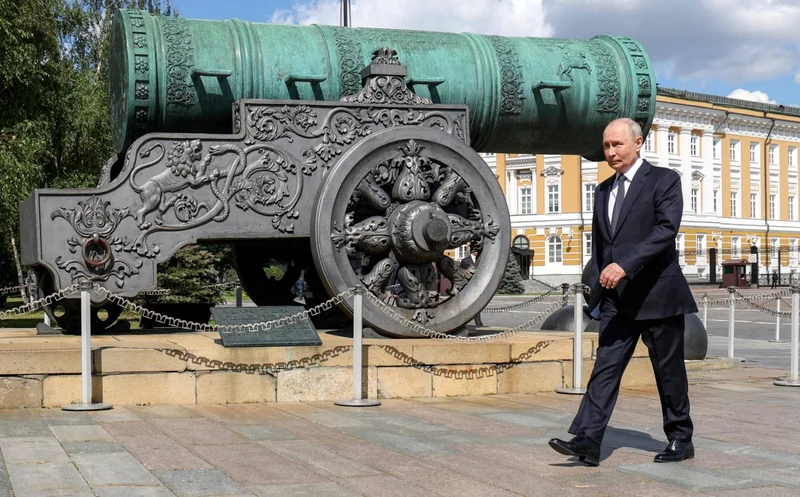
The first challenge came from Russian President Vladimir Putin, who last week visited Etorofu, the largest of the four islands seized by Russia in the last days of World War II and which it continues to hold. His first-ever visit to one of the islands was part of a trip to the Sakhalin region, during which he observed exercises by Russia’s Pacific Fleet and promised to strengthen its capabilities.
The visit to Etorofu sent two messages. Generally, it was a reminder to the world that war has consequences and that territorial conquest is a natural outcome. In other words, Etorofu today is Ukraine, or its Donbas, tomorrow.
A second more pointed message was sent to Japan: Russian policy toward Japan will be shaped by Japan’s policy toward Ukraine. When the war broke out in 2022, Russia showed its hand by suspending negotiations over the islands, along with visa-free exchanges, free visits to the islands, and talks on joint economic activities there. That freeze remains in place and Putin is making clear that Japan will have to change its policy on Ukraine, and its pointed objection to the Russian invasion, if it wants to talk about the Northern Territories.
Days later, Japan was shocked by the announcement by U.S. President Donald Trump that he will reduce joint military exercises with South Korea, complaining that they were too expensive, that the U.S. paid too much of the cost, that the Seoul government had ignored his request for help in the Strait of Hormuz, that North Korean leader Kim Jong Un had treated him respectfully and he didn’t want to send “inappropriate and hostile” signals to Pyongyang.
While the move does not directly affect Japan, it indicates a worrying shift in U.S. policy toward Kim, the Korean Peninsula and allies generally. Trump tried throughout his first administration to strike a nuclear deal with Kim; he appears to be ready to resume that effort and there are fears that it will be conditioned on acceptance of North Korea’s nuclear capability, a demand that the country has made for it to resume any diplomatic talks.
This would do great damage to the global nonproliferation regime, shift the regional balance of power and undermine confidence in the U.S. as a provider of security by accepting a check on its extended nuclear deterrent. In his story this week, Michael Bosack rightly asked if this is tacit acceptance of Kim’s ability to attack its neighbors as long as the U.S. itself is not threatened.
North Korea dismissed the move. Kim’s powerful sister, Kim Yo Jong, said the reduction in exercises does not change their “provocative and offensive nature” and Pyongyang Thursday fired off a barrage of short-range ballistic missiles. That is not the behavior of a country that seeks peace with its neighbors. And as Bosack warned, the U.S. could be signaling that it is indifferent to North Korea’s participation in the Ukraine war, another dangerous green light to a country that has long sought to reshape the regional order.
South Korea has been surprised and shocked by the announcement and the questions it has raised are fueling calls for greater independence in that country’s defense capabilities. It is likely to accelerate calls for the acquisition of its own national nuclear capability.
This poses additional risks for Japan. While the relationship between Tokyo and Seoul is good now, it has been volatile and marked by ups and downs in recent years. Redefining South Korea’s partnership with the U.S. will have profound implications for Japan; Defense Minister Koizumi has called security cooperation among Japan, the U.S. and South Korea “critical to the peace and stability of the region.” Its reduction must therefore be a problem.
Uncertainty surrounding U.S. decision making makes the declaration that this is “the golden era” of the alliance sound empty. The government of Prime Minister Sanae Takaichi must wonder if Trump will be similarly angered by its level of host-nation-support for U.S. forces or the reluctance to dispatch Self-Defense Force assets to the Persian Gulf.
Japan is already squeezed by the Trump administration’s war against the International Criminal Court and the imposition of sanctions against its members, including Tomoko Akane, a Japanese judge who heads the ICC. This week, U.S. Secretary of State Marco Rubio called the ICC a “corrupt and fatally politicized supranational court that has maliciously abused its authority.” The U.S. faults the court for investigating alleged crimes by U.S. personnel in Afghanistan and the issuance of arrest warrants for Israeli leaders, including Prime Minister Benjamin Netanyahu, over allegations of war crimes in the Gaza Strip.
Japan called the move “deeply regrettable,” and the Foreign Ministry said Japan would “continue to work to strengthen the rule of law in the international community,” while maintaining communication with relevant countries.
The assault on the ICC is part of a broader campaign that the Trump administration has waged against international law in general, an effort that is as threatening to Japanese security interests as any missile. This country has relied on law and international institutions to help create and maintain order in the world. They do not work by themselves, but complement the use of force that is in theory utilized in accordance with that framework.
This disregard for international law — evident across a range of activities, from its unilateral imposition of tariffs to the military tactics it has deployed — is one of the most dangerous legacies of the Trump administration. The belief that might is right, as pronounced by Deputy Chief of Staff Stephen Miller, is pernicious and repudiates the guiding principles of U.S. policy since the end of World War II.
The U.S. can and has done better. Its allies expect better. The world needs it to do better.
It is a dangerous and insecure world indeed.