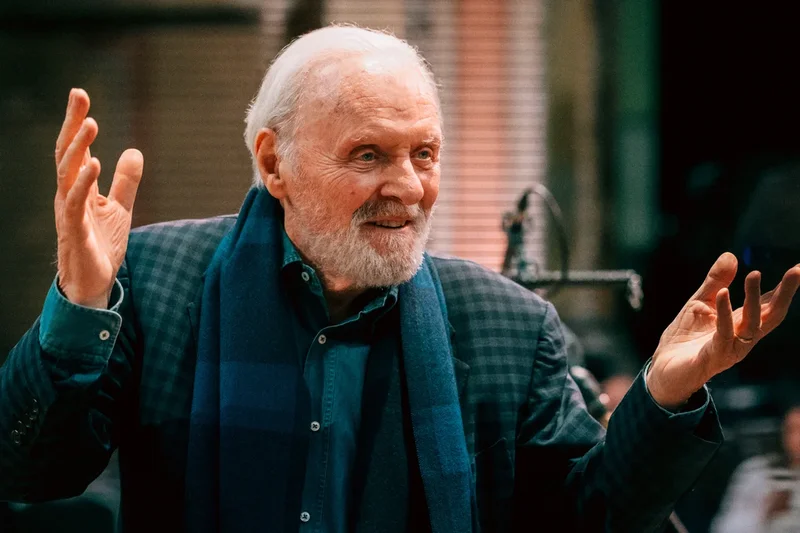
The history of music is littered with the detritus of Hollywood’s vanity. Many an A-list actor has convinced themselves they’ve got the goods to make it as a musician, be that Eddie Murphy, Bruce Willis, or Robert Downey Jr. The results are seldom good. To this end, you might have reason to hoist an eyebrow when you spot Sir Anthony Hopkins is releasing an album this week. But how wrong you’d be.
Life is a Dream is the second record from the Oscar-winning star of The Silence of the Lambs and The Father. (His previous album, Composer, was released on CD in 2012, through Classic FM.) Those who might be bewildered by the mental image of the 88-year-old Welshman strutting a stage like Mick Jagger singing “Sympathy for the Devil” need not worry: these are classical compositions, composed by Hopkins over the course of his life and performed by the Philharmonia Orchestra with Grammy Award-winning conductor Gustavo Dudamel.
There is something wonderfully, life-affirmingly sweet about this music, which shifts between classical forms, from bright, brass-led fanfares to elegant waltzes. It would be easy to sound patronising about Hopkins’s passion project, were it not for the fact that it is legitimately good. There is more music artistry on show here than in many of today’s charting pop releases – albeit in service of a genre that gets scant shrift in the mainstream. Hopkins has a pleasing grasp of harmony and an ear for flighty melody; in the spectrum of classical music, it’s on the more traditional side, absent of the dissonance and tonal complexity that the 20th century brought to the genre.
Life is a Dream is a personal thing for Hopkins; that much is evident in the music’s wordless sentimentality. Some of the tracks are inspired by his native Wales, including “1947: Suite for Solo Piano and Orchestra: II. Bracken Road”, which he wrote in 1963 while working as a young actor at the Liverpool Playhouse. Hopkins began learning the piano at the age of four, and has written music since he was a child, describing music as “my first desire” and “my first wish”. Several of his compositions have been performed before in concert halls around the world; renowned conductor André Rieu recorded a waltz by Hopkins on his 2011 album And the Waltz Goes On; that work also features here.
To some extent, hearing Hopkins’s music simply confirms what everyone has always known about him. Whatever the project – even while playing sociopathic cannibal Hannibal Lecter in The Silence of the Lambs – he radiates sophistication and sincerity. On some level, it simply makes sense that Hopkins is able to compose such moving, edifying music: it’s an extension of what he’s been doing his whole career.
When a wealthy celebrity, respected in their field, decides to venture out and try their hand in another, it’s hard to escape the whiff of egocentrism. We do not expect these things to be good, or particularly meaningful; they are referred to as “side projects” for a reason. It’s a credit both to Hopkins’ craft and his judgement that such dismissals fall away while actually listening to Life is a Dream. It is honest music made for the right reasons. In a way, he can be as proud of this as he can of any of his screen performances – and he probably is.
What’s more, for Hopkins to do this at 88 is nothing short of inspirational. If there’s a lesson here, it’s that life doesn’t stop when you hit 60, or 70, or 80. (Or even when you become the oldest actor to ever win an Oscar, at the age of 83.) There’s always something more to do. There’s always more music, waiting to be played.
‘Life is a Dream’ is out now on Decca Classics