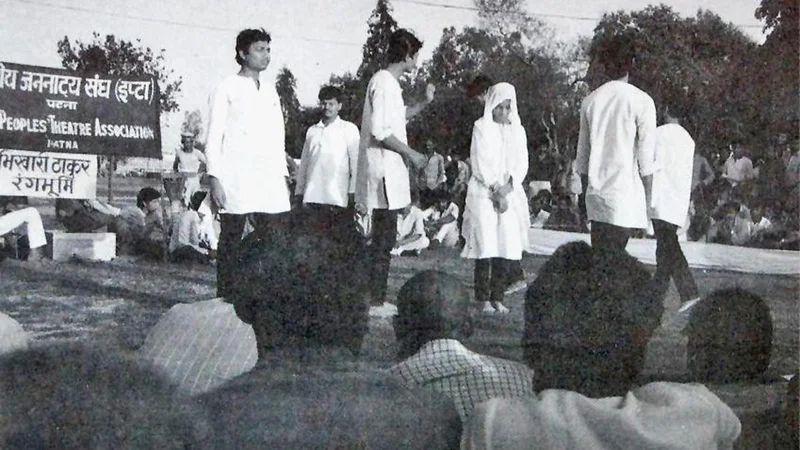
Theatre in British India saw colonial influences shaping and modernising many practices involved in theatre as well as playwrights starting to use the stage as a tool to stir a sense of communal nationalism among people, and showcase colonial exploitation through theatre. In this case, the stage became a site of cultural change as well as a battleground for freedom, identity, and power.
Establishing dominance
The East India Company arrived in Calcutta in 1690, and they did not just bring their trade work and their infrastructure, they brought their culture with them – including their style of theatre.
In 1775, the Calcutta Theatre was established, and it would stage Shakespearean tragedies and Restoration dramas (English plays written and performed after the Puritan era) for the British officers and their families. Even the Bengali elites were fascinated by these plays. They were exposed to western aesthetics and educated in the English language. Soon, they began to adopt these styles to their own plays.
East meets West
Gradually, by the mid-19th Century, Parsi theatre came about. It was a commercial theatrical tradition run by the Parsi business communities in Bombay. It was a fusion of European staging and stage technology with Indian music, melodrama, and storylines. Shakespearean plays like ‘Romeo and Juliet’ and ‘Hamlet’ were adapted in this manner. It was performed in Gujarati and Urdu and troupes were performing across cities and small towns, thereby reaching even non-elite audiences.
Stage policing
Around that same time, Indian theatre became a tool for protesting against colonial rule. The 1859 Bengali play ‘Nil Darpan’ — which showed the exploitation of indigo farmers — was one of the earliest examples of such theatre. From there started a notion of exploring colonial exploitation, nationalism, and revolution through theatre, and so more such plays began to emerge in many languages. Playwrights like Bhartendu Harishchandra, Krishnaji Prabhakar Khadilkar, and Padmanath Gohain Baruah wrote plays that showcased colonial exploitation, and helped to ignite a unified nation.
The British did not take to this use of theatre very kindly. And so, they enacted the Dramatic Performances Act, 1876, to put an end to these revolutionary plays and further police the theatre scene. Government scrutiny made people more careful about what they staged as the British government could ban plays they considered scandalous or obscene — which in their own words meant anti-colonial.
But that didn’t stop playwrights from calling out the government through their plays. Rather, they went for more subtle and indirect methods to still maintain that nationalist energy, rather than any direct jabs.
Threatening identity
The British tried to dismiss Indian theatre forms, calling them ‘primitive’ and deeming them inferior. Royal courts that sponsored Sanskrit dramas, lost their power. Temples that staged devotional performances lost their funds. The British were forcing their art, thinking, and values on to the Indians. They wanted to have the theatrical imagination their way.
Gymkhana clubs came to be, especially in urban areas like Bombay, Madras and Calcutta. They were recreational areas for sport and social interaction, and they occasionally staged amateur troupes performing Shakespearean plays and English comedies. One such was the Bombay Gymkhana club, established in 1875. Indian audiences were excluded, barring the elites. But that was done for assimilation, not inclusivity.
But of course, despite all attempts to suppress tradition, India’s traditional theatre continued to thrive alongside the modern way of the stage. Now let us look at some plays that sparked revolution on the big stage.
But of course, despite all attempts to suppress tradition, India’s traditional theatre continued to thrive alongside the modern way of the stage. Now let us look at some plays that sparked revolution on the big stage.
Regional theatre
Marathi:
Tamil:
Assamese:
Kannada:
Nil Darpan (1859)
Nil Darpan (lit. ‘The Indigo Mirror’) is a Bengali-language play written by Dinabandhu Mitra in 1859. The play centres around Goluk Chander Bose, a peasant, and his family, who are caught up in the oppressive indigo plantation system. It showed how badly they were exploited, forced to sign unfair contracts, going through manipulation from the officials, as well as starvation. The play ends on a less than happy note where nothing is resolved for the family, highlighting the harsh realities of the system with no way out of the unending debt cycle.
Interestingly, it was translated into English by Michael Madhusudan Dutta and James Long, and the latter was taken to court, after some planters and pro-planter people claimed that the play defamed them.
Fun fact, ‘Nil Darpan’ was also the first play to be staged commercially at the National Theatre in Calcutta (now Kolkata).
“Oh Indigo! You came to this land for our utter ruin. Ah! I cannot any more suffer this torture. I cannot say how many other Factories there are of this Concern. Within this one month-and-a-half, I have already drunk the water of fourteen Factories; and I do not know in what Factory I am now””A farmer singing his woes of the Indigo plantationA translated excerpt from Nil Darpan (1859)
Nabanna (1944)
Nabanna is a Bengali language play written by Bijon Bhattacharya in 1944 and staged by the Indian People’s Theatre Association (IPTA) the same year. It covers the Bengal famine of 1943, and it showed much more to the famine than just a shortage of food.
In the play, the Samnadar family move to Calcutta after a tidal wave wipes away everything they have. There is a portrayal of class difference as the upper middle class is unwilling to help them with their struggles. Towards the end, they return to the village with a collective sense of resilience alongside other farmers like them.
Nabanna not only made the famine a distant news item, but also, it was one of the plays that shifted theatre from commercial entertainment to activist-driven collective theatre. The play also generated lakhs of funds for famine relief when the IPTA staged this as a part of their Voice of Bengal festival.
““I know Pradhan that there are apprehensions in your mind, but keep this in mind that unlike last time, the difficult times will not be able to creep in and snatch away my relations; friends; here, all you are my friends and family. No, never again. If it wants to harm them, first, it will have to face me, kill me. It will have to overthrow our solidarity. Only then it may succeed.””Dayal, the neighbour, reassuring farmer Pradhan amid the famineA translated excerpt from Nabanna
Theatre was never just a mirror of the times, but also a wake up call for the people of India, and a place where freedom was portrayed, fought for, and felt. All the censorship could not silence the question that people ask even today, “What does freedom mean for us?”
Published - August 15, 2026 07:30 am IST