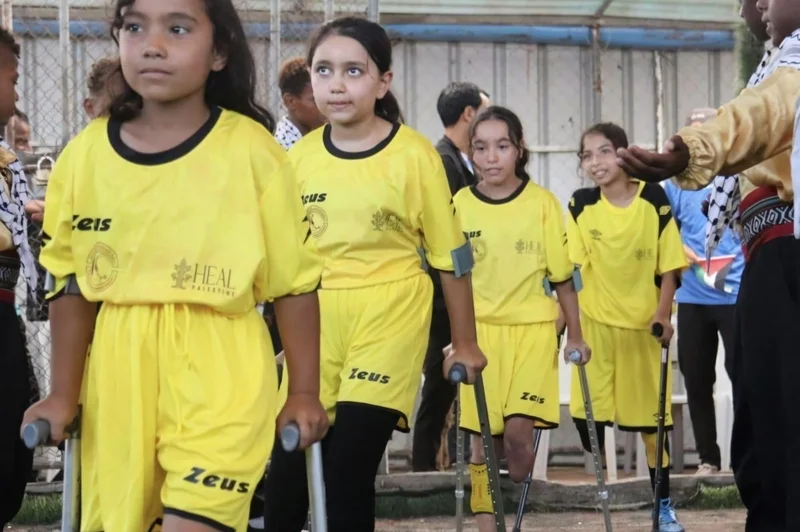
The players race across the football field on crutches. One plants his crutches, swings his remaining leg and strikes the ball with all his strength. The goalkeeper leaps, stretching out his one arm, but the ball curves beyond his reach and into the net, tracing an arc that would be difficult to replicate even on two legs.
In footage provided by the Palestine Amputee Football Association (PAFA), footballers in Gaza embodied the conviction that “life is stronger than death,” refusing to let their physical disabilities keep them off the pitch.
War-wounded footballers
As the 2026 World Cup unfolded across North America, airstrikes continued to ravage the Gaza Strip. With barely any electricity, residents gathered in small groups in the streets and beneath crumbling buildings to watch the matches.
When the Hankook Ilbo interviewed Gaza’s amputee footballers through voice messages on a messaging app Monday and Tuesday, shortly after Spain, the team they had supported, won the final, the players shared the same buoyant spirit felt by football fans around the world.
“We may run across the field on one leg rather than two, but our passion for football is just the same,” the players said. “Watching the World Cup gave us the courage to believe that we could do it, too.”
Gaza’s amputee football team is made up of players who have lost limbs in the war ravaging the region. According to the World Health Organization, Gaza has more than 5,000 amputees, one in five of whom are children.
Rozan Khaira, a 24-year-old sprinter, lost her left leg in November 2023 when an artillery shell landed in front of her home. Her father also had both legs amputated, while her brother sustained a pelvic fracture. With most hospitals closed, Khaira was unable to receive timely treatment.
“The infection worsened, so I eventually had to undergo another operation to amputate more of my leg,” Khaira recalled.
She found solace in football. At first, dribbling a ball with one foot while balancing on crutches seemed nearly impossible, but with practice, she eventually scored her first goal. Before long, her teammates had become a new family and the football field a source of strength that kept her going.
“The moment I stepped onto the field, I could briefly shut out all the pain and harsh realities beyond it.” Khaira said.
Si al-Masri, 40, who joined the team eight years ago, agreed.
“Simply coming together and playing football with others who have endured the same pain is itself part of the healing process,” he said.
**Dire conditions, scant support **
Yet continuing to train is an uphill struggle. Most football grounds across Gaza have either been destroyed by bombardment or converted into temporary shelters for displaced residents.
Each week, the players travel dozens of kilometers along shattered roads to reach a grass pitch in Deir al-Balah, virtually the only one still available. Israel’s tight restrictions on goods entering Gaza have made even basic supplies such as balls, shoes and protective gear difficult to obtain. Specialized equipment, including sports crutches and advanced prosthetic limbs, is effectively unavailable.
“The crutches we use now aren’t designed for football, so they break easily when we kick the ball hard,” said Saadi Muhammad al-Masri, who joined Palestinian amputee football team Al-Jazira Club in 2018.
Fouad Ibrahim Abu Ghalyoun, founder of PAFA, said FIFA had pledged support the rebuilding of Gaza’s football infrastructure, but no meaningful international assistance had materialized on the ground.
“Even the proposed Gaza peace council has no body assigned to oversee the reconstruction of sports infrastructure,” he said.
The association also hopes to expand its academy to serve the growing number of young amputees, but faces severe practical constraints.
Undeterred, the players continue to race across the field. In Khaira’s words, they are not mere numbers in news reports or victims to be pitied, but footballers who take the field and fight.
“The war may have destroyed our homes and stadiums and taken parts of our bodies, but it has not broken our will or spirit,” she said.
Saadi added, “We will keep going until we achieve our goal of raising the Palestinian flag at an international tournament.”
The World Amputee Football Federation World Cup will be held in Mexico in November, but the war and blockade prevented the Palestinian players from competing even in the regional qualifiers.
“Given the devastation and tragedy Gaza has endured, comprehensive support from international organizations is urgently needed, including measures guaranteeing our participation in international competitions,” Abu Ghalyoun said.
Although their World Cup hopes have been dashed this time, their journey continues in the heart of Gaza as they keep kicking toward hope on one leg.
This article from the Hankook Ilbo, the sister publication of The Korea Times, is translated by a generative AI system and edited by The Korea Times.