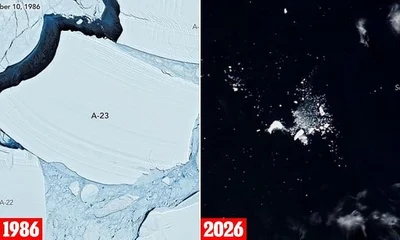
The world's largest iceberg has finally ended its ocean odyssey, crumbling into chunks just shy of its 40th birthday.
A–23A is a 'megaberg' that weighed nearly a trillion tonnes and measured 1,540 square miles (3,988 square kilometres) at its peak – twice the size of Greater London.
It originally calved from Antarctica's Filchner Ice Shelf back in 1986, remaining grounded on the seabed before finally setting off on its slow journey in 2020.
Since then, the giant has drifted more than 2,000 miles (2,300 kilometres) north, going on an epic jaunt that has captured the attention of scientists across the globe.
Its final months have brought extensive melt and breakage, shrinking the colossal berg to just over 66 square miles (170 square kilometres) before it disintegrated.
Dr Jan Lieser of Australia's Bureau of Meteorology has been tracking the iceberg using remote sensing.
'I noticed in recent weeks how Mother Nature seemed to keep a veil of clouds over the dying iceberg as if trying to give it some privacy at this stage,' he said.
There were still enough observations, however, to capture glimpses of its death throes – showing the colossal structure finally splintering into tiny fragments.
A–23A (pictured in 1986) is a 'megaberg' that weighed nearly a trillion tonnes and measured 1,540 square miles (3,988 square kilometres) at its peak – twice the size of Greater London
Satellites were able to capture a glimpse of the iceberg in its final death throes, showing the colossal structure splintering into tiny fragments
'Iceberg A–23A ranks among the giants known to have broken, or 'calved', from Antarctica,' NASA wrote in a blog post.
'Though several other icebergs in the satellite era have been larger, A–23A was remarkable for its longevity.
'After spending its early days in the Weddell Sea, its journey came to an end in the South Atlantic Ocean, months shy of its 40th birthday.
'These images show the iceberg at the start and end of its lifespan.'
During its time grounded in the shallow waters of the Weddell Sea, the iceberg remained almost unchanged for over 30 years.
After freeing itself in 2020, it spent several months spinning in an ocean vortex known as the Taylor column.
This phenomenon causes water to rotate above an underwater mountain, trapping objects in place.
In December 2024 satellite images confirmed it was on its way again, drifting north in the Southern Ocean. At the time, scientists called the news 'exciting'.
The giant has drifted more than 2,300 kilometres (2,000 miles) north, going on an epic jaunt from the Weddell Sea to the South Atlantic Ocean
After initially detaching from the Filchner Ice Shelf in 1986, the iceberg remained grounded for several decades
How do icebergs form?
The word iceberg comes from the Dutch term 'ijsber', meaning an ice mountain.
Icebergs are created from pure snow, making them fresh water.
As snow accumulates over polar landmasses, it packs down to become ice and this forms a glacier.
Icebergs are the result of glaciers extending over the ocean and calving (breaking) off from the ice shelf.
'It's exciting to see A–23A on the move again after periods of being stuck,' said Dr Andrew Meijers, an oceanographer with the British Antarctic Survey (BAS).
'We are interested to see if it will take the same route the other large icebergs that have calved off Antarctica have taken.'
However, alarm bells started to ring when it appeared to be on a devastating collision course with a remote British island.
At the time the iceberg measured around 1,351 square miles (3,499 square kilometres) – roughly the size of Cornwall.
At one point it was just 173 miles off the coast of South Georgia, a British territory and wildlife haven home to thousands of penguins and seals.
Simon Wallace, captain of the South Georgia government vessel, Pharos, warned that the iceberg was dangerously close to grounding and smashing into pieces.
Worryingly, these pieces can linger for years – wreaking havoc for sailors and fishermen trying to navigate the waters.
Speaking to BBC News, Mr Wallace said: 'Icebergs are inherently dangerous. I would be extraordinarily happy if it just completely missed us.'
Alarm bells started to ring when it appeared to be on a devastating collision course with a remote British island
As the iceberg moved through warmer waters the iron–rich meltwater fuelled a phytoplankton bloom, providing food for local marine life
Iceberg A–23A turned bright blue, as seen by an astronaut aboard the International Space Station on December 27, 2025
Luckily, A–23A ran aground in shallow waters off the island in March 2025. It was stuck for months, with waves and warmth chipping away at its sides.
Eventually it moved along the eastern flank of South Georgia, where it started to fragment into smaller pieces.
In a remarkable image captured by an astronaut on the International Space Station, the iceberg's surface was seen covered in meltwater and slush that turned it a vivid blue colour.
As it moved through warmer waters the iron–rich meltwater fuelled a phytoplankton bloom, providing food for local marine life.
This meltwater also cut through the ice like knives, helping it fracture.
Finally, the latest image of the iceberg – captured on April 3 – shows it completely disintegrated. Tiny fragments are all that remain of the once–mammoth structure.
What are icebergs and why are they important?
Icebergs are pieces of freshwater ice more than 50 feet long that have broken off a glacier or an ice shelf and are floating freely in open water.
Icebergs that break off from an already floating ice shelf do not displace ocean water when they melt – just as melting ice cubes do not raise the liquid level in a glass.
Some icebergs contain substantial amounts of iron–rich sediment, known as 'dirty ice'.
'These icebergs fertilise the ocean by supplying important nutrients to marine organisms such as phytoplankton,' said Lorna Linch, lecturer in physical geography at the University of Brighton.
Icebergs can also pose danger to ships sailing in the polar regions – as demonstrated in April 1912, when an iceberg led to the sinking of RMS Titanic in the North Atlantic Ocean.
Icebergs may reach a height of more than 300 feet above the sea surface and have mass ranging from about 100,000 tonnes up to more than 10 million tonnes.
Icebergs or pieces of floating ice smaller than 16 feet above the sea surface are classified as 'bergy bits', while those smaller than 3 feet are 'growlers'.